The World of Utsuri and Jihada Drawn Out by the Togishi——Whetstone Approaches for Itame, Mokume, Masame, and Ayasugi-hada, and Hatsuya Finishing
 * Image is for illustrative purposes only.
Table of Contents
What Is a Togishi: The Final Craftsperson Who Determines the Sword's Beauty
In the process of making a Japanese sword, while the tōkō (swordsmith) forges steel to create the shape of the blade, the togishi (polisher) is the specialist craftsperson who polishes the blade to its final aesthetic state. No matter how excellent the tōkō who forged a celebrated blade, its true worth cannot be realized if the togishi's skill is lacking. Conversely, in the hands of a skilled togishi, even a seemingly plain sword can have its latent beauty drawn out to the fullest.
The togishi's work is not mere "polishing." It is a crystallization of refined sensibility and technique that optimizes the shape and activity of the hamon (temper line), the scenery of the jihada (grain pattern of the steel), and the way the utsuri appears, through subtle control of whetstone type, polishing angle, and applied pressure.
Types of Whetstones and Stages of Polishing: From Rough Grinding to Final Finish
The togishi's work is broadly divided into two stages: shitaji-togi (foundation polishing) and shiage-togi (finishing polishing).
In shitaji-togi, the work progresses from coarser-grained whetstones to finer ones in sequence, shaping the overall form of the blade and removing kaji-me (marks from the forging process). The main whetstones used are as follows.
- Arato: The coarsest whetstone, used to correct blade distortion and remove heavy rust and deep scratches. Artificial whetstones are often used for this stage.
- Nakato: A whetstone that removes the scratches left by the arato while bringing the blade surface closer to smooth; this is the stage at which directional control of the polishing marks becomes important.
- Hosoto: The flatness of the blade surface increases, and the patterns of the jihada (itame, mokume, masame, etc.) begin to become visible.
Shiage-togi is a stage that could be called the essence of the togishi's art, where the choice of whetstone and technique determines the final appearance.
- Uchigumori-to: A natural whetstone from Kameoka in Kyoto, which produces a uniform "clouded" finish across the entire blade surface. The selection and handling of this whetstone clearly demonstrates the togishi's level of mastery.
- Hatsuya: A thin whetstone fragment used in the final stage of shiage-togi to accentuate the activity of the hamon (nie, nioi). This work determines the "brilliance" of the hamon.
The Difficult Technique of Drawing Out Utsuri: The Dialogue Between Hamon and Jihada
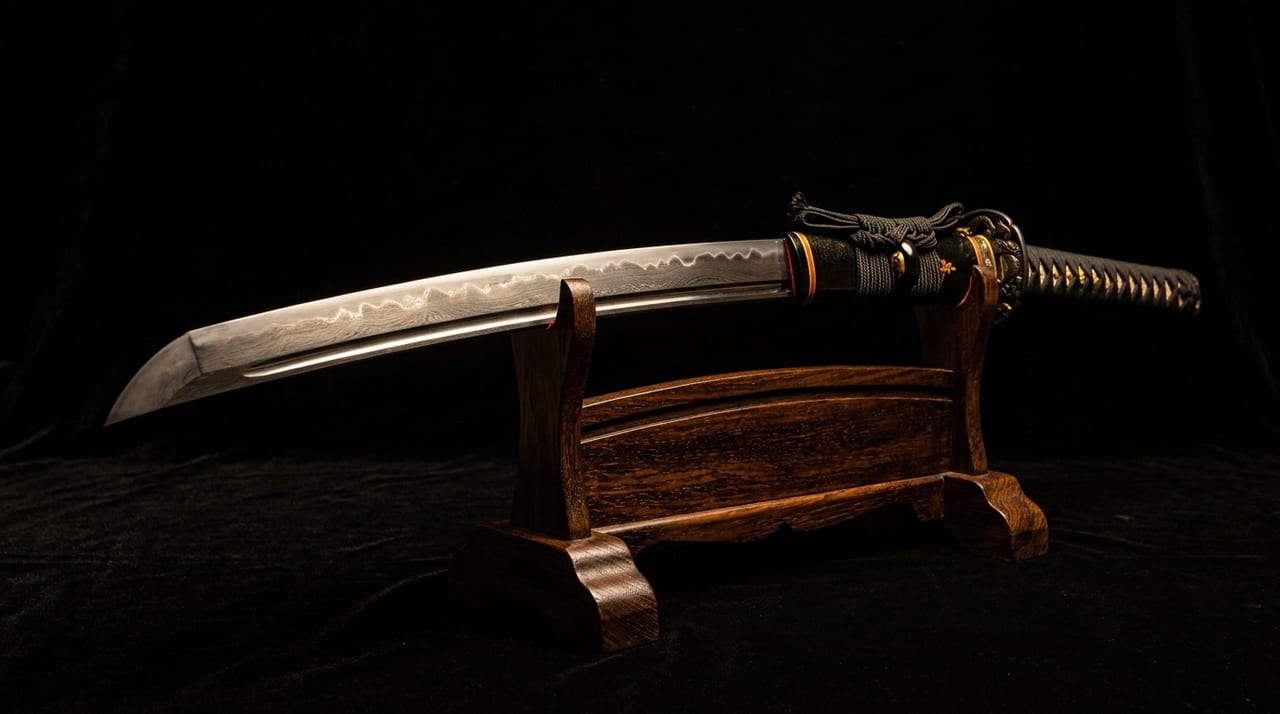
One of the technical pinnacles of the togishi's art is drawing out the utsuri. Utsuri is a whitish shadow that appears in the jigane (steel of the blade surface) corresponding to the hamon, and is seen particularly often in Bizen-den swords. This utsuri is latent in the jigane from the kaji stage, and the togishi "draws it out" through the manner of polishing.
Drawing out utsuri requires fine adjustments of polishing angle and pressure specialized for the appreciation of jihada, and this takes a different direction from polishing optimized for appreciating the hamon. A skilled togishi adjusts the polishing method as appropriate, with the discerning eye to judge "what should be shown in this sword at this moment."
There are the following types of utsuri, and expressing each type to its fullest requires a corresponding polishing approach.
- Shiro-utsuri
- Bo-utsuri
- Midare-utsuri
Types of Jihada and Their Polishing: Approaches for Each Pattern
Jihada is the pattern of forge-welding lines that appears on the surface of the jigane, formed by the tōkō's forging method and the properties of the steel. The togishi determines the type of jihada and selects the optimal polishing method.
| Jihada | Characteristics | Polishing Method |
|---|---|---|
| Itame-hada | The most common jihada, characterized by a flowing pattern resembling the straight grain of wood | Polishing uniformly across the whole blade with uchigumori-to tends to bring it out most beautifully |
| Mokume-hada | A rounded, swirling pattern like the burl grain of wood, seen often in Bizen-den swords | Must be polished with an extremely light touch so as not to crush the "scenery" of the surface |
| Masame-hada | A jihada pattern particular to Yamato-den swords, flowing straight in the vertical direction | Polishing in alignment with the direction of the masame is the basic approach; polishing against it will cause the lines of the jihada to break down |
| Ayasugi-hada | A distinctive zigzag pattern seen in the Gassan school, and one of the most technically difficult jihada | Considerable specialized experience is required to express it, and togishi who excel at it are considered rare even within the profession |
Hatsuya Finishing: Maximizing the Activity of the Hamon
The culmination of the togishi's work is hatsuya finishing. Hatsuya is a small whetstone fragment used by pressing it with the fingertip and moving it in fine motions along the hamon, bringing the activity within the hamon (nie, nioi, ashi, ha) into clear relief.
Nie (visible martensite crystals) is the granular brilliance that appears within the hamon, a visualization of subtle differences in carbon concentration. The togishi draws out the three-dimensional quality of the nie granules to the fullest by varying how the hatsuya is applied. Nioi (fine martensite mist) is finer than nie and appears as a haze-like band of light. Showing nioi beautifully requires precise control of the direction and angle at which the hatsuya is pressed.
Hatsuya finishing is a painstaking process that may take many hours—or in some cases several days—for a single sword.
The Path to Becoming a Togishi: Apprenticeship and Certification
To become a togishi, one must take on an apprenticeship under a master, as with tōkō, and undergo a long period of training. A training period of five to ten years is generally considered standard, but it is not uncommon to take more than ten years before being recognized as a fully independent togishi.
The Agency for Cultural Affairs administers a system of "togishi technical preservation holders," and togishi of particularly outstanding skill may be designated as holders of an Important Intangible Cultural Property (Living National Treasure). The following individuals are known as Living National Treasures in sword polishing:
- Hon'ami Nisshu
- Ono Mitsuyoshi
- Fujishiro Matsuo
- Nagayama Mitsumoto
- Hon'ami Koshu
A togishi's remuneration varies greatly depending on the volume and quality of the work and the needs of the client, but the standard polishing fee is generally in the range of tens of thousands to hundreds of thousands of yen per sword, and when seeking polishing by a celebrated togishi, it may exceed one million yen.
Conclusion: The Togishi as a Prerequisite for Appreciation
When speaking of the beauty of Japanese swords, the togishi cannot be left out of the equation. The latent beauty created by the tōkō is made visible through the togishi's togi (polishing) technique. In every moment a collector is moved by a single sword, the togishi's work is always present.
When acquiring a fine sword, confirming its polishing history by a trusted togishi and commissioning re-polishing as needed connects to the proper preservation of Japanese sword culture. The togishi, too, is an indispensable cultural bearer supporting the "total art" that is the Japanese sword.