The Gassan School in the Military Era: How Osaka's Master Smiths Preserved Ayasugi-Hada Through Showa Japan
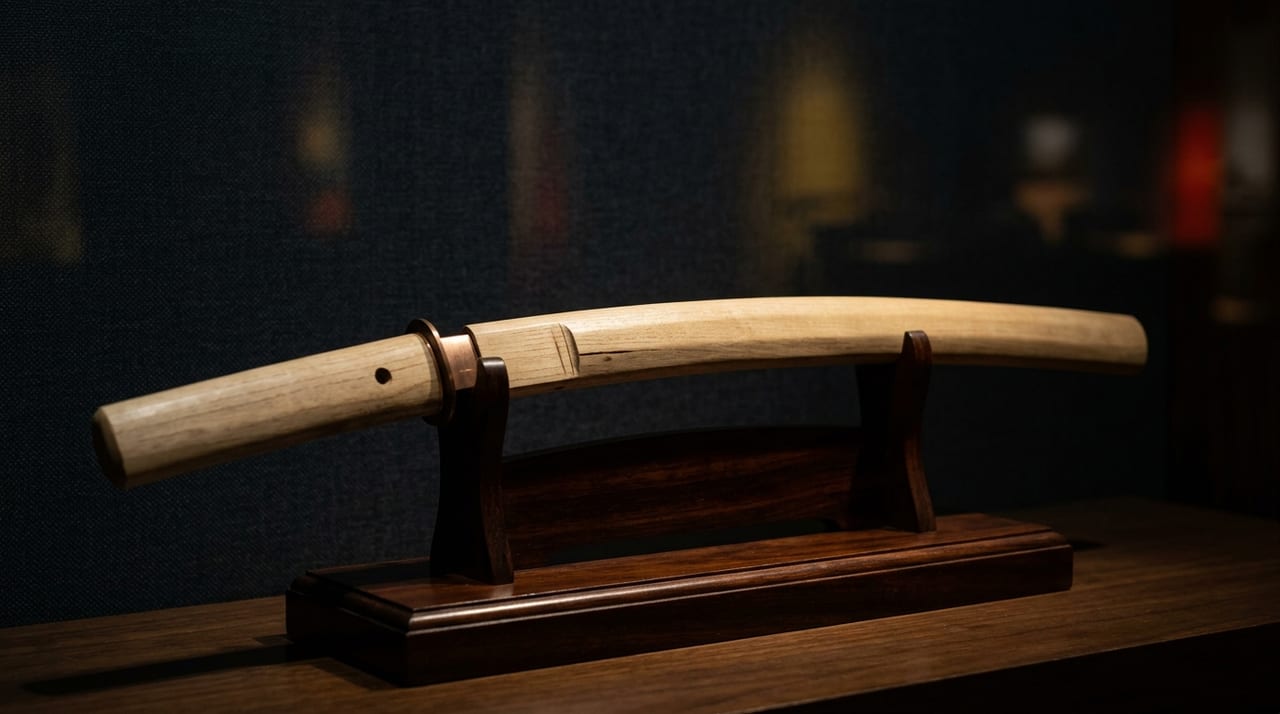 * Image is for illustrative purposes only.
Table of Contents
Technical Characteristics of the Gassan School—What Kind of Ground Pattern is Ayasugi Hada?
The Gassan school is a lineage of swordsmiths based in Osaka. Its name is derived from Mount Gassan, the sacred peak in Dewa Province (present-day Yamagata Prefecture), and the school traces its lineage to ancient smithing traditions that flourished at the foot of Mount Gassan in Ōshū during the Kamakura and Muromachi periods. In the Tenpō era of the late Edo period, Gassan Sadayoshi, who carried the blood of these Gassan smiths, moved from Yamagata through Edo and settled on Yariyamachi in Osaka, reviving the ancestral ayasugi forging technique and thereby beginning the history of the Gassan school in Osaka. The adopted son whom Sadayoshi brought into the family took the name of the first-generation Gassan Sadakazu and went on to establish the Osaka Gassan school as a first-rate lineage of swordsmiths in the Meiji era and beyond.
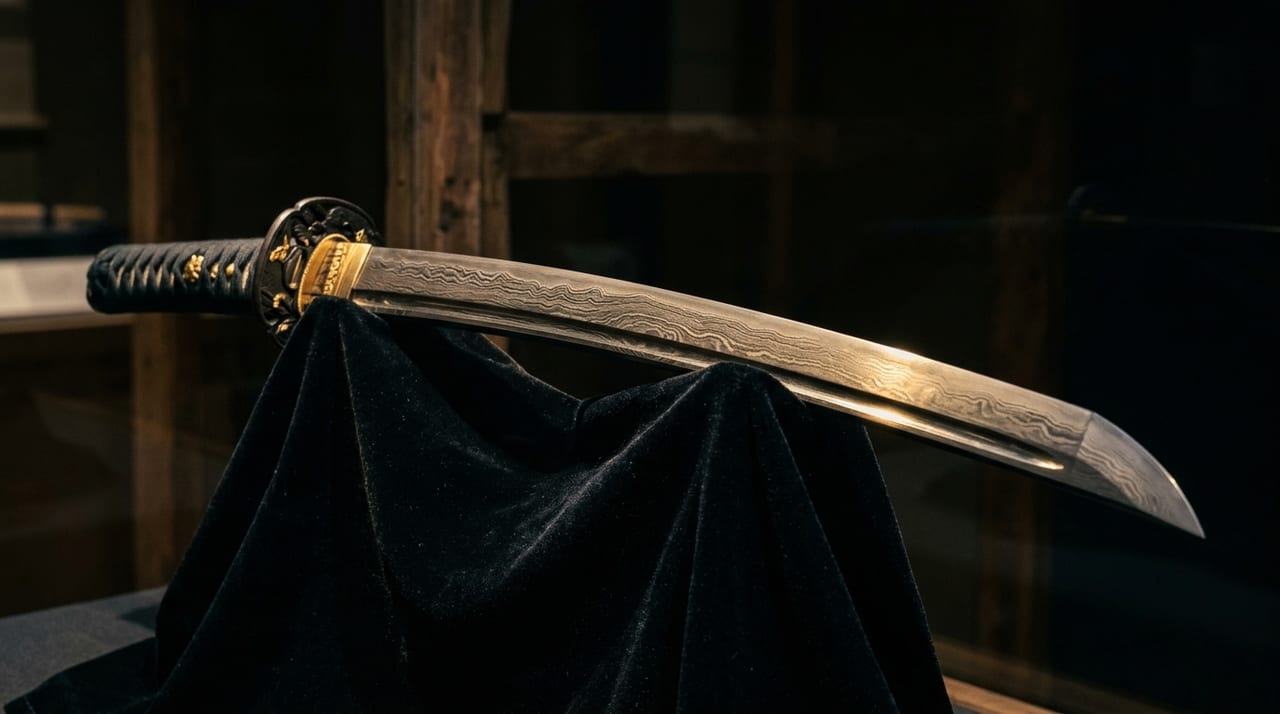
The most distinctive characteristic of the Gassan school lies in a unique ground pattern called ayasugi hada. This is a wave-like flow that evokes the grain of a sugi (Japanese cedar) tree, created by performing hammer strikes at alternating angles during folding and forging, rather than fixing the direction of folding and forging in a single direction. Precise control of the direction of hammer strikes during forging and meticulous management of the number of folds is essential, and even a slight deviation in angle can disturb the pattern, making long years of practice necessary for mastery.
Notably, this ground pattern transcends mere decorative significance. As ayasugi hada forms, the carbon distribution within the steel becomes complexly interwoven, creating distinctive properties in the tensile strength and resilience of the forged body. Among sword researchers, it is pointed out that Gassan's forged body exhibits unique behavior under bending stress, and the technique is highly valued as one that combines both aesthetic merit and functional superiority.
Regarding the blade pattern (hamon), the kaeruko chōji—a variant of chōji midare (clove-like temper pattern)—is known as a specialty technique of the Gassan school. In this blade pattern, the tips of each chōji projection gather into small bubble-like formations. It is a highly difficult technique that demands precision in quenching temperature and clay placement, and even experienced swordsmiths find stable reproduction challenging. Works that combine both ayasugi hada and kaeruko chōji are positioned as representative masterpieces demonstrating the pinnacle of Gassan achievement.
Military Sword Demands and the Gassan School's Dilemma
The sharp increase in military sword demand accompanying the expansion of the military in the early Showa period presented a critical crossroads for swordsmiths. The Army and Navy required enormous quantities of swords, and the market became flooded with military swords made from industrial steel materials produced at iron mills (the so-called "nanban iron" or "yō tetsu"). Mass-produced items made by mechanical pressing also appeared, and swords increasingly assumed the character of consumable goods.
During this era, many swordsmiths came to terms with reality and shifted toward mass production using industrial steel. However, the bearers of the Gassan tradition made a different choice. They remained steadfast in their commitment to using tamahagane—steel produced through tatara smelting, the traditional Japanese process using sand iron and charcoal.
"Ayasugi hada cannot be born without tamahagane." This conviction was grounded in experience. Industrial steel has carbon content that is too uniform; even with repeated folding and forging, the unique non-uniform stratified structure characteristic of the Gassan school is difficult to form. The ayasugi hada pattern came into existence only through the fine distribution of impurities and carbon gradients inherent in tamahagane. To preserve tradition meant not merely conserving a style, but safeguarding the inseparable chain linking materials and technique. The stance of the Gassan school, which maintained this conviction in resistance to the pressure of mass production, is highly valued by later generations.
Gassan Sadakatsu—The Spirit of Gassan Inscribed in the Yasukuni Forging Workshop
Gassan Sadakatsu was born in 1869 (Meiji 2) in Yariyamachi, Osaka, as the eldest son of first-generation Sadakazu, and learned sword forging and blade carving from his father from an early age. He was an accomplished swordsmith who flourished from the Taishō period into the early Showa period, forging numerous imperial swords and blades commissioned by the Army and Navy. In 1933 (Showa 8), when the "Japanese Sword Forging Society" established its forge in the grounds of Yasukuni Shrine through cooperation between the sword-making world and the Army, Sadakatsu became one of the participating swordsmiths. Blades forged here came to be called "Yasukuni swords," and the swordsmiths who worked on them were known as "Yasukuni swordsmiths." Sadakatsu died at the age of seventy in 1943 (Showa 18), so he was not involved throughout the entire period of the forge's operation, which continued until 1945.
Gassan Sadakatsu's works from the Yasukuni forge are treasured by modern collectors as "Gassan swords among Yasukuni swords," prized for their double rarity. The forge as a whole is said to have produced numerous Yasukuni swords over more than a decade, but among them, those in which ayasugi hada can be confirmed allow easy identification of the forging smith, and they show high distinguishability when cross-referenced with the forge's documentary records.
Until his death in 1943, Sadakatsu maintained his commitment to tamahagane and traditional techniques even at the Yasukuni forge, a philosophy directly inherited by his successor, second-generation Gassan Sadakazu. The choice to preserve quality even at the sacrifice of quantity was the greatest reason why the name Gassan maintained its reputation throughout the Showa era.
Gassan Sadakazu (2nd Generation)—The Pride Demonstrated by a Showa-Era Living National Treasure
Gassan Sadakazu (2nd generation, born name Gassan Noboru) was born in 1907 (Meiji 40) in Osaka as the son of Gassan Sadakatsu. In 1929 (Showa 4), he forged a grand marshal's sword to be presented to the Showa Emperor together with his father. After the war, he endured a difficult period during which sword forging was forbidden under GHQ policy, but when the Weapons Manufacturing Act was enforced in 1954 (Showa 29), he resumed forging. In 1966 (Showa 41), he succeeded to the name "Gassan Sadakazu," which had been his grandfather's. In 1971 (Showa 46), he was designated as a Living National Treasure (Holder of Important Intangible Cultural Property) in the field of "Japanese swords." Alongside Miyairi Yukihira, his contemporary who was designated in 1963 (Showa 38) and died in 1977, he is regarded as one of the two great swordsmiths who represented traditional forging in the Showa era.
The core of second-generation Sadakazu's identity as a craftsman is revealed in his consistent stance spanning from wartime through the postwar reconstruction period. He did not comply with mass production pace; instead, he persisted in the conventional method of selecting tamahagane for each individual blade and carefully producing ayasugi hada. As a craftsman of that era, this was an economically disadvantageous choice, but after the war his stance came to be properly evaluated.
After his designation as a Living National Treasure, second-generation Sadakazu not only inherited the Gassan family tradition of ayasugi forging but mastered all the techniques of the Five Traditions, conducting demonstrations and instruction nationwide as an inheritor of traditional craftsmanship, and also contributed to the recovery of the social standing of Japanese swords as cultural heritage. His works are housed in major collections both within Japan and abroad, and continue to be consulted by researchers as canonical works demonstrating the standard of sword and blade art in the Showa period.
Distinguishing Works of the Gassan School—Actual Authentication Practice
When authenticating a Gassan school blade, it is important to confirm the following elements in combination:
- Observation of ground pattern: When viewing the ground pattern in a polished state, if a wave-like flow reminiscent of sugi wood grain is observed, the likelihood of Gassan school attribution is high. However, in recent years works by other schools that have consciously imitated ayasugi hada also exist, so caution should be exercised against making judgments based on this single factor. By changing the angle of the light source while observing, the diffuse reflection of light caused by the intersecting layers becomes easier to confirm.
- Format of the signature: A two-character signature reading "Gassan," or a signature adding a personal name in the format "Gassan Sada-" is common. If a date of manufacture or an inscription indicating the recipient is engraved on the reverse, cross-reference with documentary sources becomes possible, increasing the accuracy of attribution.
- Blade pattern characteristics: The presence of kaeruko chōji strongly suggests Gassan school attribution, but not all Gassan swords possess this pattern; blades with gunome or suguha also exist. Judgment based on blade pattern alone would be an oversimplification.
- Curvature and form: The Gassan school tends to favor robust construction, and many blades in their style have broad width and thick cross-section. Morphological comparison with mass-produced military swords of the same period can also serve as supplementary information in determining attribution.
Ayasugi Hada Continuing into the Modern Era—The Generation of Gassan Sadatoshi and Gassan Sadanobu
The present-day Gassan school is centered on Gassan Sadatoshi (born Showa 48), who inherited the techniques of second-generation Sadakazu, and his son Gassan Sadanobu is also undergoing training as a swordsmith. The workshop is located in Yao, Osaka Prefecture, and sword forging using tamahagane produced through traditional tatara smelting continues in the modern era.
Gassan Sadatoshi has engaged not only in faithful reproduction of traditional techniques but also in creating contemporary swords in dialogue with modern aesthetic sensibilities. His stance can be understood as a continuous progression of "shu-ha-ri"—first completely mastering the techniques of predecessors, then adding contemporary interpretation to materials and blade patterns, and eventually opening up one's own territory.
The lineage of the Gassan school, which survived the era of mass consumption represented by military swords, took on the burden of cultural revival in the postwar period under a Living National Treasure, and transmitted its techniques to modern inheritors—this stands as evidence that the craft of the Japanese sword was not swallowed by industrial rationalism. The ayasugi hada, a visual imprint, continues to shimmer on the blade's surface today as a symbol of that long resistance and continuity.