Japanese Sword Culture in the Horeki-Tenmei Era (1751-1789): How the Tanuma Period Transformed Samurai Etiquette and Sword Aesthetics
 * Image is for illustrative purposes only.
Table of Contents
What was the Horeki-Tenmei Period?
From Horeki 1 (1751) to the end of Tenmei / early Kansei (around 1788-1789), this was a tumultuous period that passed through the reigns of the 9th shogun Tokugawa Ieshige and 10th shogun Ieharu, transitioning to the 11th shogun Ienari, and is known as the "Tanuma Era" led by Roju Tanuma Okitsugu. Note that Ieharu died in Tenmei 6 (1786), and from Tenmei 7 (1787) onwards, it became the era of Ienari. This period, in which the shogunate's finances were restored through the promotion of commerce and active fiscal policy, was an era in which townspeople's culture reached its full bloom while, at the same time, subtle changes occurred in the appreciation of swords within samurai society.
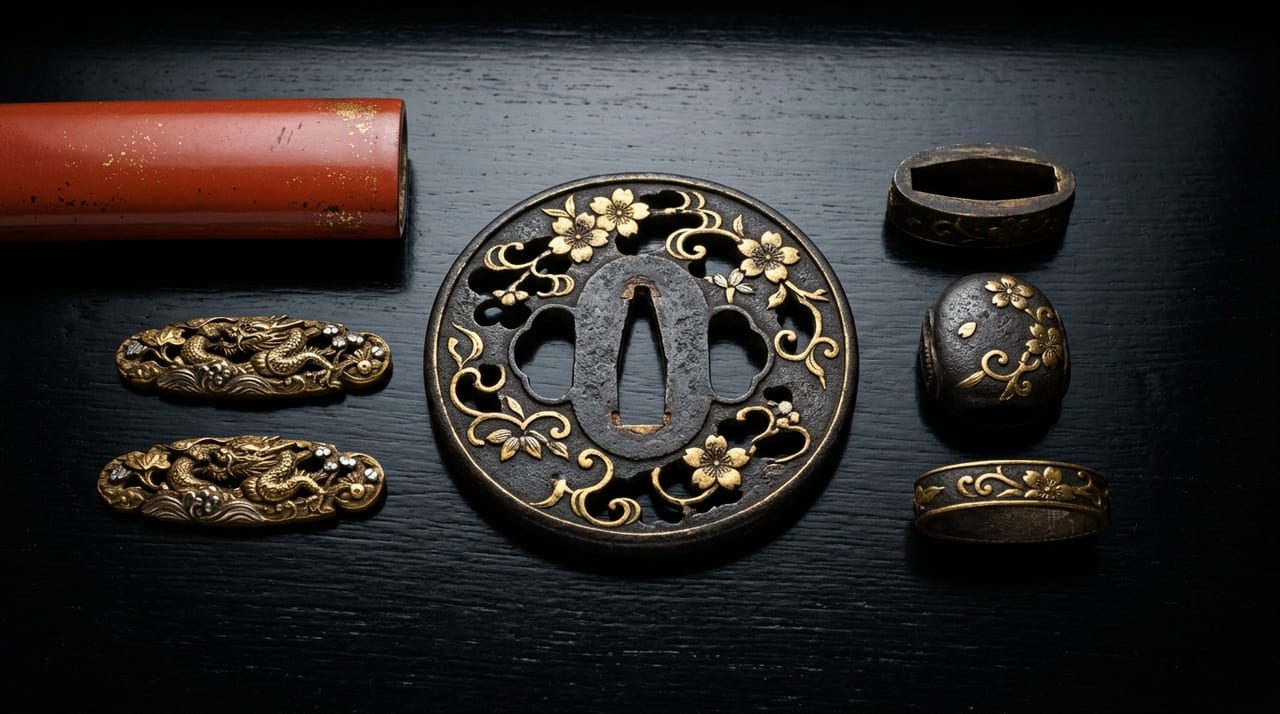
In contrast to the Kyoho Reforms of the previous era (1716-1745), which had frugality and simplicity as their banner, the Tanuma period emphasized the activation of economic activity, and interest in "display swords" increased even within samurai society. The remarkable refinement of sword fittings (tsuba, menuki, fuchigashira, kogai) that progressed during this period was not unrelated to this historical background.
Tanuma Okitsugu was a man who, though born into a bannerman family of relatively low stipend, achieved an exceptional rise in fortune by using his service as a shogun's attendant as a stepping stone. He is also known for publicly approving merchant guilds (kabunakamaand collecting taxes from commercial activities, taking an approach that diverged from the traditional agrarian-based fiscal management. This way of thinking—"utilizing the power of commerce"—is believed to have influenced the valuation of goods within samurai society, particularly swords and sword fittings, preparing fertile ground for the emphasis on not only functionality but also design and rarity.
The Flourishing of the Sword Fitting Industry—From the Goto Family to Individual Artisans
The Goto family (gotouке), which had held the highest rank in sword fittings from the Muromachi through the early Edo period, maintained their privileged position as official metalworkers to the shogunate. However, during the Horeki-Tenmei period, their status was being relativized by the rise of independent metalworkers outside the official system.
Even after Nara metalworker Tsuchiya Yasuchika (1670-1744) passed away, his disciples continued to work in Edo and Osaka, creating works that added unique designs to traditional casting and metalworking techniques. In particular, the Higo metalworking tradition (from Kumamoto) reached its heyday during this period, establishing a distinctive aesthetic of applying simple openwork and modest gold and silver inlay to sturdy iron tsubas. This tradition consisted of the following four schools:
- Hayashi
- Nishigaki
- Hirata
- Shimizu
This was also a period in which the materials used for tsubas diversified. Works skillfully combining shakudo (red copper), shibuichi (silver-copper alloy), gold, silver, and iron were highly prized among wealthy Edo merchants and feudal lords.
There were the following differences between the styles of the Goto family and independent metalworkers:
| Tradition | Practitioners | Characteristics |
|---|---|---|
| Iebori (house carving) | Goto family | Formal designs primarily intended as offerings or gifts to the shogun's household or feudal lords |
| Machibori (town carving) | Independent metalworkers who rose to prominence during the Horeki-Tenmei period | More free and realistic designs reflecting the tastes of not only samurai but also wealthy townspeople |
This shift in emphasis from "iebori" to "machibori" is arguably the greatest change in the history of sword fittings during the Horeki-Tenmei period.
The Eve of Shinshintoу—The Accumulation of Forging Culture
The Horeki-Tenmei period was also an important period of accumulation immediately preceding the shinshintoу movement in blade-forging technology. Suishinshi Masahide's major work "Toshin Fukko Ron" (On the Revival of Sword Aesthetics) was published in Bunsei 9 (1826), but the ideological seeds of this work lie in the experimental efforts of swordsmiths of the Horeki-Tenmei period.
Most swordsmiths of this period, while inheriting the conventions of the shintoу era—a system in which swordsmiths from Sagami or Settsu established themselves in Edo and Osaka to produce blades—began exploring a return to the techniques of the older "kotoу" (ancient swords). The momentum for "kotoу revival" followed the current of cultural restraint and revival movements that had gained strength during the Kyoho Reform period, and was shared among intellectuals and samurai of the Tenmei era.
The challenge that swordsmiths of the time faced was that the blade-forging techniques established during the shintoу period alone were insufficient to reproduce the beautiful jihada and richly varied hamon patterns seen in celebrated swords from the Kamakura and Nanboku-Choу periods. For this reason, some swordsmiths are said to have repeatedly engaged in trial and error, returning to the most basic aspects such as the selection of iron as a raw material and the processes of forging, attempting to approach the style of kotoу. This accumulation of patient exploration prepared the way for the shinshintoу movement led by Suishinshi Masahide and others of the next generation.
Changes in the Position of Swords in Samurai Etiquette
By the middle Edo period, swords had almost entirely lost their meaning as practical weapons, and their aspect as ritual instruments demonstrating samurai identity came to the foreground. The method of wearing a sword (the etiquette of carrying swords), the handling of swords during audiences, and the rituals surrounding the presentation and acceptance of swords all became more refined during this period.
Particularly notable is the way the practice of "denchu-zashi" (wearing swords in the shogun's palace) became established and settled. At the time of entering Edo Castle, the carrying of long swords was prohibited, and only short wakizashi below a certain length were permitted. This regulation produced a specific form of tantou culture known as "denchu-zashi," which accelerated the sophisticated aestheticization of sword fittings.
Ritualistic gift-giving of swords was also a field in which refinement progressed during this period. There was a practice of presenting swords and sword fittings on various occasions—celebrations, condolences, or expressions of loyalty in master-servant relationships—and selecting appropriate fittings and sword ornaments according to the status of the recipient was expected as part of a samurai's cultural refinement. The expansion of this gift-giving culture also served as a factor supporting the demand for sword fittings not merely as practical items but as works of art.
The Great Tenmei Famine and Its Impact on the Sword Industry
The Great Tenmei Famine, which began in Tenmei 3 (1783), caused devastating damage, particularly in the Tohoku region, and dealt a serious blow to shogunate finances. This economic impact extended to the sword industry as well, with orders for expensive custom-made swords declining and a certain check being placed on the luxury ornamentation of sword fittings.
The famine is said to have expanded in damage due to the combination of volcanic ash from the eruption of Mount Asama and cold damage centered on the Tohoku region, bringing social unrest beyond mere fiscal problems to various areas.
However, paradoxically, this economic hardship also contributed to the technical deepening of swordsmiths. With fewer orders, swordsmiths gained the leisure to devote time to "experimental works honing techniques" rather than "mass-produced bestsellers," and the technical exploration that would later lead to the shinshintoу revival movement deepened.
The Horeki-Tenmei period, lacking dramatic political incidents or major foreign conflicts, is often overlooked in sword history. However, as an era in which the transition of the sword from a practical tool to an artwork and ritual instrument was completed, it is an indispensable period classification for understanding Japanese sword culture.
Perspectives for Distinguishing Swords and Sword Fittings of the Horeki-Tenmei Period
At present, several perspectives serve as clues when appreciating and collecting swords and sword fittings made during the Horeki-Tenmei period. First, regarding sword fittings such as tsuba and menuki, the distinction between "iebori" and "machibori" mentioned earlier becomes a basic point of departure for interpreting design and technique. By comparing works from the perspective of whether they are formal designs emphasizing the status of the shogun's household and feudal lords, or realistic designs reflecting the tastes of townspeople, one can more easily grasp the individuality of each work.
Second, since this era corresponds to the transitional period from shintoу to shinshintoу, the blade itself may show differences in jihada and hamon tendencies depending on whether the smith's signature represents an attempt to return to kotoу techniques or a smith whose style retains strong characteristics from the shintoу period onward. In cases where the stylistic tendencies favored by each school are known, such as the four schools of Higo metalworking, this also serves as a clue to interpreting the background of a work.
In either case, the final determination regarding period, maker, and transmission is best confirmed through authentication by the Nippon Bijutsu Touken Hozon Kyokai (NBTHK). Particularly for unsigned sword fittings or reconstructions that may have been altered in later periods, the assessment indicated in the authentication certificate from a specialized institution becomes an important foundation for understanding the provenance and value of a work.