The Kogai Guide: From Heian Origins to Higo Metalwork's Four Schools—Your Gateway to Sword Fittings Collecting
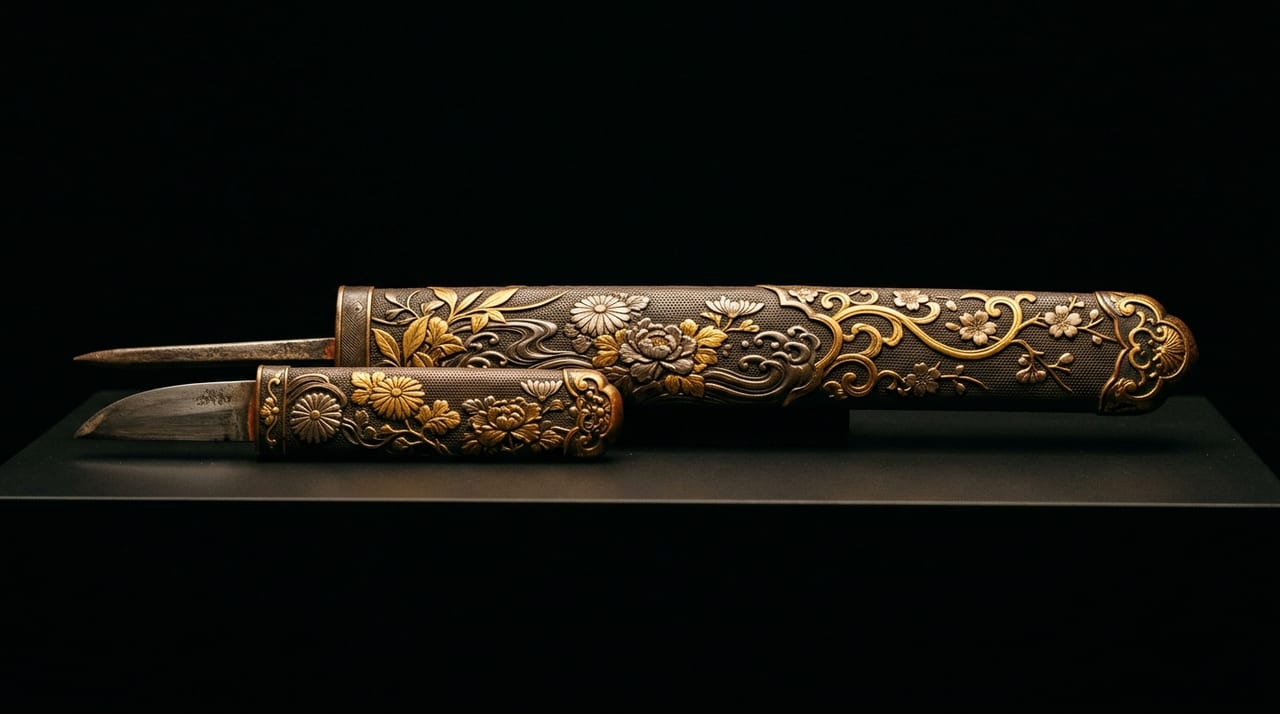 * Image is for illustrative purposes only.
Table of Contents
Kōgai: A Unique Presence Among Japanese Sword Fittings
The kōgai is a slender metal tool inserted into a dedicated groove (kōgai-bitsu) built into the scabbard of a Japanese sword, originally said to have been used for grooming hair. Typically 20-22 cm in length and 1-2 cm in width, it has a distinctive shape with one end wider than the other.
While tsuba, menuki, and fuchigashira are relatively well-known among sword fittings, the kōgai is a prime example of something many people have never heard of. However, the kōgai is an important element in completing the koshirae of a Japanese sword, and Edo period metalworkers devoted their highest technical skills to the design of the kōgai.
Historical Origins of the Kōgai: From Heian Court Culture to the Samurai
The prototype of the kōgai can be traced to hair ornaments used by Heian period court women. During this era, kōgai were usually made of wood or ivory, while metal versions symbolized nobility. From the Kamakura period onward, as the samurai class rose to prominence, the kōgai became incorporated into armor and weaponry as a practical tool.
There are several theories about the use of the kōgai among the samurai. Besides the theory that it was used to tie back hair, there are theories that it functioned as an ear pick or as a tool for detailed work such as undoing seams. In any case, it was a practical implement carried daily and, as a part of sword fittings that was meant to be displayed, considerable care was devoted to its design.
Combination with the Koduka: The Three Fittings of the Uchigatana Koshirae
The koshirae of an uchigatana is considered complete when it includes three fittings: the kōgai, the koduka, and the menuki. The koduka is a small blade (approximately 10 cm in blade length) inserted into the sword scabbard and was used for multiple purposes such as cutting paper, severing cord, and eating. The kōgai and koduka were customarily made as a pair by the same metalworker, with matching designs as a matter of etiquette.
In the sword fitting market from the mid-Muromachi period through the early Edo period, dominated by the Goto family, the combination of Goto-style kōgai, koduka, and menuki became established as the "standard finest works" among the samurai. The seventeen generations of the Goto family, beginning with Goto Yūjō, continued as official suppliers to the shogunate until the end of the Edo period, and the extant kōgai and koduka made by the Goto family are evaluated as the finest examples of kinko art.
Edo Period Metalworking Techniques: The Technical Skills That Color Kōgai Design
Edo period metalworkers employed diverse techniques in the creation of kōgai.
- Nikubori (sculptural carving): A technique for carving metal surfaces three-dimensionally to create raised designs. Classical motifs favored by the Goto family, such as "bamboo and sparrows" and "plum and nightingale," were often expressed through nikubori.
- Zogan (inlay): A technique for inlaying silver and copper into a gold ground. The combination of multiple materials—such as expressing leaf veins through gold line inlay on a shibuichi (an alloy of silver and copper) ground—enriched the expression of the kōgai.
- Nanako-uchi (fish-egg texture): A technique for evenly striking fine dots into the background metal. The regularly arranged, fine dots resembling fish eggs create an effect that enhances the figure placed upon them. This was also a technique favored by Higo metalworkers.
Higo Kōgai: An Austere Aesthetic
The kōgai created by Higo metalworkers from Higo (Kumamoto) possess a concise and powerful aesthetic in contrast to the Goto family style. Higo metalwork, represented by four schools—Hayashi, Nishigaki, Hirata, and Shimizu—created kōgai as part of their distinctive aesthetic, the "Higo koshirae," which was established from the mid-Edo period onward.
Higo kōgai, which minimize decoration and create meaning through only minimal piercing in an iron ground and sparse gold and silver inlay, embody the "aesthetics of subtraction" that corresponds to the beauty consciousness of the tea ceremony.
Extant Masterpieces and Points of Appreciation
Among the famous kōgai that survive to the present day, representative examples include peony-motif kōgai by the Goto family, an iron-raised kōgai by Higo metalworker Hayashi Matashichi, and a fierce tiger-motif kōgai by Edo master craftsman Yokoya Sōmin.
When appreciating a kōgai, appreciation deepens when attention is given to the following three points:
- The theme of the design (auspicious motifs, samurai culture motifs, or literati preferences)
- Materials and techniques (the color of the metal, the precision of the inlay, the depth of the carving)
- The unity of pairing with the koduka
Among sword fittings, kōgai are a relatively accessible field, making them an appropriate entry point for beginning collectors to experience the precision of metalworking.
The Historical Position of the Goto Family
Goto Yūjō (1440-1512), the founder, served the Ashikaga shogun family during the mid-Muromachi period and established the Goto family as a hereditary metalworking profession. Subsequently, the lineage continued through second-generation Jōshin and third-generation Jōkei, and was organized as official suppliers to the Edo shogunate, continuing unbroken to the seventeenth generation at the end of the Edo period. The continuation of the family craft over approximately four hundred years beginning in the mid-Muromachi period is the defining characteristic that distinguishes the Goto family from other metalworking schools, and is the source of both the rarity and authority of extant Goto works.
When collecting kōgai and koduka, it is important to verify not only whether they are by the Goto family, but also the consistency of school, period, and design, as well as the unity as a pair. High-quality pairs often command valuations more than double that of single pieces. The metalworking technique and refinement cultivated by the Goto family from the mid-Muromachi period remain indispensable foundational knowledge for sword fitting collectors to this day.