Ko-kaji and Ō-kaji — The History of the Two-Stage Division of Labor in Nihontō Production and Its Inheritance into the Modern Era
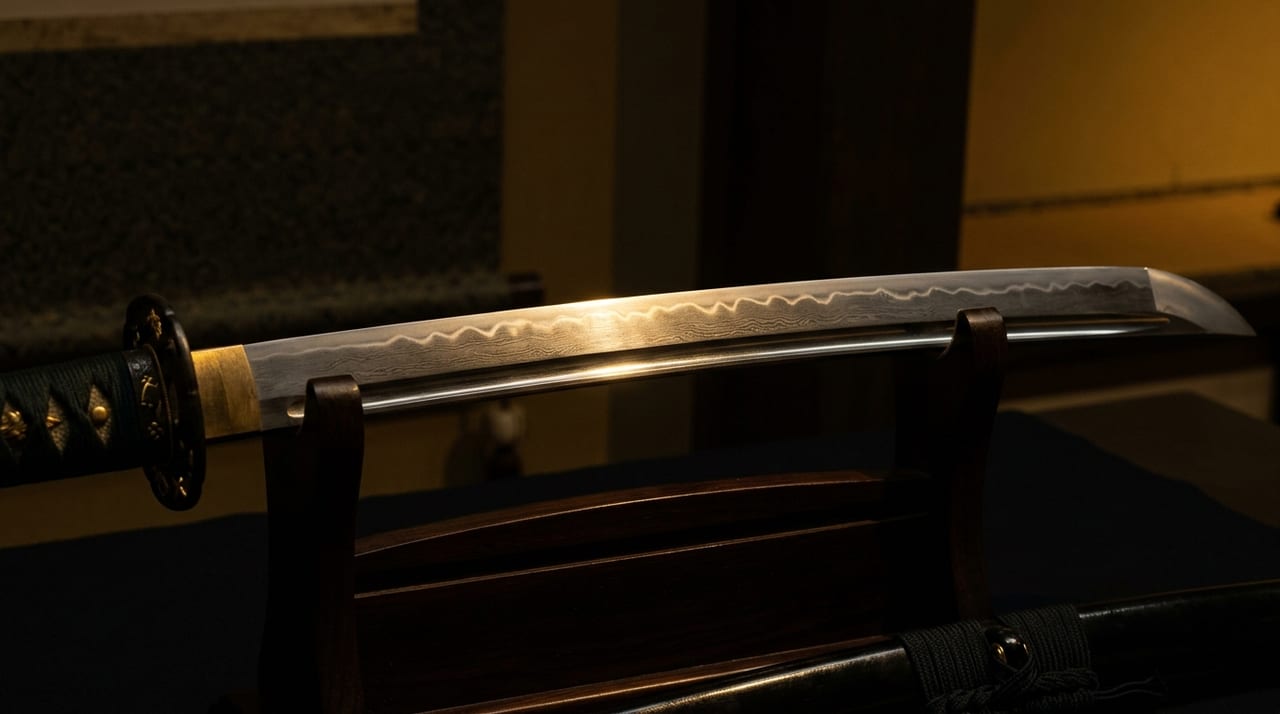 * Image is for illustrative purposes only.
Table of Contents
The Meaning of "ko-kaji" and "ō-kaji"
Today it is common for a single tōshō or kaji to handle everything from forging to finishing the blade, but historically there existed a functional division of labor known as ō-kaji and ko-kaji.
The ō-kaji was responsible for refining and shaping the tamahagane, handling the process of preparing the steel into a state that the tōshō could work with. The ko-kaji, by contrast, was the craftsman who used the refined material to actually forge the blade, and is the direct ancestor of what later generations would call the tōshō.
This dichotomy is an extension of the division of roles between the kanashi (iron masters) and tōkō in government-operated smithing before the Nara period, and it continued as a functional division even after the Kamakura period in contexts of large-scale commissioned production.
The word kaji itself is composed of two kanji: tan (to forge, meaning striking to increase strength) and ya (to smelt, meaning melting metal into a workable state). The etymology of this word itself hints that "refining" and "forging" were originally two distinct skills.
The Skills of the ō-kaji — The Science of Material Preparation
The core of the ō-kaji's work is "homogenization of the steel" and "control of carbon content."
Tamahagane produced by tatara (traditional smelting) has an uneven distribution of carbon content depending on the position within the furnace and the amount charged. Sections with high carbon content are hard and brittle, while sections with low carbon content are soft. Using such an uneven material directly for a blade results in unstable strength during yaki-ire (quenching).
The ō-kaji heats the tamahagane to an appropriate temperature and strikes it to homogenize the carbon distribution, producing a "well-prepared material" that the tōshō can work with. The oroshigane or refined forging material produced in this process is a preparatory material that makes the subsequent orikaeshi tanren (folding) more effective.
The technical challenge at the ō-kaji stage lies in "judging the heating temperature." If too high, the carbon burns off and disperses; if too low, sufficient forging cannot be achieved. Visual judgment of flame color and the color of the iron, based on experience, is the crux of the craftsman's skill.
In the ō-kaji's workshop, personnel were needed to continuously operate the fuigo (bellows) to maintain a constant temperature in the hodo (hearth), and a role dedicated solely to managing the furnace — separate from the craftsman handling the forging itself — was often established. The fact that material preparation was not a single solitary skill but was built on the coordination of multiple tasks — furnace management, bellows operation, and striking and forging — was one of the reasons that made ō-kaji an independent specialized domain.
The Skills of the ko-kaji — The Process of Creating the Blade
The process handled by the ko-kaji proceeds in the following sequence.
- Shitaji kitae
- Orikaeshi tanren (folding)
- Hizukuri
- Sunobe
- Rough finishing
Orikaeshi tanren is the most distinctive process, in which the steel is heated in the furnace, struck flat on the anvil with a hammer, folded over from the edge, and then heated and struck again — a sequence that is repeated. This folding forces out impurities (slag) from the steel and forms a layered structure. The number of folds varies by school and craftsman, but typically eight to fifteen folds produce a layered structure of approximately 256 to 32,768 layers (8 folds yielding 2^8 = 256 layers, 15 folds yielding 2^15 = 32,768 layers). Because excessive folding causes embrittlement, the judgment of the appropriate number of folds reflects the craftsman's expertise.
Hizukuri is the process of shaping the outer form of the blade, in which the heated steel is struck with special hammers (uwazuchi and shitakanatoko) to form the sugata (shape) of the blade — the variations in curvature, mihaba (blade width), and kasane (blade thickness). In this process, the formation of sori (curvature) is also important, and the skill of controlling uniform heating and cooling during forging determines the quality of the sori.
The ko-kaji's work was likewise not completed by a single person. A collaborative practice known as aizuchi was widely performed, in which the master tōshō (oyakata) lightly tapped with a hammer to indicate the position and force of each strike, while apprentices and assistants swung large hammers in response. Just as there is a theory that the expression for giving a conversational aizuchi derives from this collaborative forging work, orikaeshi tanren was a process accomplished through the coordinated cooperation of multiple people working in rhythm.
The Historical Transformation of the Division of Labor — Why Did It Merge?
During the Kamakura period, when large-scale demand for swords was high, it is believed that the division of labor between ō-kaji and ko-kaji was functionally maintained. Research suggests that in the Osafune school of Bizen (Okayama), workshop organization was well developed, with the work from refining tamahagane through to finishing the completed product organizationally divided among workers.
The dissolution of this division of labor came about due to multiple factors.
- Workshop organizations were dismantled by the warfare that swept from the late Muromachi period through the Sengoku period
- The peaceful era of the Edo period saw the individualization and specialization of craftsmen advance
- The reputation of the "solo tōshō" — a swordsmith who handles everything from materials to completion single-handedly — grew
These factors combined to establish the modern image of "the tōshō who performs all processes alone."
Given this historical trajectory, it is not easy to determine from appearance alone whether any given surviving sword belongs to the category of "a sword made under the division-of-labor system" or "a sword in which a single tōshō handled all processes." This is a matter that must be considered comprehensively together with provenance information about the period, place of production, and school, as well as the mei (signature); it cannot be determined from the appearance of the jigane or hamon alone.
Inheritance into the Modern Era — The Revival of the ō-kaji Process
The tamahagane used by modern tōshō is produced at the tatara (traditional smelting) operation in Okuizumo, Shimane Prefecture, managed by the NBTHK (Society for the Preservation of Japanese Art Swords), and a degree of quality control is maintained. However, tamahagane varies from lot to lot in its carbon content and hardness, and modern tōshō rarely use the tamahagane they obtain as-is; the common procedure is to first carry out an "ō-kaji-style refining process" themselves to prepare the material before beginning orikaeshi tanren (folding).
In other words, the modern tōshō is a craftsman who "handles both ō-kaji and ko-kaji alone," inheriting the skills of both sides of the historical division of labor. In this sense, one could say that the technical demands placed on modern tōshō are greater than those on specialized historical swordsmiths.
What to Know When Appreciating or Purchasing a Sword
Knowing the history of the division of labor between ō-kaji and ko-kaji broadens the perspective from which one can appreciate a sword. The wood-grain and itame patterns that appear in the jigane (steel of the blade surface) are the layered structure created by orikaeshi tanren (folding) that has risen to the surface through polishing. The fineness and uniformity of these patterns reflect how carefully the steel material was homogenized and how diligently the tanren (forging) was carried out, demonstrating the accumulated effort of the craftsman that derives from both the ō-kaji and ko-kaji processes.
On the other hand, one cannot accurately determine from the appearance of the jigane alone "whether it was made under the division-of-labor system or by a single person" or "how many times it was folded." This is because even among swords of the same school and same period, there are individual differences in the condition of the material and the forging procedure. When selecting a sword, it is advisable to make a comprehensive judgment combining the impression of the jigane and hamon with multiple sources of information such as provenance, period, and evaluations by authentication bodies.
In any case, in the making of a single sword — from the stage of preparing the tamahagane material through to the stage of forging the blade — historically, multiple specialized skills were accumulated. The fact that the modern tōshō bears responsibility for both of these alone is background knowledge worth having in order to understand the total measure of effort that goes into a single sword.