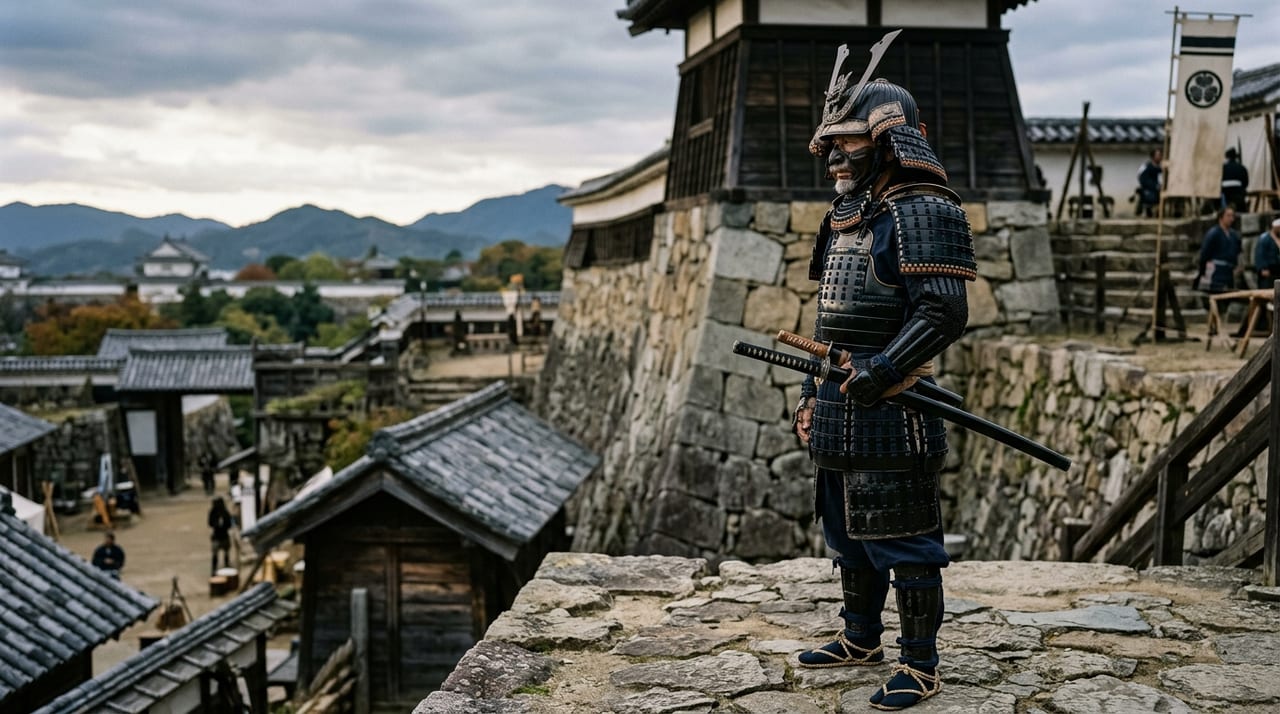
 * Image is for illustrative purposes only.
Kusunoki Masashige
楠木正成
The Paragon of Loyalty
Description
The Birth of Kusunoki Masashige
Kusunoki Masashige, said to have been born in Kawachi Province around 1294 (Einin 2), is regarded as a symbol of loyalty in Japanese history, a loyal retainer of the Southern Court who served Emperor Go-Daigo to the very end. His military talent and unwavering loyalty have given later generations of Japanese an ideal of what a loyal retainer should be, and seven centuries later he still commands reverence.
Loyalty to Emperor Go-Daigo
Masashige first appears on the stage of history in the Genkō War of 1331 (Genkō 1). Responding to Emperor Go-Daigo's call to overthrow the Kamakura shogunate, he raised an army at Akasaka Castle in Kawachi Province. His force numbered barely five hundred men, yet it held its own in a siege against a great army sent by the Kamakura shogunate, using unorthodox strategies to fight it out to the end.
Exploits in the Old Castle Battles
The siege of Chihaya Castle, which followed the defense of Akasaka Castle, displayed Masashige's military genius to the realm. Chihaya Castle was a mountain fortress that made use of the steep terrain of the Kongō mountain range. With barely a thousand men, Masashige outmaneuvered a force that the Kamakura shogunate claimed numbered one million. He rolled boulders down the slopes, burned the bridges the enemy had built with torches and oil, and used straw effigies to mislead the attackers. Knowing the castle's terrain inside out, he unleashed one unconventional tactic after another. The siege lasted for several months, and the shogunate's forces never managed to take Chihaya Castle. His tactics are also regarded as a forerunner of later guerrilla warfare.
Feelings About Swords
Among the swords said to have been worn by Masashige is a tachi called “Koryū Kagemitsu,” a National Treasure held by the Tokyo National Museum. It was made by Kagemitsu, a swordsmith of Bizen Osafune in the late Kamakura period. It bears an inscribed date of 1322 (Genkō 2) and is also called “Nankō Kagemitsu,” although doubts have also been raised about the tradition that Masashige wore it.
Changing Times
Even after the Kenmu Restoration was established, a confrontation with Ashikaga Takauji was unavoidable. In 1336 (Engen 1), when Takauji led a large army toward Kyoto, Masashige advised the emperor to leave the capital and move to Mount Hiei. The emperor's close advisers rejected this plan and ordered Masashige to meet Takauji's forces at Minatogawa. Masashige knew this battle would end in certain defeat, but out of loyalty to the emperor, he set out for battle anyway.
Death at Minatogawa, Hyōgo
The Battle of Minatogawa became Masashige's final battlefield. Faced with an overwhelming disparity in numbers, his forces were annihilated, and Masashige took his own life at Minatogawa together with his younger brother, Kusunoki Masasue. According to the Taiheiki, when Masashige asked his brother what his final wish was, Masasue replied that he wished to be reborn as a human seven times over in order to destroy the enemies of the court, and Masashige agreed. This vow of “shichishō hōkoku” has been passed down through the ages as the ultimate expression of Japanese loyalty.
Symbol of Loyalty
After the Meiji Restoration, Masashige was deified as “Dai-Nankō,” and his contributions to the Kenmu Restoration were newly honored. The statue of Kusunoki Masashige at Kōkyo Gaien (Imperial Palace Outer Garden), donated by the Sumitomo family to mark the bicentennial of the opening of the Besshi Copper Mine, shows him in a heroic pose on horseback, clad in armor and wearing a sword. It is widely cherished as a symbol of the loyalty of the Japanese people. The military strategies Masashige used and the sword he wore preserve, to this day, the image of a warrior who kept his loyalty intact in the turbulent era of the Northern and Southern Courts.
Notable Swords
- Koryū Kagemitsu (a tachi made by Kagemitsu of Bizen Osafune in the late Kamakura period. Said to have been worn by Masashige, and also called “Nankō Kagemitsu.” National Treasure, held by the Tokyo National Museum)