What Is Jitte and What Is Tessen — Structure, Types, and the Firearms and Swords Control Act of Edo-Period Arrest Tools and Self-Defense Weapons
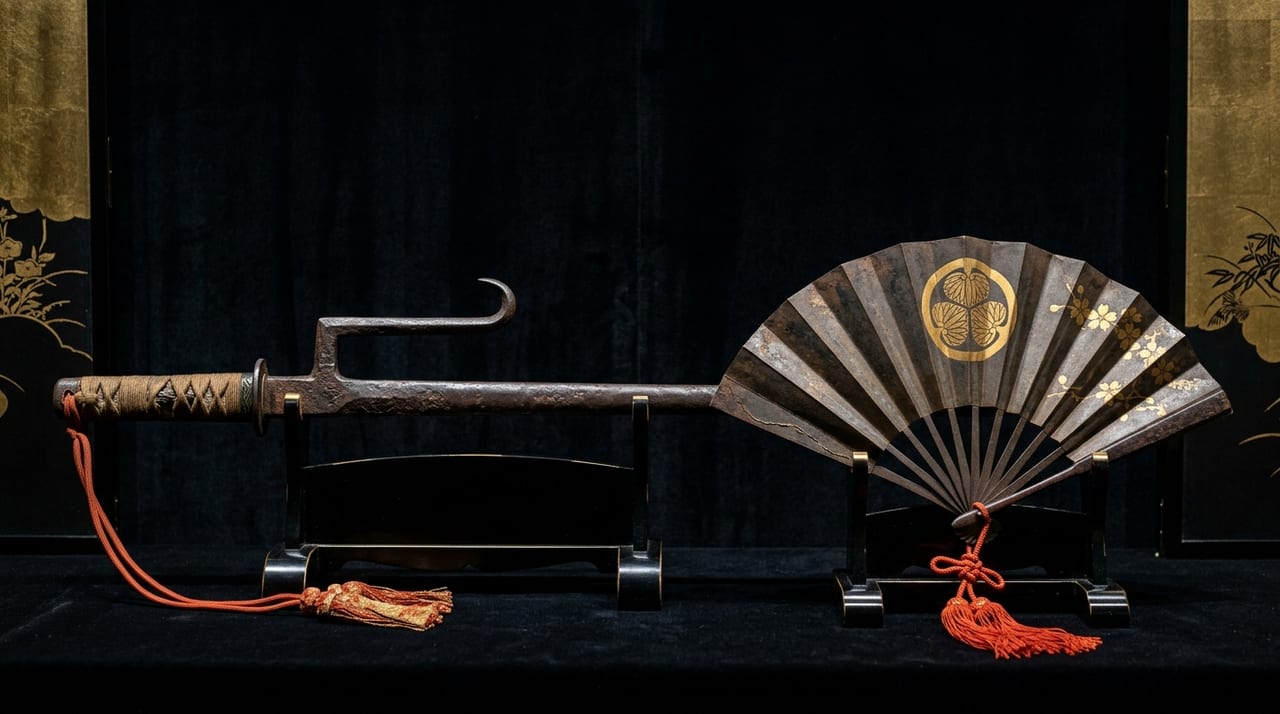 * Image is for illustrative purposes only.
Table of Contents
Jitte is an iron rod fitted with a hook (kagi) for catching sword blades, carried as an arrest tool by yoriki, dōshin, and okappiki of the Edo period. Tessen is a fan-shaped weapon with an iron or metal-reinforced frame, used by samurai as a self-defense implement in situations where carrying a sword was not permitted. This article explains the structure, types, and history of these metal weapons and restraining tools that complemented the Japanese sword, as well as their treatment under the modern Firearms and Swords Control Act (Jūtōhō), from the perspective of sword history.
Metal Weapons Beyond the Sword — The Wider World of Japanese Sword Culture
The world of the Japanese sword does not end with tachi, uchigatana, wakizashi, and tantō. Japan developed a diverse range of metal weapons and restraining tools that complemented the sword, each cultivating its own technology and culture.
This article focuses in particular on jitte, tessen, and other arrest tools that were deeply intertwined with Edo-period samurai culture and law-enforcement culture, explaining them from the perspective of sword history.
Jitte — The "Police Weapon" of Edo
What Is Jitte?
Jitte (also read jutte) was a restraining weapon used by yoriki (mounted police officers), dōshin (foot officers), and okappiki (unofficial constables of the shogunate or domain) of the Edo period. Yoriki and dōshin were officially permitted to wear swords and carried jitte at all times, but okappiki were unofficial collaborators and were in principle forbidden from carrying swords; in practice, dōshin would lend them a jitte on a temporary basis during arrest operations.
- Basic structure: A rod-shaped weapon approximately 30 to 60 cm long, made of iron or brass. One or more hooks (kagi) project from the base of the handle (usually a single hook).
- Function of the hook: The hook is jitte's defining feature. It is used in the katana-dome (blade-catching) technique, in which the sword blade is caught and entangled with the hook to subdue the opponent.
History of Jitte
- Heian-Kamakura prototype: Weapons that served as precursors to jitte are said to have existed in the Heian-Kamakura period, but the form now recognized as the "jitte as an arrest tool" was established during the Edo period.
- Spread in the Edo period: As the Edo shogunate's law-enforcement apparatus was developed in the 17th and 18th centuries, jitte became standardized as an arrest tool.
- Shogunate-approved weapon: Official yoriki and dōshin were permitted to carry swords, but okappiki (unofficial collaborators) were in principle forbidden from doing so. Jitte functioned as a weapon that such "semi-official constables" could legally carry.
Types of Jitte
- Hon-jutte: The standard type. The basic form with a single hook.
- Kagi-jutte: A type with multiple hooks (two hooks, etc.), capable of handling more katana-dome situations.
- Hoso-jutte: A slender, lightweight type. Used by female constables or for covert purposes.
- Sōshoku-jutte (decorated jitte): A type fitted with a fusa (silk cord tassel). The color and shape of the fusa attached to a jitte indicated the rank and office of its bearer (for example, a red fusa, known as shu-busa or aka-busa, was standard for both yoriki and dōshin, while white tassels were used in some offices such as those under the jisha-bugyō).
Jittejutsu
The techniques for using jitte have been systematized as jittejutsu (also known as toritejutsu). The main techniques are as follows.
- Katana-dome (blade catching): When an opponent brings a sword down, the hook catches the blade or tsuba (hand guard) to stop it.
- Striking techniques: Striking the opponent directly using the rod. This includes atemi (strikes to vital points) such as the wrist, elbow, and knee.
- Entanglement: Entangling the opponent's arm or sword with the hook to break their posture.
Some schools continue to transmit jittejutsu and jittedō today in the form of traditional martial arts.
Tessen — The "Folding Weapon" of the Battlefield
What Is Tessen?
Tessen is a metal or metal-reinforced weapon shaped to resemble a fan (ōgi). While an ordinary fan is made of Japanese paper and bamboo ribs, tessen is made of iron or metal ribs.
- Folding type: Like an ordinary fan, it can be folded. When carried it looks like a normal fan, but when opened it becomes a sturdy striking weapon.
- Non-folding type (katachi-tessen / gunbai-sen): There are also fixed types forged as a solid iron piece in the shape of a closed fan. Being sturdier for lacking an opening mechanism, they functioned as pure striking and blocking self-defense implements. The gunbai type, fixed in an open position, was used mainly by commanders for directing and signaling troops.
Approximate Dimensions and Weight of Tessen
Tessen made since the Edo period most commonly have an outer rib (oyabone) length of about eight sun to one shaku (approximately 24 to 30 cm) and weigh several hundred grams. The essence of tessen is the combination of portability and striking power — "the appearance of a fan that tucks into the breast of one's garment, yet strikes like an iron rod when swung" — and dimensions, weight, number of ribs, and decoration vary considerably from piece to piece.
Uses of Tessen — Self-Defense, Etiquette, and Command
- Self-defense weapon: In samurai society, a fan could be carried even in situations where bearing a sword was forbidden (certain areas within a castle, when attending upon the castle, etc.). Tessen functioned as a self-defense implement in such settings.
- Striking weapon: Used to receive or deflect an enemy's attack, or to strike the opponent. It also has the aspect of a "non-lethal weapon" for subduing without drawing a sword.
- Ceremonial implement: For commanders and daimyo, carrying a fan was a matter of etiquette. A tessen with elaborate decoration was also a symbol of authority.
Notable Users of Tessen
- Kusunoki Masashige: Multiple legends exist that the Nanbokuchō-period commander Kusunoki Masashige used a tessen.
- Uesugi Kenshin: Stories have been passed down of Kenshin wielding a tessen on the battlefield.
- Tokugawa Iemitsu: The third shogun Tokugawa Iemitsu is also said to have favored the tessen.
Tessen in the Modern Era
In modern Japan, tessen are used as practice implements for iaidō and classical martial arts, and some traditional schools transmit tessenjutsu. Many tessen are also preserved and collected as antiques, and they can be obtained at martial-arts equipment shops and in the antique market. Value is determined by the material of the ribs (iron, brass, etc.), the elaborateness of the decoration, the period, and the presence or absence of a mei (signature). For carrying tessen, see the legal notes below.
Other Arrest Tools
Manriki-gusari
A weapon with weights attached to both ends of a chain. It is swung to entangle the opponent's weapon or body. The principle is the same as that of the kusarigama (chain sickle), which wraps a chain around a sword blade to subdue the opponent.
Tekkō-kagi
A claw-shaped iron weapon worn between the fingers. Used to grip an opponent's sword or to enhance striking power in unarmed combat.
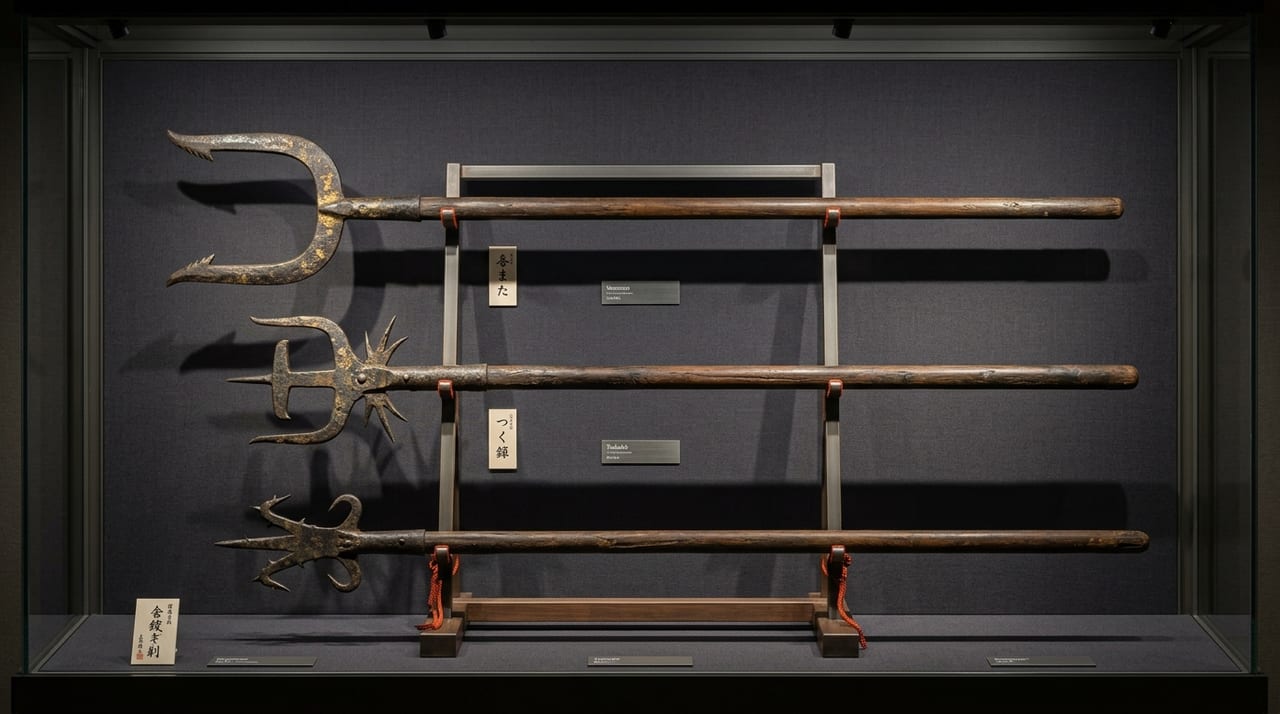
Sasumata
A long-handled restraining tool with a Y-shaped tip. It is used to hook the waist or shoulder of a fleeing criminal to restrict their movement. In modern Japan it continues to be used as a security implement by police and schools.
Tsukubō
A staff with iron hooks and barbs at the tip. Used to catch on an opponent's clothing or body to immobilize them.
Modern Appraisal and Collection of Jitte and Tessen
Value as Antiques
Tessen and jitte hold their own distinct value in the antique market.
- Tessen value factors: Material of the ribs (iron, silver, etc.), elaborateness of decoration, period (early or late Edo), presence or absence of a mei (maker's name).
- Jitte value factors: Material (iron, brass, silver, etc.), shape of the hook, condition of the fusa, presence or absence of a mei, historical background (whether it was officially issued by a prominent magistrate's office).
Frequently Asked Questions (FAQ) — Jitte, Tessen, and the Firearms and Swords Control Act
Does possessing a jitte violate the Firearms and Swords Control Act?
In principle, it does not. The "swords and other edged weapons" whose possession is regulated by the Firearms and Swords Control Act (Jūtōhō) refers to bladed weapons such as swords, spears, and naginata with a blade length of 15 cm or more, and swords with a blade length of 5.5 cm or more (Article 2, Paragraph 2, Act for Controlling the Possession of Firearms or Swords and Other Such Weapons (Jūtōhō) (e-Gov Legal Search)); a jitte, having no blade, does not fall under this category. Possession and storage as an antique or martial-arts implement is freely permitted. However, carrying one in public without legitimate reason may run afoul of Article 1, Item 2 of the Minor Offenses Act (the offense of carrying a dangerous weapon) or the nuisance prevention ordinances of individual prefectures.
Is it permissible to carry a tessen for self-defense?
Possession (keeping it at home, transporting it to a dojo, etc.) is not a problem, but carrying it daily for the purpose of self-defense is unlikely to be recognized as a legitimate reason and carries risk under the Minor Offenses Act. It is safest to limit transport to clearly defined purposes such as practice or exhibition, and to carry it in a dedicated bag or case.
Does the color of a jitte's fusa have meaning?
The color and presence of the fusa are said to have indicated the rank and affiliation of the bearer. The red fusa (shu-busa / aka-busa) of yoriki and dōshin is well known, but practice varied by period and magistrate's office, and many jitte had no fusa at all, being purely functional.
What is the difference between jitte and sasumata?
Jitte is a short, one-handed subduing weapon for close combat, used to catch and entangle a sword and close in on the opponent. Sasumata is a restraining tool that pins the opponent down with its long-handled tip, immobilizing them while maintaining distance. In Edo-period arrest operations, they were used together as the "three tools" along with tsukubō and sode-garami (sleeve entangler).
Conclusion — What the "Periphery of the Sword" Tells Us About Japanese Weapon Culture
The culture of Japanese metal weapons developed at the periphery of the sword — jitte, tessen, sasumata, and others — was born of a social need: how to fight and subdue in situations where one does not or cannot carry a sword.
Jitte — a weapon for constables who could not carry swords, born of the Edo-period law-enforcement system — and tessen, which reconciled samurai etiquette with self-defense: though both arose at the margins of a weapon culture centered on the Japanese sword, each developed its own distinct technology, culture, and aesthetics. To truly understand the world of the sword, a view that extends to these non-sword weapons is indispensable.