New Arrivals — Browse our catalog for the latest authentic Japanese sword arrivals. Browse →
1350–1352 (Kannō 1–3)
Yamashiro (Kyoto), Settsu, and Kamakura (various theaters of war)
Forces
Ashikaga Takauji / Kō no Moronao's Forces (anti-Tadayoshi faction)
Ashikaga Tadayoshi's Forces
About 17 min read
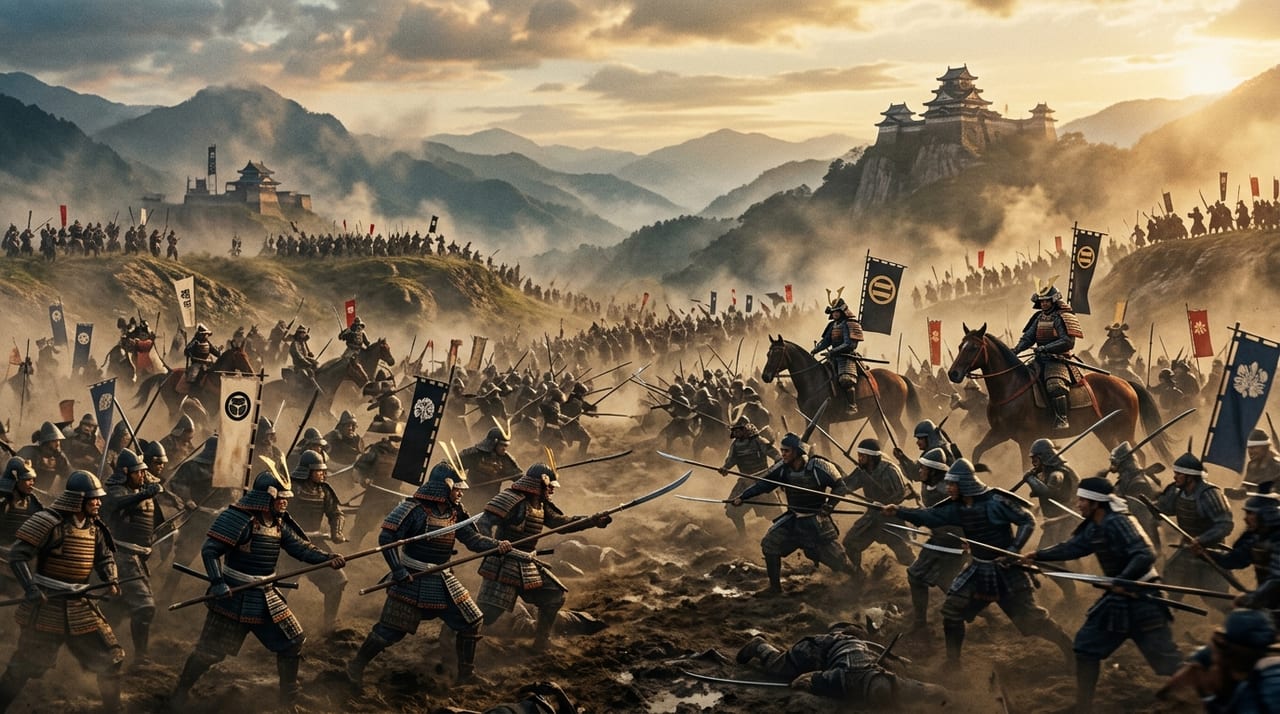
From Kannō 1 (1350) to Kannō 3 (1352), the Kannō Disturbance (Kannō no jōran) shook the newly founded Muromachi shogunate to its foundations, and it is considered one of the most complex civil wars in Japanese medieval history. The protagonists of this civil war were the brothers Ashikaga Takauji (1305–1358), who founded the Muromachi shogunate, and his younger brother Ashikaga Tadayoshi (1306–1352). The elder brother, distinguished in martial prowess, embodied the military authority of the shogunate as Seii Taishōgun, while the younger brother, skilled in governance, ran the shogunate's administration and justice. Why did two men who should have complemented each other come to a fratricidal struggle? Behind it lay the turbulent Nanboku-chō period and a serious contradiction in the power structure within the shogunate.
After the Kenmu Restoration (1333–1336) of Emperor Go-Daigo collapsed, Ashikaga Takauji founded the Muromachi shogunate in 1336. Amid the Nanboku-chō period, in which the Southern Court (on the side of Emperor Go-Daigo) and the Northern Court (on the side of Emperor Kōmyō) existed side by side, Takauji sought to establish the legitimacy of the shogunate by enthroning the Northern Court. During this period, the actual power of the shogunate was run by a dual leadership of Takauji and Tadayoshi. It was a division of labor in which Takauji held military authority and the position of Seii Taishōgun, while Tadayoshi handled the shogunate's administration and adjudication.
However, the figure who created a fissure in this system was Kō no Moronao (?–1351), who wielded enormous power as Takauji's shitsuji (steward of the Ashikaga house). Moronao was outstanding in practical administrative ability and enjoyed Takauji's absolute trust, but he came into fierce conflict with Tadayoshi over both policy and the foundations of power. Moronao's clan pursued practical gains from control of land, and this was fundamentally incompatible with the courtier-like and legalistic order that Tadayoshi sought to maintain.
The Nanboku-chō period (1336–1392), in which the Kannō Disturbance occurred, is an important turning point in the history of the Japanese sword. In this period, large swords called ōdachi (nodachi), which had developed in the late Kamakura period, were used widely on the battlefield. As the Nanboku-chō wars became prolonged across the entire country and warriors thoroughly pursued the usefulness of swords in actual combat, the shape of swords changed dramatically.
Swords of the Nanboku-chō period had evolved into forms better suited to actual combat, unlike the elegant curves of the Kamakura period. Ōdachi with a blade length (hachō) exceeding 90 centimeters appeared, and they were swung two-handed on foot, responding to a tactic of striking down mounted enemies from the ground. This change corresponded to the battlefield realities produced by the Nanboku-chō turmoil: long-term siege warfare and infantry-centered group combat. The transition from an age of one-on-one duels among mounted warriors to an age in which foot warriors (kachi-musha) fought in organized groups changed the very way swords were used.
The warriors who took part in the Kannō Disturbance also wore swords of this era. In particular, the ōdachi forged by Osafune Kanemitsu of the Bizen Osafune school, a master smith representative of the Nanboku-chō period, were prized by the warriors of the time. Kanemitsu's swords are known as "Osafune Kanemitsu," and many famous blades from later generations survive as masterpieces combining practicality and beauty. Swords in the lineage of Yukimitsu and Sadamune, smiths of the Sōshū tradition (Sagami Province, present-day Kanagawa Prefecture), were also valued by the warriors of this period. Sōshū-den swords, with their turbulent nie and richly varied hamon, carried a force that seemed to embody the spirit of the chaotic Nanboku-chō age.
The confrontation between Kō no Moronao and Ashikaga Tadayoshi went beyond a simple power struggle and reflected a fundamental difference in political thought. Moronao was a pragmatic, realist politician who valued the actual rule of military force over the authority of the emperor and the courtiers. Tadayoshi, on the other hand, while running a warrior government, valued courtier-like order and etiquette and sought to maintain a system in which the shogunate respected the authority of the imperial court. The clash between Moronao's idea that "only military force governs the world" and Tadayoshi's idea that "a warrior government also gains legitimacy through ritual and order" highlights an essential tension in Japanese warrior culture. Whether those who wear swords protect social order through etiquette, or whether the power of the sword itself becomes the source of order, is also a fundamental question of bushidō.
In the intercalary 6th month of Jōwa 5 (1349), Tadayoshi pressed Takauji and removed Moronao from the post of shitsuji. In the 8th month of the same year, however, Moronao led troops to surround Takauji's residence (gosho-maki, surrounding the shogun's residence) and forced Tadayoshi out of governance. Tadayoshi took the tonsure in the 12th month of the same year, and in the 10th month of Kannō 1 (1350) he left Kyoto and called for the destruction of Moronao. Daimyō and warriors across the country were forced to choose whether to side with Takauji and Moronao or with Tadayoshi, and the conflict developed into a nationwide upheaval.
What broke through the crisis was Tadayoshi's unorthodox strategy of submitting to the Southern Court. Tadayoshi surrendered to the Southern Court (under Emperor Go-Murakami) and, relying on the Southern Court's authority, drew influential Northern Court commanders into his own camp. As the rivalry between the Northern and Southern Courts became intricately entangled with the power struggle within the shogunate, Takauji and Moronao's side, cornered, had no choice but to compromise. In the 2nd month of Kannō 2 (1351), Moronao and his brother Moroyasu were executed by Uesugi Yoshinori of Tadayoshi's side while under escort on the banks of the Muko River in Settsu Province.
After Moronao's death, Takauji and Tadayoshi temporarily reconciled, but their relationship was never fully repaired. Tadayoshi went down to Kamakura, gained the support of the Kantō warrior bands, and again showed a stance of opposing the shogunate. Takauji went down the Tōkaidō to pursue Tadayoshi and defeated his forces at the Battle of Satta Pass in Suruga Province (present-day Shizuoka Prefecture). On the 26th day of the 2nd month of Kannō 3 (1352), Tadayoshi died suddenly at Enpuku-ji within the precincts of Jōmyō-ji in Kamakura. There is also a theory that Takauji poisoned him. The feud between the brothers came to an end with the younger brother's death.
The most important influence the Kannō Disturbance had on the history of the Japanese sword was the sharp rise in demand for swords during the turbulent Nanboku-chō period, and their "popularization" among the common people. As the nationwide civil war grew prolonged, demand for swords as weapons surged. Smiths of each production region, including Bizen Osafune, Yamato, Sōshū, and Mino, forged large quantities of swords, and not only the upper warrior class but also jizamurai (local samurai) and farmers came to arm themselves. Swords of this era have two aspects: they are both pure works of art and mass-produced weapons for actual combat.
The Kannō Disturbance was also a test of the fundamental precept of bushidō: loyalty to one's lord. Each warrior had to judge whether the side of Moronao or the side of Tadayoshi was legitimate, and was forced to choose, staking his life on it. Some warriors changed sides midway, and the conflict between loyalty and the instinct for survival is vividly recorded. The weight of "choosing one's lord" equals the weight of the sword one wears, and it was the essential question of living as a warrior.
Even after the Kannō Disturbance, Takauji remained in office as shogun, but the authority of the shogunate was greatly damaged. The turmoil of the Nanboku-chō period continued until the unification of the Northern and Southern Courts in Meitoku 3 (1392), and during this time sword culture took a major turn toward mass production and practical use. The weakening of the shogunate that led to the Ōnin War (1467) can be traced in part to the Kannō Disturbance. The historical hypothesis of the "other lost possibility" of the Muromachi shogunate, namely what kind of shogunate it would have been had Tadayoshi lived, shows how deeply the Kannō Disturbance affected the course of medieval Japan.
A distinctive cultural phenomenon born in the turbulent age of the Kannō Disturbance is the warrior aesthetic called basara. Basara refers to the warrior culture of the early Muromachi period, in which people disregarded traditional etiquette and rank and asserted themselves through extravagant, eccentric dress and conduct. Its foremost representative was Sasaki Dōyo (1296–1373).
Dōyo maneuvered skillfully between the side of Moronao and the side of Tadayoshi during the Kannō Disturbance and ultimately survived.
The authority vacuum created by the Kannō Disturbance paradoxically brought about a liberation of warrior culture. In an age when it was unclear who was legitimate, warriors sought to assert their identity through their swords, armor, and attire.
Ashikaga Takauji
First Ashikaga shogun, who fought his own brother Tadayoshi in the Kannō Disturbance
Kusunoki Masashige
Southern Court hero Kusunoki Masashige, whose loyalty contrasts sharply with the fratricidal Kannō Disturbance
Nitta Yoshisada
Southern Court general Nitta Yoshisada, whose loyalty to the Southern Court contrasts with the internecine Kannō strife
Sasaki Dōyo
Sasaki Dōyo — the flamboyant basara daimyo who navigated the Kannō Disturbance with characteristic opportunism
Imagawa Ryōshun
Imagawa Ryōshun — warrior who continued to support the Ashikaga shogunate through and after the Kannō Disturbance
Nanbokuchō
The Nanbokuchō period; the Kannō Disturbance represents its most labyrinthine internal conflict
Early to Mid Muromachi
Early-to-mid Muromachi era; the Kannō Disturbance exposed the fragility of the shogunate's power base at its founding
The Kenmu Restoration and Swords
Kenmu Restoration sword culture; the Kannō Disturbance continued the turbulent sword-culture era begun by the restoration