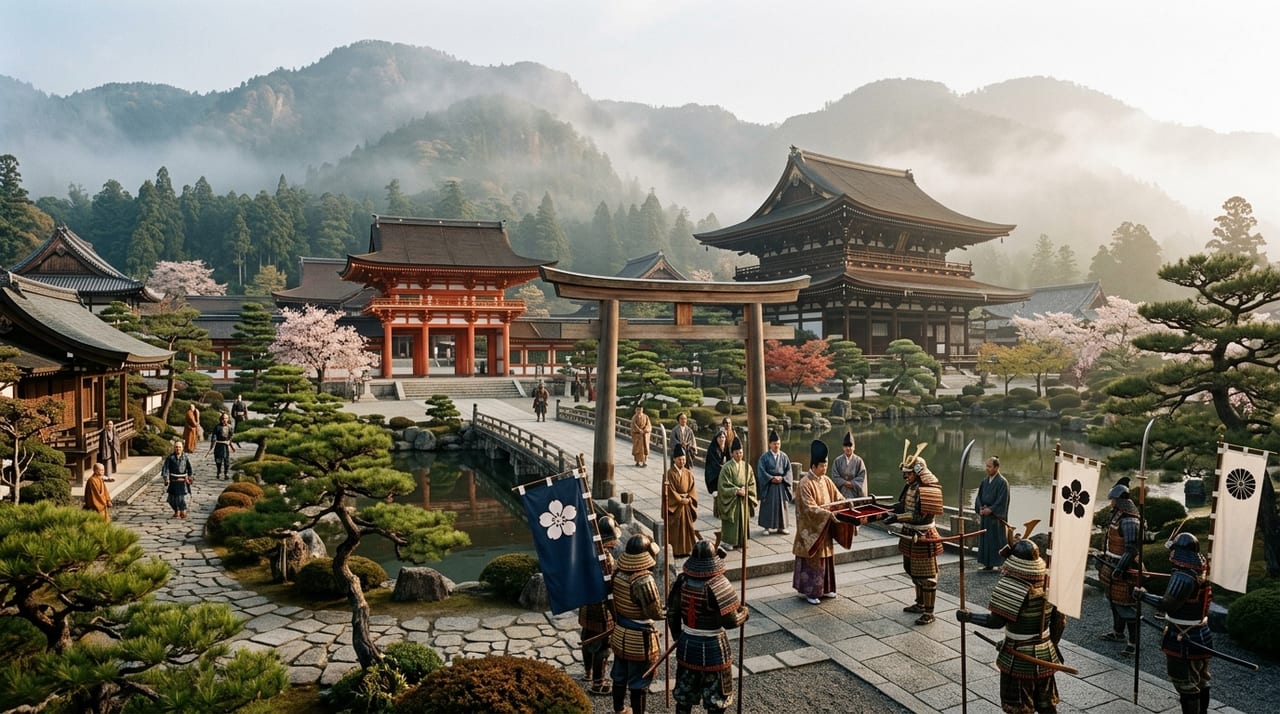
 * Image is for illustrative purposes only.
The Kenmu Restoration and Swords
建武の新政と刀剣
The Kenmu Restoration (1333–1336) of Emperor Go-Daigo was a short-lived regime of direct imperial rule, established after the fall of the Kamakura shogunate. In the history of swords, it marks a transitional period from the tachi form of the late Kamakura era to the ō-tachi and nodachi of the Nanboku-chō period. The Bizen Osafune smith Kanemitsu left tachi bearing inscriptions dated to the Genkō and Kenmu eras.
Description
Fall of the Kamakura Shogunate and Establishment of the New Government
In 1333 (Shōkyō 2 / Genkō 3), the Kamakura shogunate fell as a result of Emperor Go-Daigo's movement to overthrow it and the defection of Ashikaga Takauji, Nitta Yoshisada, and others. Emperor Go-Daigo proclaimed the "Kenmu no Shinsei" and aimed to revive direct imperial rule based on the ritsuryō system. This regime sought to concentrate power under the emperor, but in reality it was beset by a contradiction: it had no choice but to rely on the military strength of the warriors.
The Flourishing of Bizen and Sōshū Swordsmiths
The Kenmu period (1333–1336) immediately preceded the Nanboku-chō period (1336–1392), a transitional era in which swords were shifting toward greater size and bolder, more imposing forms. In the Osafune school of Bizen, Kanemitsu left behind tachi bearing the dates Genkō 3, Kenmu 2, and Kenmu 3, while in Sōshū, the leading disciples of Masamune produced masterpieces of rustic vigor that carried on their master's techniques. Hasebe Kunishige, counted among Masamune's Ten Great Disciples (Masamune Juttetsu) and a smith of Yamashiro, was active in the somewhat later Nanboku-chō period and is regarded as the founder of the Hasebe school.
The End of a Short-Lived Regime and the Fate of Swords
In 1335 (Kenmu 2), Ashikaga Takauji broke away from the new government and came into conflict with Emperor Go-Daigo. In 1336 (Kenmu 3), the new government collapsed and the rivalry between the Northern and Southern Courts began. Emperor Go-Daigo fled to Yoshino with the Three Sacred Treasures and established the Southern Court. A tachi by Kanemitsu bearing this year's date, known as "Imamura Kanemitsu" (inscription: Bizen no kuni Osafune Kanemitsu Kenmu sannen hinoe-ne jūnigatsu-hi), is preserved as an Important Cultural Property at the Kōchi Castle Museum of History.
Significance in the History of Swords
Although the Kenmu no Shinsei was an extremely short-lived regime that collapsed after roughly two and a half years, it holds an important place in the history of swords in two respects. First, it was a period in which transitional works, bridging the late Kamakura style and the enlargement of the Nanboku-chō period, were concentrated. Second, the Nanboku-chō turmoil triggered by the collapse of this short-lived regime brought about what was the most magnificent Era of Ōdachi and Nodachi in the history of Japanese swords. Paradoxically, the failure of the Kenmu no Shinsei prepared the ground for one of the peak periods in the sculptural development of the Japanese sword.
Characteristics of This Era
- A transitional period toward larger blades: the shift began from the well-balanced tachi of the late Kamakura period to the ō-tachi and nodachi of the Nanboku-chō period. Blade width increased and the back thickness (kasane) grew, and the first signs of the development toward large, turbulent hamon (ō-midare) can be seen.
- Movement toward Sōden Bizen: Osafune Kanemitsu left tachi in the late Kamakura form, dated to the Genkō and Kenmu eras, and later moved to a style of large ō-notare and gunome-midare influenced by the Sōshū tradition.