New Arrivals — Browse our catalog for the latest authentic Japanese sword arrivals. Browse →
February 4, 1348 (Shōhei 3 / Jōwa 4, 1st month, 5th day)
Nozaki to Kitajō, Sarara District, Kawachi Province (present-day Daitō and Shijōnawate, Osaka Prefecture)
Forces
Southern Court (Kusunoki forces)
Muromachi shogunate forces (Northern Court)
About 9 min read
By 1348 (Shōhei 3 / Jōwa 4), Kusunoki Masatsura, serving the Southern Court's Emperor Go-Murakami, had taken up his late father Masashige's cause and continued resistance against the Muromachi shogunate from a base in Kawachi Province. More than a decade had passed since Masashige's death in battle at Minatogawa in 1336, and Masatsura had grown into the head of the Kusunoki house. From 1347 he raised troops repeatedly in Kii and Kawachi, defeating shogunate forces at places such as Fujiidera and Sumiyoshi and building considerable momentum. News of his victories that November over the Suda and Takayasu forces, and over an army led by Hosokawa Akiuji and Yamana Tokiuji, reached Kyoto and alarmed the brothers Ashikaga Takauji and Tadayoshi, who directed shogunate policy, as well as Takauji's steward Kō no Moronao.
In response, the shogunate resolved to strike directly at Yoshino, the Southern Court's seat, and dispatched a large army into Kawachi under Moronao's overall command. Sources differ on exact numbers, but the Daigo Jizō-in Diary puts Moronao's first army at roughly 10,000 mounted men; he established headquarters at Nozaki in Sarara District and stationed a detachment on nearby Mount Iimori to guard the eastern flank. His brother Kō no Moroyasu led a second army toward Sakai in Izumi Province, positioning it to catch the Southern Court forces in a pincer. Masatsura's own strength is given in the Taiheiki as 3,000-odd horsemen, though this is widely regarded as exaggeration, and the real figure was likely smaller.
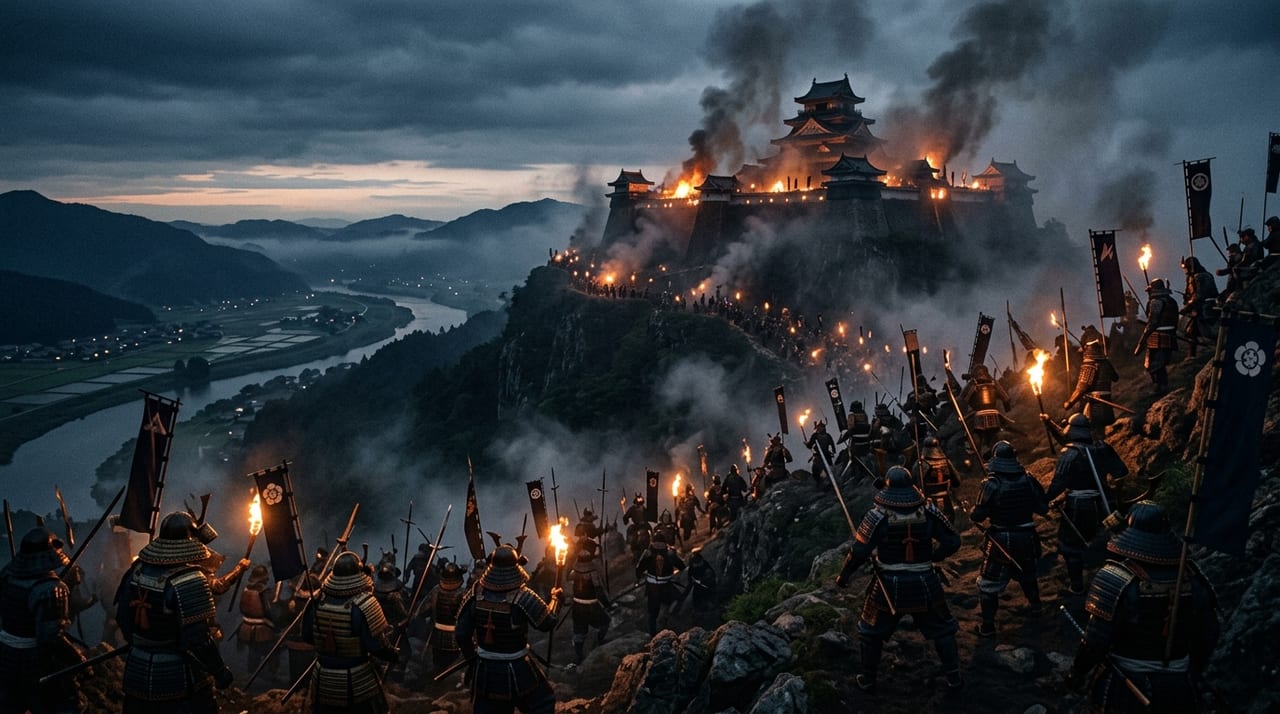
On the 5th day of the 1st month of Shōhei 3 (February 4, 1348), Masatsura and his younger brother Masatoki chose to force a decisive engagement despite being heavily outnumbered. The ground around Nozaki, where the two armies faced off, was narrow marshland hemmed in on the west by the Fukono Pond, and the Kusunoki forces are said to have used this terrain to launch a surprise strike at Moronao's headquarters. The opening phase favored the Southern Court army, which is said to have cut its way close to Moronao's own position, but the tide turned when the shogunate detachment on Mount Iimori sortied in support and struck from the flank. Caught in this pincer, Masatsura's force was pushed back from Nozaki toward Kitajō, steadily losing men as the encirclement tightened.
Masatsura fought on but was gravely wounded, and, judging the battle lost, is said to have taken his own life with his brother Masatoki. His severed head, taken at Kitajō, was exposed the next day at the Rokujō riverbed in Kyoto. Records state the Southern Court side lost 27 men of the Kusunoki house and its senior retainers, plus several hundred rank and file, while shogunate losses were limited to a handful of men such as Ueyama Takamoto and Hosokawa Yoriyuki. By any measure it was an overwhelming shogunate victory.
The catastrophic defeat at Shijōnawate effectively collapsed the Southern Court's defensive line in Kawachi. With Masatsura, its foremost young commander, dead, the Southern Court lost the core around which organized resistance had been built, and shogunate forces advanced into Yamato almost unopposed. By the end of the 1st month of Shōhei 3, Yoshino itself, the Southern Court's seat, fell to shogunate attack, forcing Emperor Go-Murakami to flee to the temporary palace at Anō (present-day Gojō, Nara Prefecture).
The Kusunoki house, which since Masashige's day had formed the military core of Southern Court power in Kawachi and Izumi, suffered a double blow in the deaths of Masatsura and Masatoki and the loss of Yoshino, and Southern Court fortunes declined sharply from this point. The defeat at Shijōnawate was not merely a local engagement; it is also regarded as one of the turning points that secured Northern Court ascendancy heading into the internal shogunate power struggle — the Kan'nō Disturbance — that would break into the open the following year.
Before marching out, Masatsura is said to have carved a death poem into a wall panel of the Nyoirin-dō at Yoshino: "Knowing I shall not return, I leave my name among the fallen, like an arrow shot from a catalpa bow." This episode, alongside the famous parting at Sakurai — where Masashige counseled his son before marching to Minatogawa — became one of the most widely retold stories of Kusunoki filial loyalty. Reverence for the Kusunoki house intensified amid Meiji-era arguments for Southern Court legitimacy; Shijōnawate Shrine, enshrining Masatsura, was founded at Kitajō in 1890. Masatsura's grave and monuments marking the battlefield still stand across present-day Daitō and Shijōnawate, Osaka, and the place name Shijōnawate derives from this battle.