New Arrivals — Browse our catalog for the latest authentic Japanese sword arrivals. Browse →
August 29, 1359 (Shōhei 14 / Enbun 4, 8th month, 6th day)
Ōbaru, Mihara District, Chikugo Province (present-day Ogōri and Kurume, Fukuoka Prefecture)
Forces
Seiseifu forces (Southern Court)
Shōni forces (Northern Court)
About 8 min read
Amid the Nanboku-chō turmoil, Kyushu became home to a Southern Court power base — the Seiseifu, or Pacification Government of the West — built around Prince Kanenaga, a son of Emperor Go-Daigo, with the backing of the powerful Kikuchi clan of Higo. Kikuchi Takemitsu served for years as the Seiseifu's de facto military leader, fighting repeated engagements against Northern Court and shogunate forces across Kyushu. Opposing him was the Shōni clan, based at Dazaifu and dominant across northern Kyushu. Shōni Yorihisa, who had once sheltered Ashikaga Takauji during his flight through Kyushu, was a formidable Northern Court figure in his own right, but he found himself increasingly pressed as Seiseifu power expanded.
In 1359 (Shōhei 14 / Enbun 4), the Southern Court, led by Prince Kanenaga and Kikuchi Takemitsu, advanced from Higo into Chikugo and committed to a full confrontation with the forces of Shōni Yorihisa and his son Naosuke. Both sides mobilized armies of extraordinary size for the pre-Sengoku era: the Southern Court (Seiseifu) force is put at roughly 40,000, while the Northern Court (Shōni) side, reinforced by neighboring warrior houses such as Ōtomo Ujitoki and Kii Fuyutsuna, is said to have reached roughly 60,000. With nearly 100,000 men converging on the Chikugo River basin, this became the largest engagement of the Nanboku-chō era in Kyushu.
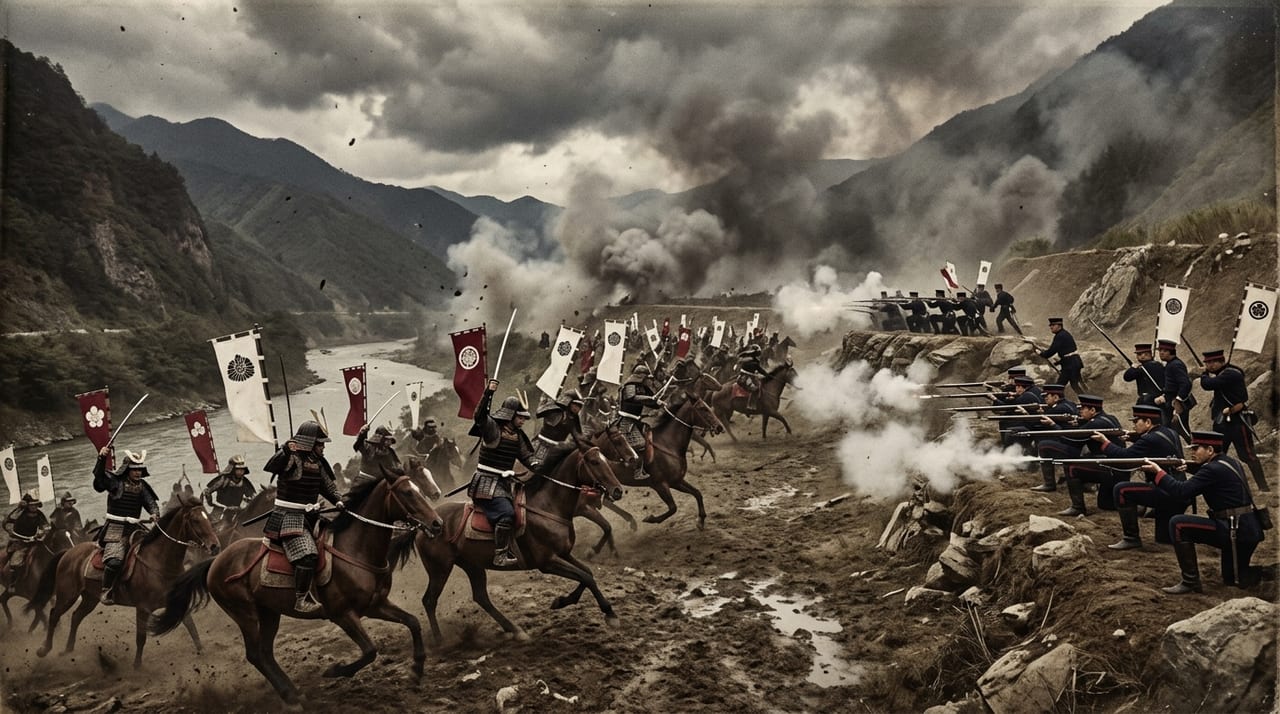
Kikuchi Takemitsu's Seiseifu army first took up position south of the Chikugo River, then crossed on the 19th of the 7th month to attack Shōni Yorihisa's force, which was encamped at Ajisaka-shō on the north bank. Unable to hold, Yorihisa withdrew and established a new position in the marshland of Ōbaru, near present-day Ogōri in Fukuoka Prefecture, preparing to meet the Southern Court army there. After a period of standoff, in the predawn hours of the 6th of the 8th month (August 29 by the Western calendar), a Seiseifu detachment under Kikuchi Takemasa launched a preemptive night raid, and the engagement escalated into a full-scale melee between the two main armies.
The fighting became a grinding, overnight battle of attrition that continued into the following day, and both sides suffered enormous losses. On the Northern Court side, Yorihisa's son Naosuke was killed — a severe blow — while on the Southern Court side, Prince Kanenaga himself was wounded, and Kikuchi Takemitsu, the army's effective commander, is likewise said to have suffered serious injury. In the end, however, the Seiseifu forces held the field and the Shōni army broke and fled. Combined casualties are estimated in the thousands, with one figure putting the dead at over 5,400; local tradition holds that the toll from this single battle exceeded that of the Mongol invasions of Bun'ei and Kōan combined.
Victory at Chikugogawa (Ōbaru) secured the Seiseifu's dominance across northern Kyushu. From the following year, 1360, Kikuchi Takemitsu continued to expand Southern Court power, and by 1361 he had seized Dazaifu itself and relocated the Seiseifu's headquarters there. For more than a decade afterward, Kyushu became the region where the Southern Court held its most stable and effective rule anywhere in Japan — a distinction noted even in the context of the wider, nationwide Nanboku-chō conflict.
The defeated Shōni clan, by contrast, went into rapid decline after this battle and lost its grip on the area around Dazaifu. In deciding the balance of power between the Northern and Southern Courts in Kyushu, the Battle of Chikugogawa carries historical weight well beyond that of a purely local engagement.
Given the scale of the forces involved, the intensity of the fighting, and its lasting historical impact, the Battle of Chikugogawa (Ōbaru) has often been ranked alongside the Battle of Sekigahara and the Battle of Kawanakajima as one of "Japan's three great battles." This designation took hold in later centuries and is not a matter of rigorous scholarly classification, but the extraordinary scale of mobilization for a Nanboku-chō-era engagement is well supported by the surviving sources. The area around present-day Ogōri and Kurume in Fukuoka Prefecture still preserves sites associated with Kikuchi Takemitsu and this battle, including the place name Tachiarai ("sword-washing"), traditionally said to mark where Takemitsu washed the blood from his sword after the fighting — a name that continues to evoke the ferocity of the engagement to this day.