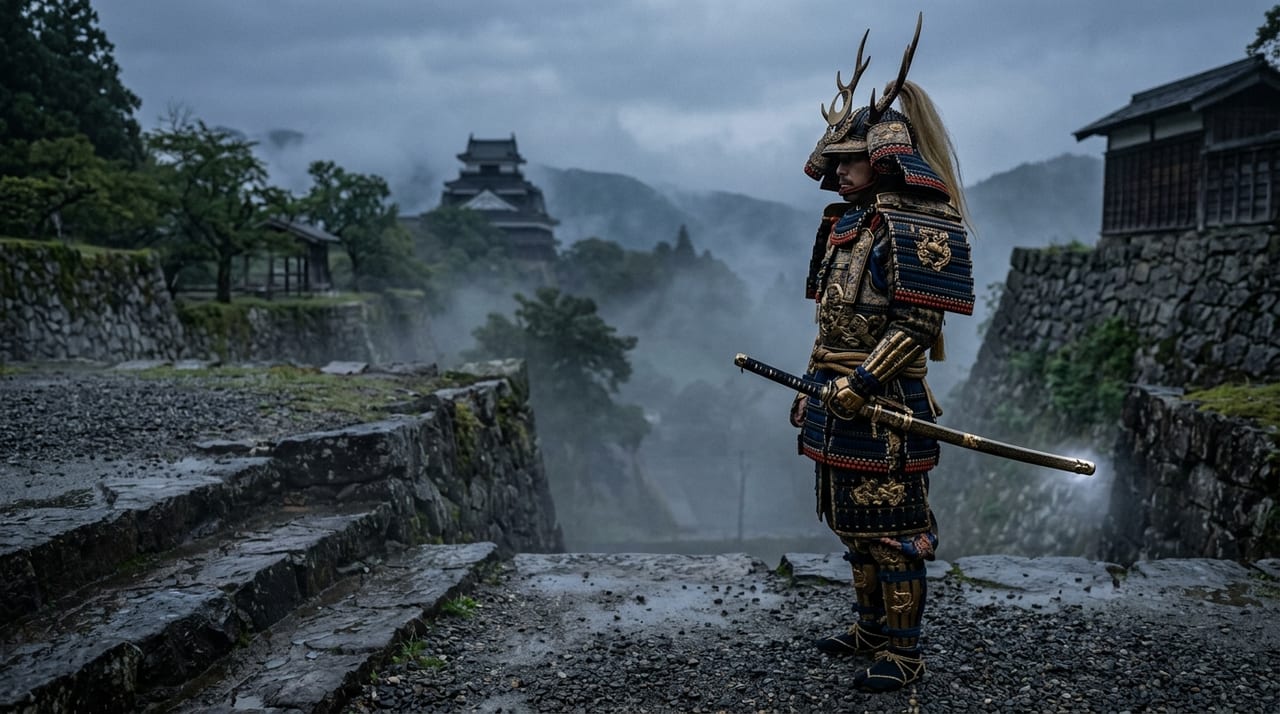
 * Image is for illustrative purposes only.
Sasaki Dōyo
佐々木道誉
The Basara Lord — who laughed at convention, reveled in excess, and pioneered the culture of medieval Japan
Description
What Is Basara?
Sasaki Dōyo (real name: Sasaki Takauji) is a daimyō of Ōmi said to have been born around Einin 4 (1296). “Basara” was a mode of behavior that spread during the Nanboku-chō period. It meant deliberately disregarding established authority, etiquette, and order, and expressing oneself through lavish clothing, eccentric conduct, and an indulgence in excessive beauty. As an embodiment of this basara, Dōyo was called a “basara daimyō” by the people of his time. Modern researchers assess that his behavior was not mere dissolute conduct but a deliberate challenge that relativized the authority of both the traditional court-noble culture and the warrior culture, and sought to create new aesthetic values.
Service to Ashikaga Takauji and Political Activity
Dōyo played an important military and political role in the Nanboku-chō turmoil as a leading supporter of Ashikaga Takauji. In the turbulent period from Takauji’s overthrow of the Kamakura shogunate through the collapse of the Kenmu regime to the establishment of the Muromachi shogunate, Dōyo consistently supported the three Ashikaga shoguns: Takauji, Yoshiakira, and Yoshimitsu. His political stance sometimes shows complex movements, but basically, as a leading supporter of the Muromachi shogunate, he maintained his control over Ōmi and his power. Militarily, he took part in the campaigns to topple the bakufu and demonstrated his martial prowess.
Passion for Swords and “Tōcha”
In swords, the tachi known as the “Dōyo Ichimonji,” named after Dōyo’s ownership of it, from the Fukuoka Ichimonji school of Bizen is well known. It was presented to the Imperial Household in Shōwa 3 (1928) and is now part of the Gyobutsu (Imperial Household collection). Dōyo was also fond of “tōcha” (a game of identifying the place of origin of tea) and was involved in the development of tea culture. The way of life of Dōyo, who loved swords and tea with the same passion, became a precedent for the integration of martial and literary arts in later Muromachi culture.
Patron of Renga and Nō
As a patron of renga, Dōyo interacted with the leading literati of his day, including Nijō Yoshimoto. He helped the Tsukuba-shū be recognized as a quasi-imperial anthology, and 81 of his own verses are included in it. He is also known as a patron of sarugaku (the precursor of Nō), and an exchange with Kan’ami, father of Zeami, is also recorded. The cultural salon Dōyo created became a prototype of Muromachi culture, in which the culture of the warrior and court families fused, and it served as a bridge to the Kitayama culture under Yoshimitsu and the Higashiyama culture under Yoshimasa.
As a Creator of Nanboku-chō Culture
Dōyo’s historical significance lies in opening new directions in Japanese culture during the chaotic Nanboku-chō period. While mocking traditional authority, he set new standards of beauty in each field, including tea, renga, sarugaku, and rikka (flower arrangement), and these had a decisive influence on the formation of Muromachi culture. The very way of life of basara became a prototype of the aesthetics of breaking with convention in Japanese culture, and set an example for later cultural revolutionaries. Dōyo’s spirit of laughing it off established the beauty of deviation as an important pillar within Japanese aesthetic sensibility.
Notable Swords
- Dōyo Ichimonji (a tachi of the Fukuoka Ichimonji school of Bizen, named after Sasaki Dōyo’s ownership of it. Its signature is only the character “ichi” (one). It later passed to the Owari Tokugawa family and the Nanbu family, and in Shōwa 3 (1928) it was presented to the Imperial Household. It is now part of the Gyobutsu (Imperial Household collection).)