 * Image is for illustrative purposes only.
Early to Mid Muromachi
室町初期〜中期
A period of stability in which the turmoil of the Northern and Southern Courts subsided and Kitayama and Higashiyama culture flourished under the Muromachi shogunate. The style shifted from the grandeur of great tachi to a more gentle build, and the transition from tachi to uchigatana began. It was an important transitional age in which the refined, elegant style represented by Ōei Bizen emerged, and large-scale sword exports were also carried out through the Japan–Ming trade.
Description
Establishment of the Muromachi Shogunate
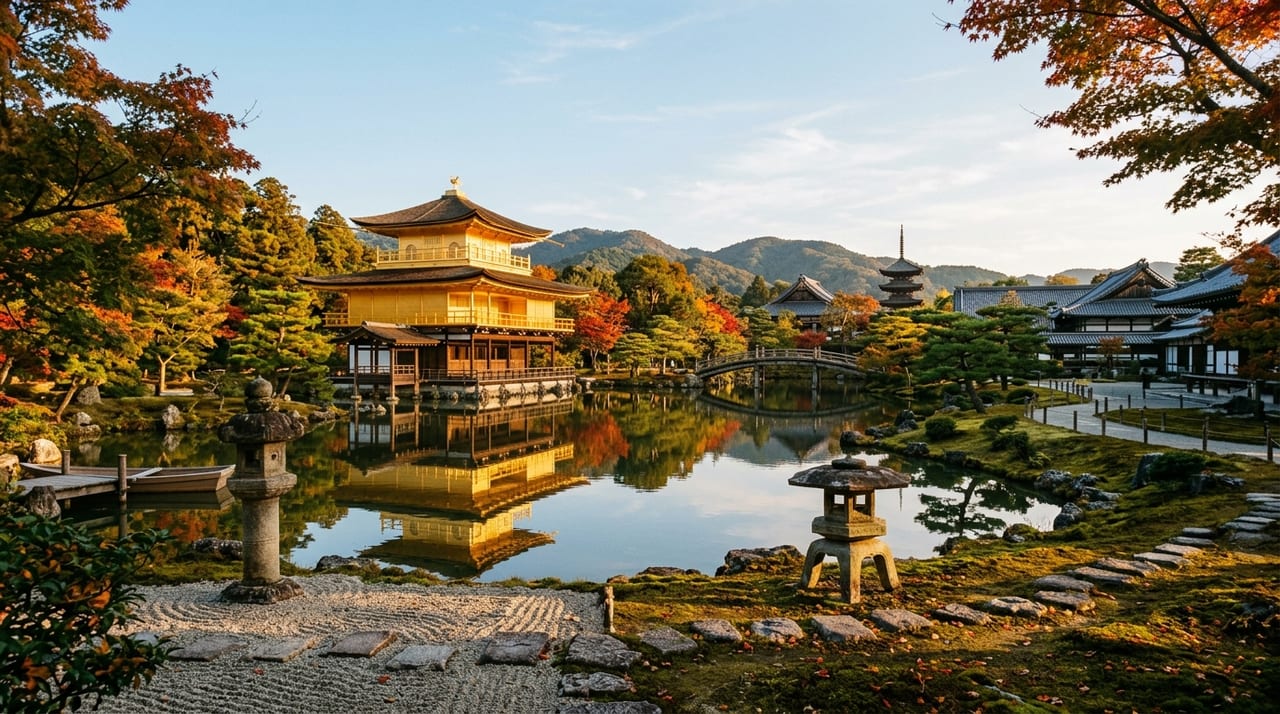
Following the unification of the Northern and Southern Courts in Meitoku 3 (1392), the third shogun Ashikaga Yoshimitsu built the height of the Muromachi shogunate. Yoshimitsu led the splendid Kitayama culture, typified by Kitayama-dono (Kinkaku-ji), and began the Japan–Ming trade (kangō trade, tally trade), deepening exchanges with the continent. In the following era of the eighth shogun, Ashikaga Yoshimasa, Higashiyama culture flowered, and many arts that form the foundation of Japanese culture matured, including Ginkaku-ji, shoin-zukuri architecture, the tea ceremony, ikebana, and noh theater. Under such a stable cultural environment, major changes also came to the world of swords.
Changes in Swords
With the end of the fierce wars of the Northern and Southern Courts period, practical demand for great tachi declined rapidly, and blade dimensions converged toward a gentler form. Blade length settled at roughly 2 shaku 3 sun to 4 sun (about 69–72 cm), with the width slightly narrower and the kasane (blade thickness) slightly thinner, and an elegant form with koshi-zori was favored. In this period, the shift from tachi (worn edge-down) to uchigatana (worn edge-up, thrust through the belt) gradually began, showing the beginnings of the era of uchigatana dominance that would be established in the later Sengoku period.
Diversification of Schools
In the Bizen tradition, during the Ōei era (1394–1428), Osafune Morimitsu, Yasumitsu, and others perfected the refined and elegant style known as “Ōei Bizen.” The characteristics of Ōei Bizen lie in its refined hamon, in which nioi-deki chōji-midare is fired on a beautiful jigane of dense ko-itame-hada. Turning away from the grandeur of the Northern and Southern Courts period, this style, which pursued dignity and delicacy, shows a high artistry as if returning to the masterpieces of Nagamitsu and Kagemitsu of the late Kamakura period. Morimitsu is especially known for many fine tantō, and works with delicate horimono (carved decoration) are also known. Yasumitsu, a master on a par with Morimitsu, left masterpieces in tachi and uchigatana, and the works of both are still highly regarded among kotō today. Osafune Iesuke also carried on the Ōei Bizen tradition, and works signed Iesuke show neat hamon.
Trends in Mino, Yamashiro, and Yamato
In the Mino tradition, this was a period when the smith groups of Seki rapidly gained strength. Seki was blessed with good clay and pine charcoal, and had geographical conditions suited to producing blades. Smiths including Kanetsune, Kanefusa, and Kanehiro forged many practical swords with good cutting ability, and the foundation was laid in this period for Seki's later renown across the country in the Sengoku period as “Seki blades.” In the Yamashiro tradition, Nobukuni II continued working in Kyoto, inheriting the style of the first generation, and the smiths of the Kanenaga lineage in the Yamato tradition also continued forging swords, centered on the temples and shrines of Nara.
The Japan–Ming Trade and Sword Exports
A notable event of this era was the large-scale export of Japanese swords carried out as part of the Japan–Ming trade. In the kangō trade (tally trade) begun by Ashikaga Yoshimitsu, Japanese swords became one of the main export goods, and it is said that several thousand to tens of thousands of swords were sent to Ming China on a single trading ship. Bizen Osafune was the main production center for these export swords, and with mass-production systems established, the organizational strength of Bizen smiths was further reinforced. In Ming China, the sharpness of Japanese swords was highly praised, to the point that they were even sung of in poetry.
Historical Significance
This era before the Ōnin War (1467) is characterized by a relatively calm and culturally mature style even within the late kotō period, and holds significance as a transitional period positioned between the grandeur of the Northern and Southern Courts and the practicality of sue-kotō. Refined works of Ōei Bizen survive in relatively large numbers as signed pieces, and because they belong to the more accessible category among kotō, they are valued by discerning collectors as an entry point into collecting kotō.
Characteristics of This Era
- A shift from the grand form of the Northern and Southern Courts to a gentler build. Blade length converged to 2 shaku 3–4 sun (approx. 69–72 cm), with the width slightly narrower and the kasane slightly thinner. The elegant form with koshi-zori reflects the cultural maturity of the stable Muromachi period
- The refined and elegant style represented by Ōei Bizen (Osafune Morimitsu and Yasumitsu) reached its peak. The refined hamon, in which nioi-deki chōji-midare is fired on a jigane of dense ko-itame-hada, shows a high artistry reminiscent of a return to the masterworks of the Kamakura period
- A transitional period in which the shift from tachi to uchigatana gradually began. In place of the tachi worn edge-down, the uchigatana worn edge-up began to spread among warriors, and seeds of the style that would be established in the later Sengoku period can be seen
- Through the Japan–Ming trade (kangō trade, tally trade), Japanese swords on the scale of several thousand to tens of thousands were exported to Ming China. Bizen Osafune became the main production center, and the establishment of mass-production systems further strengthened the organizational strength of Bizen smiths
- The development of koshigatana and the practical adoption of tantō advanced, and the Ōei Bizen smiths left refined works not only in tachi but also in tantō. Morimitsu's tantō include many highly artistic works with horimono
- The Seki smith groups of Mino grew rapidly in this period. Kanetsune, Kanefusa, and others mass-produced practical swords, and the foundation was formed in this period for Seki's renown across the country in the Sengoku period as “Seki blades”