The Sword Appraisal Boom of the Mid-Edo Period and the Hon'ami Family — The Reality of the Shōshinsho Monopoly Market and Appraisal Fee Income from Genroku Onward
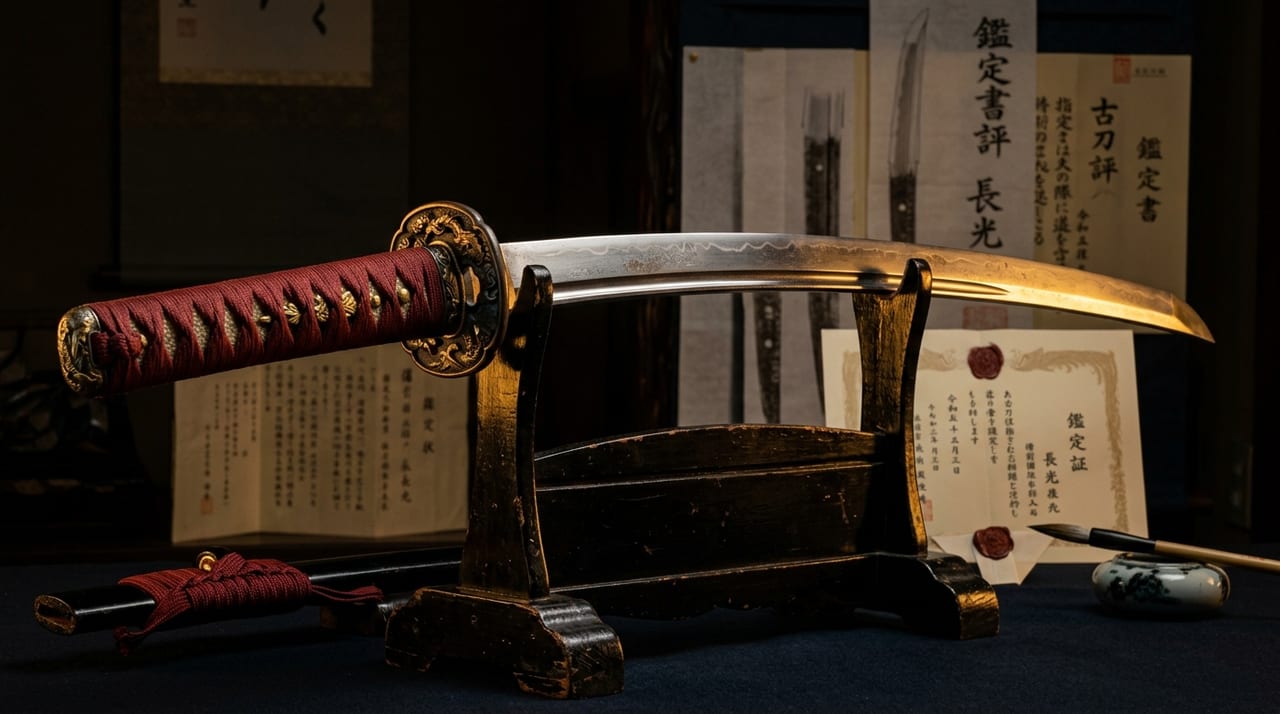 * Image is for illustrative purposes only.
Table of Contents
In the mid-Edo period, particularly from Genroku (1688–1704) to Hōreki (1751–1764), social demand for the appraisal of nihontō grew rapidly. The backdrop was the completion of the shift from military governance to civil governance, and the consequent change in the warrior class's view of swords — from practical tools to objects of aesthetic and cultural value. This article explores the reality of the sword appraisal boom that arose in the mid-Edo period, the dominant monopoly position held by the Hon'ami family, who stood at its center, and the economic structure of the shōshinsho issuance business.
The Genroku Culture and the Rise of Sword Appraisal
The Genroku era was a time in which both samurai and merchants enjoyed economic prosperity. In this period, known as the "Age of Tsunayoshi," it became common among samurai to regard swords not as "weapons for actual use" but as "works of art and cultural assets that displayed the prestige of one's family."
This shift in awareness fundamentally changed the criteria for evaluating swords. Rather than sharpness, what came to be valued were "who forged it (the authenticity of the mei)," "how old and rare it was (period and school)," and "the beauty of the hataraki."
As a result, demand surged for kanteisho (appraisal certificates) that certified the authenticity and value of swords.
Warrior houses had a custom of using swords as gifts, and the attachment of a prestigious kanteisho to a gifted sword served as a social "guarantee of quality." Not only were such swords essential as gifts presented to the shogunal house, but renowned swords accompanied by kanteisho were also indispensable as gifts in the social dealings and marriages of daimyo houses.
The Hon'ami Family's Appraisal Monopoly System
In the specialist field of sword appraisal, the Hon'ami family established a de facto monopoly on authority during the Edo period. The Hon'ami family's appraisal business began in the Muromachi period during the time of Ashikaga Yoshimitsu, and became institutionally established as the "official appraiser to the shogunal house" with the founding of the Edo shogunate.
The Hon'ami family was divided into multiple branch families, and renowned appraisers such as Kōchū, Kōho, and Kōjō carried on the appraisal business from generation to generation, centered on the main family proper (honke). In the Edo period, the Hon'ami family established a system for issuing two types of kanteisho: the shōshinsho and the origami.
| Kanteisho | Contents |
|---|---|
| Shōshinsho | A basic kanteisho certifying the authenticity of the tōkō |
| Origami | A special certificate of evaluation issued for higher-ranking swords. It recorded the assessed value (the so-called "valuation"), and carried sufficient influence in the Edo-period sword market to directly affect actual transaction prices |
Appraisal Fee Rates and the Scale of the Economy
How much were appraisal fees in the mid-Edo period? According to historical sources, fees for issuing a shōshinsho varied by the type, period, and assessed value of the sword, but the going rate was said to be from one bu in gold for a standard shōshinsho (several times the daily wage of a carpenter of the time) to over one ryō in gold for an origami.
For renowned swords by famous tōkō or swords of kokuhō (National Treasure) class, the origami issuance fee could reach several tens of ryō in gold. Taking into account the demand for sword appraisal in the Genroku and Kyōhō eras, it can be estimated that the Hon'ami family's total annual appraisal income reached a considerable scale.
In addition to appraisal fees, the Hon'ami family also provided a service involving polishing, known as togirei, and the sequence of sword polishing → appraisal → shōshinsho issuance functioned as a revenue stream.
The Problem of "Forged Documents" and Market Distortion
As the authority of the Hon'ami family grew, the problem of forged kanteisho inevitably arose. From the mid-Edo period onward, the circulation of forged kanteisho known as nise-origami became an industry-wide problem.
Forged documents were created through mainly two routes.
- Those that used blank paper and seals improperly obtained by peripheral associates of the Hon'ami family or by togishi (polishers) who frequented the family
- Those created by persons unconnected with the Hon'ami family who imitated the family's handwriting style and document format
In response to this problem, the Hon'ami family attempted to counter it by keeping their document format secret (using proprietary seals, handwriting styles, and paper stock), but the detection of forged documents proved extremely difficult. The shogunate also regarded the circulation of forged kanteisho as a problem, and records remain showing that enforcement was strengthened in the Kyōhō era (1716–1736).
The problem of forged documents highlighted the structural issue that the mid-Edo-period sword market had become over-reliant on the kanteisho of the Hon'ami family alone.
Internal Competition Among Branch Families and the Transformation of Authority
The Hon'ami family was by no means monolithic. Multiple branch families existed, and because each issued its own kanteisho, contradictions sometimes arose in which different evaluations were given by different branches for the same sword.
In the Hōreki era (1751–1764), competition among branch families intensified, and a debate arose within the industry over "which Hon'ami family's origami carried the most authority." This internal fragmentation ultimately relativized the authority of the Hon'ami family as a whole, and created fertile ground for other appraisers — disciples of the Hon'ami family and independent sword researchers — to rise to prominence.
Summary — From Monopoly to Pluralization
The sword appraisal boom of the mid-Edo period elevated the monopoly authority of the Hon'ami family to its peak while simultaneously exposing the fragility of that authority. The kanteisho system of shōshinsho and origami played an important role in standardizing the cultural asset value of nihontō, but the problem of forged documents and competition among branch families shook its credibility.
This history has given great lessons to the design of the review committee system carried out by the modern NBTHK (Society for the Preservation of Japanese Art Swords). Rather than dependence on a single authority, a collegial system involving multiple experts, transparent evaluation criteria, and technical countermeasures against forgery — all of these can be understood as answers to the problems experienced by the Hon'ami family in the Edo period. The history of sword appraisal is also a history of building and maintaining trust.