A Guide to Disposing of Unwanted Japanese Swords — Legal Obligations and Practical Steps Every Owner Should Know, from Police Surrender to Sale and Donation
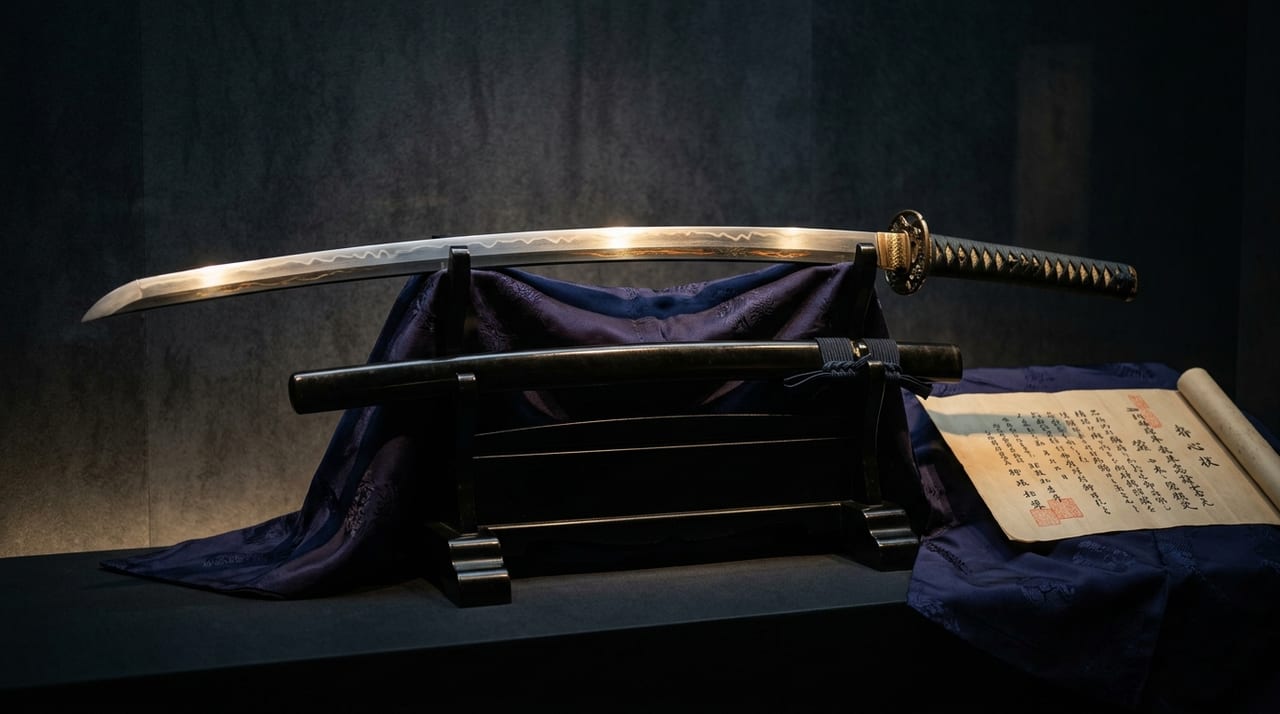 * Image is for illustrative purposes only.
Table of Contents
Anyone who owns a nihontō will eventually face a moment when they want to "let it go" or "get rid of it." Whether the reason is inheriting a relative's belongings but being unable to manage them, wanting to sort through a collection, or finding storage difficult in old age — the reasons vary, but it is absolutely prohibited by law to dispose of swords and bladed weapons with ordinary household rubbish. If the proper disposal procedures prescribed by the Act for Controlling the Possession of Firearms or Swords and Other Such Weapons (hereafter "Jūtōhō") are not followed, the act of disposal itself can constitute a criminal offense. This article explains the specific steps and points to bear in mind when safely and lawfully disposing of unwanted swords.
Checking for a Registration Certificate Before Disposal
The first thing to check is whether the sword one wishes to dispose of has an accompanying "Firearms and Swords Registration Certificate" (registration certificate). The registration certificate is an official document issued by the prefectural Board of Education and serves as the certificate required to legally possess a sword.
The procedures differ significantly depending on whether a registration certificate is present or not.
- Swords with a registration certificate: These are lawfully possessed items, and any disposal method may be chosen — sale, transfer, donation, or surrender for disposal.
- Swords without a registration certificate: These may be unregistered. Swords and bladed weapons that have not been registered cannot in principle be possessed (Act for Controlling the Possession of Firearms or Swords and Other Such Weapons (e-Gov Law Search), Article 3, Paragraph 1), so they must be reported to the police without delay (ibid., Article 23). If a registered sword has simply had its registration certificate lost, one should report this to the prefectural Board of Education that issued the registration and apply for a reissue (ibid., Article 15, Paragraph 2).
Note: if a sword has just been inherited as part of a deceased person's belongings and the registration certificate cannot be found, the first step is to inquire with the prefectural Board of Education that registered the sword to confirm whether the registration still exists. If the registration can be confirmed, one should report to that Board of Education and apply for a reissue of the registration certificate (Jūtōhō, Article 15, Paragraph 2). Swords whose registration status is unknown or cannot be confirmed are not eligible for reissue, so one should promptly report the discovery to the local police station to receive a "Report of Discovery Certificate" (ibid., Article 23), and then apply for registration with the prefectural Board of Education of one's place of residence and undergo a registration examination (Tokyo Metropolitan Board of Education, "Procedures for Reissuing a Registration Certificate" · "When You Have Discovered Firearms or Swords"). There is no "within two weeks" reporting deadline under the Jūtōhō, but it is important to act promptly after discovery.
Police Reporting Procedures
If one is in possession of a sword without a registration certificate, or wishes to notify the police of the sword's existence regardless of whether a registration certificate is present, a report should be made to the nearest police station (the reporting destination when a sword has been discovered or found is the nearest police station — Jūtōhō, Article 23).
An officer will examine the sword and record whether a registration certificate is present and the type of sword. For swords without a registration certificate and whose registration cannot be confirmed, a "Report of Discovery Certificate" is issued at the police station; the sword is then submitted together with this certificate for a registration examination by the prefectural Board of Education. If the examination by the registration committee finds the sword meets the criteria for registration, a registration certificate is issued; if it does not, a "Notice of Ineligibility for Registration" is issued (Tokyo Metropolitan Board of Education, "When You Have Discovered Firearms or Swords"). This report is not merely a means of avoiding criminal liability; it is also the first step toward enabling proper subsequent disposal.
Specific Methods of Disposal
There are four main methods of disposing of unwanted swords.
- Surrender to a Police Station (Disposal): According to guidance from the Kumamoto Prefectural Board of Education, the first step is to contact the nearest police station to report the intention to surrender the sword for disposal; the sword and registration certificate are then brought to the police station for the procedure. The registration certificate is returned to the prefectural Board of Education through the police ([Kumamoto Prefecture, "[Firearms and Swords] Registration Procedures"](https://www.pref.kumamoto.jp/soshiki/125/193618.html)). The specific details of the procedure should be confirmed using the guidance of one's own prefecture. The sword's value is lost. When transporting it, the registration certificate must be carried (Act for Controlling the Possession of Firearms or Swords and Other Such Weapons (e-Gov Law Search), Article 24, Paragraph 1).
- Sale to a Sword Dealer / Request for Purchase: When considering sale rather than disposal, an appraisal should be requested from a specialist sword dealer. If the sword has been properly maintained, older pieces may command higher prices. Dealers who are members of the National Sword Dealers Cooperative Association are generally reliable. When selling, the sword is handed over together with the registration certificate (Jūtōhō, Article 18), and the buyer (the person who receives the transfer) must file a notification of change of ownership with the prefectural Board of Education that registered the sword within 20 days (Act for Controlling the Possession of Firearms or Swords and Other Such Weapons (e-Gov Law Search), Article 17, Paragraph 1).
- Donation to a Museum, Art Museum, or Shrine or Temple: For swords of high historical or cultural value, donation to a local museum or an affiliated shrine or temple is another option. Acceptance may not always be possible, but this is an effective means of preserving a sword with cultural heritage value for future generations.
- Submission to an Auction: It is also possible to sell a sword by submitting it to a fine-art auction house. Whether fees apply and the rate charged vary by company.
Approximate Costs
For swords that could not be registered, the Tokyo Metropolitan Board of Education advises that if one reports to the local police station in one's area of residence and surrenders the sword together with the "Notice of Ineligibility for Registration," the disposal will be carried out free of charge (Tokyo Metropolitan Board of Education, "When You Have Discovered Firearms or Swords"). The cost of surrendering a registered sword for disposal at a police station is not stated in the Kumamoto Prefecture guidance cited above, so this should be confirmed with the police station.
| Disposal Method | Approximate Cost |
|---|---|
| Surrender to a police station | Swords that could not be registered are free of charge (per Tokyo Metropolitan Board of Education guidance). For registered swords, confirm with the police station |
| Sale to a sword dealer | If the condition is good, purchase may be possible; income may in fact be obtained |
| Submission to an auction | Buyer's premium and other fees apply (rates vary by company) |
One should exercise caution with businesses that advertise online that they will "take unwanted swords for free." It is strongly recommended to request appraisals from multiple dealers and to compare them before making a decision.
Conclusion — The Principles of Lawful Disposal
The disposal of unwanted swords is predicated above all on "compliance with legal procedures." The registration certificate system prescribed by the Jūtōhō is an important mechanism for making the whereabouts of swords traceable and preventing their illegal circulation. Whether the chosen course is disposal or sale, it is the owner's responsibility to follow the proper procedures.
When in doubt, the first step recommended is to consult the nearest police station or the relevant counter at the prefectural Board of Education. From the way a sword is handled to the way it is parted with, culture and decorum accompany every step — one should cherish that spirit when proceeding with disposal. Those considering selling a sword are also welcome to reach out via the TOUKENZA inquiry form.