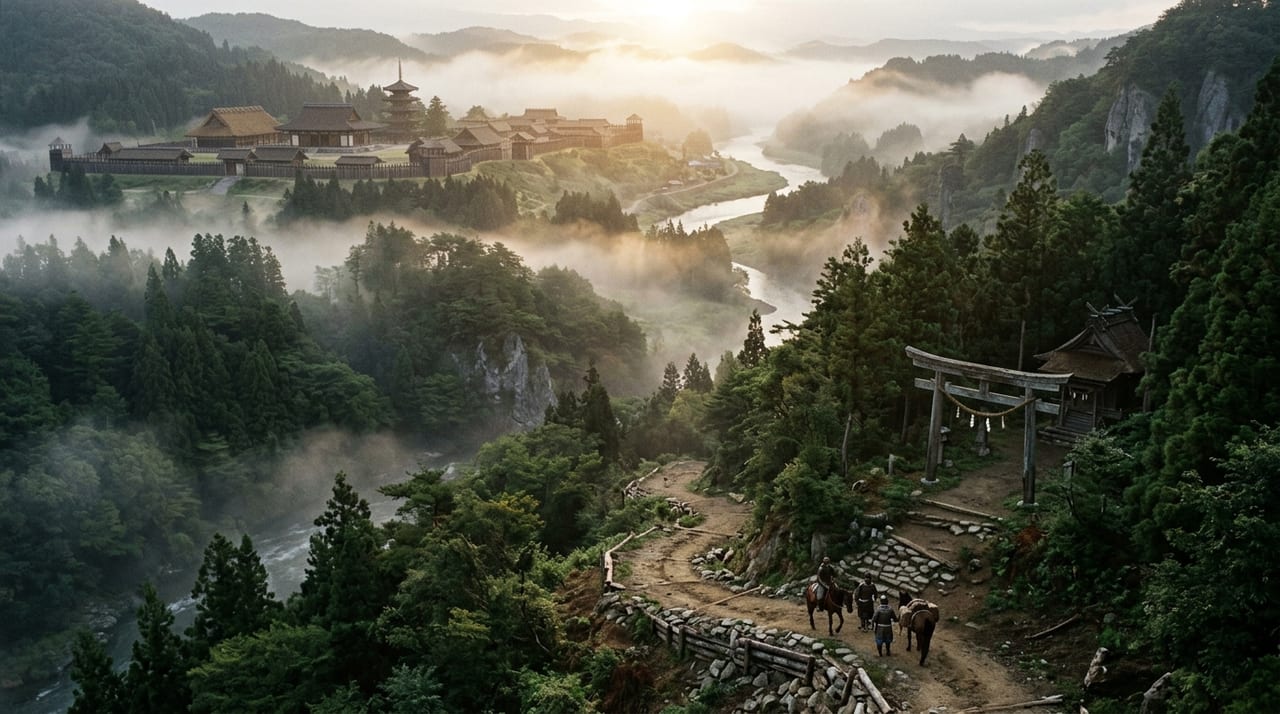
 * Image is for illustrative purposes only.
Zenkunen-Gosannen Wars
前九年・後三年の役期
The Former Nine Years' War (Zenkunen War) and Later Three Years' War (Gosannen War), fought in Mutsu and Dewa, were an era in which the rise of Tōhoku swordsmiths and the practical sword demand of eastern warrior bands grew, and the clash between the Minamoto and the Abe and Kiyohara clans exerted a distinctive influence on the development of Japanese swords.
Description
Warfare in Ōshū and Demand for Swords
The Former Nine Years' War (Zenkunen War, 1051–1062) and the Later Three Years' War (Gosannen War, 1083–1087) were fierce contests between warrior bands for supremacy in Tōhoku. The clash between Minamoto no Yoriyoshi and his son Yoshiie and the powerful Abe clan of Ōshū (Former Nine Years' War), followed by the battle in which Yoshiie intervened in the internal strife of the Kiyohara clan (Later Three Years' War), once again proved that swords were the practical tools that decided life and death for warriors living in Kantō and Tōhoku. Warfare of this period was based on one-on-one combat between mounted warriors, and there were many phases in which fighting shifted from long-range archery to close combat with the tachi, so demand for sturdy tachi capable of withstanding battle surged.
Early Tōhoku Swordsmiths
Fujiwara no Kiyohira, who laid the foundations of the Ōshū Fujiwara clan, seized actual control of Mutsu after the Later Three Years' War and formed an independent cultural sphere centered on Hiraizumi (present-day Iwate Prefecture). The prosperity of the Ōshū Fujiwara clan over three generations, Fujiwara no Kiyohira, Motohira, and Hidehira (c. 1090–1189), brought forth the golden culture known as Hiraizumi culture, and demand for swords also became refined, following the standards of court culture. During this period, groups of swordsmiths began to form in various parts of Tōhoku, and in particular the smiths of Mutsu developed their own forging methods using locally produced iron sand and charcoal.
Minamoto Warriors and Sword Culture
Minamoto no Yoriyoshi and Yoshiie were revered in later generations as embodiments of the Way of the Warrior (tsuwamono no michi), and the swords they carried were regarded as possessing special spiritual power, linked to belief in martial deities. A sword said to have been dedicated by Yoshiie (Hachiman Tarō) was transmitted to Hachiman shrines across the country and became a spiritual pillar for warriors of the eastern provinces. This tradition is the source of the later culture of sword worship in the Kamakura shogunate, and the custom of dedicating swords to pray for victory in battle and long life in arms took root in this period.
Weapons Procurement by the Kiyohara and Fujiwara Clans
Fujiwara no Kiyohira, who assisted Minamoto no Yoshiie, the victor of the Later Three Years' War, needed large quantities of weapons in the course of establishing his control of Ōshū. In Mutsu at that time there were many sources of high-quality iron sand, and a self-sufficient supply of iron supported weapon production. Gold from Mutsu, called 'gold of Ōshū,' was also used for the metal fittings of sword koshirae, and became an important resource that raised the standard of Hiraizumi's craft products. It is thought that some of today's lineages of swordsmiths in various parts of Tōhoku trace back to local smiths of this period.
Characteristics of Swords in the Age of War
Swords of this period differ from the elegant ceremonial tachi of Heian aristocrats, and their defining feature is a sturdy construction that places battle first. The blade is somewhat wide in width (mihaba) and thick in kasane, and the curvature (sori) is moderate, emphasizing practicality. The jigane shows many large itame and nagare-masame with a coarse forging texture, and the hamon are mainly suguha or small midare, with little of the decorative quality of the later chōji-midare. However, the functional beauty of the sword, namely the balance of its center of gravity and the ease of grip of the tsuka, and the rationality needed to survive in battle, is condensed in the blade, forming an important style that became a bridge to the later swords of Kamakura warriors.
Rarity of Surviving Examples
Very few surviving objects can be identified as belonging to this period, and almost no signed examples confirmed as Ōshū-type exist. Swords that may actually have been used in the Former Nine Years' War and Later Three Years' War remain as dedicatory swords at various shrines, with traditions attached, but the certainty of their provenance varies. Tōhoku museums hold fragmentary transmitted pieces, but this is also a field in which research has not yet sufficiently advanced as an object of study.
Characteristics of This Era
- Practicality-first sturdy construction. Mostly tachi with somewhat wide blades and thick kasane, designed to prioritize durability and cutting power in mounted combat
- Jigane mostly large itame and nagare-masame, a forging texture pursuing toughness over refinement, reflecting the iron quality characteristic of Tōhoku iron sand
- Hamon mainly suguha and ko-midare, a neat appearance prioritizing practicality over decoration. The hardened width is also modest, with hardening that considers blade toughness
- Form of dedicatory swords linked with the Hachiman faith of the eastern provinces, a significant period in which the spiritual and sacred nature of swords took root in warrior culture
- Some precision metalwork koshirae linked to the gold culture of the Ōshū Fujiwara clan are seen, and a separation between practical swords and formal swords was gradually progressing