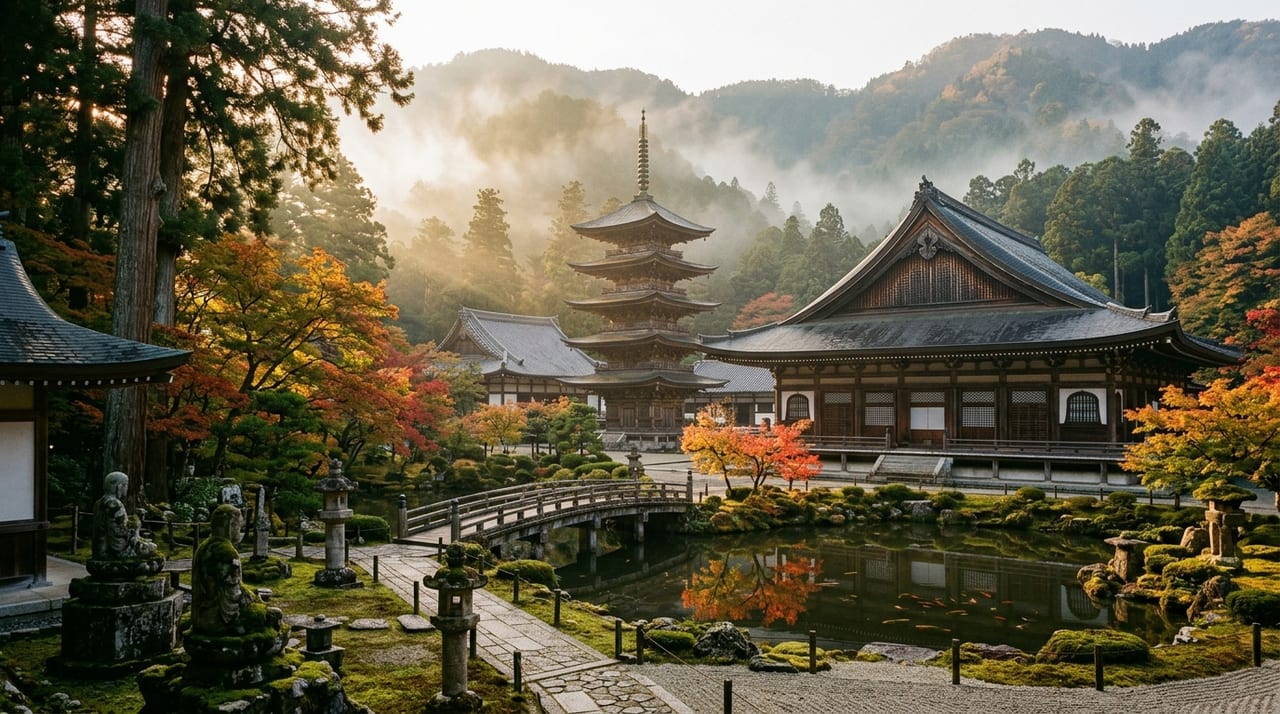
 * Image is for illustrative purposes only.
Ōei Era — Muromachi Peace and the Ōei Swords
応永(おうえい)
Sword culture of the Ōei era (1394–1428), when Ashikaga Yoshimitsu unified the Northern and Southern Courts and the Muromachi shogunate reached its peak. Bizen Osafune dominated production with the stable, high-quality style known as 'Ōei Bizen,' while broad distribution networks serving warriors, court nobles, and temples became firmly established.
Description
The Ōei era (1394–1428) immediately followed Ashikaga Yoshimitsu's unification of the Northern and Southern Courts (the Meitoku Agreement of 1392) and represented the political and cultural apex of the Muromachi shogunate. This political stability had a decisive impact on sword culture. With the urgent demand of civil war subsided and systematic production at stable quality levels now possible, the Bizen Osafune workshops established the mature style that later generations would call "Ōei Bizen" (Ōei-Bizen).
The technical hallmarks of Ōei Bizen represent a clear departure from the spectacular great-swords (ō-tachi) of the Nanbokuchō period toward blades combining practicality with artistic refinement. Blade lengths stabilized at around 70–73 centimeters, curvature became somewhat shallower, and the jihada (forged grain) moved toward predominantly itame with uniform, refined kneading. Hamon favored suguha (straight temper) or gentle gunome (undulating patterns), abandoning the turbulent ō-midare of the Nanbokuchō era in favor of measured, composed beauty. This Ōei Bizen aesthetic became the template for late-Kotō mass-production blades, the direct precursor of the high-volume Sue-Bizen production that would dominate the Sengoku era.
Ashikaga Yoshimitsu was also an active patron of the arts, laying the cultural foundations that would eventually crystallize into the Higashiyama culture of his grandson Yoshimasa. The Chinese paintings and objects (karamono) he acquired through trade with Ming China were later inherited by the famed Higashiyama-gomotsu (Higashiyama treasury). Yoshimitsu's active pursuit of the Kangō trade with Ming China (from 1401) also brought continental metalworking knowledge into contact with Japanese tosogu (sword furniture) culture.
Beyond Bizen, the Yamato schools — the Tegai and Senjuin lineages — continued active production during the Ōei era, while the Samonji lineage in Chikuzen (Fukuoka) contributed high-quality blades. Crucially, the Ōei era saw sword-furniture production begin to crystallize as an independent specialized craft: the division of labor among metal-fittings smiths (kinkōshi), scabbard makers (sayashi), and handle wrappers (tsukamakishi) became more clearly defined, laying the groundwork for the explosive flourishing of tosogu culture in the late Muromachi period.
The final years of the Ōei era (1420s) saw renewed stirrings of intra-shogunal power conflict that would culminate in the Kakitsu Disturbance of 1441. Nevertheless, the approximately 35 years of the Ōei era occupy a distinctive place in Japanese sword history as an era of "stabilization and maturation" — a period of balanced achievement in sword culture situated between the revolutionary transformations of the Nanbokuchō period and the chaos of the post-Ōnin era.
Characteristics of This Era
- Establishment of 'Ōei Bizen' — the transition from Nanbokuchō great-swords to a stable style combining practicality and artistry
- Maturation of the Bizen Osafune workshop system — systematic production and broad distribution networks
- Ashikaga Yoshimitsu's cultural patronage — collection of Chinese art (karamono, later Higashiyama-gomotsu) and continental art influence via Kangō trade
- Specialization of tosogu craftsmen — the division of metalwork, scabbard, and handle arts as a precondition for later sword-furniture culture
- Template formation for late-Kotō style — the technical and aesthetic foundation for Sue-Bizen mass production