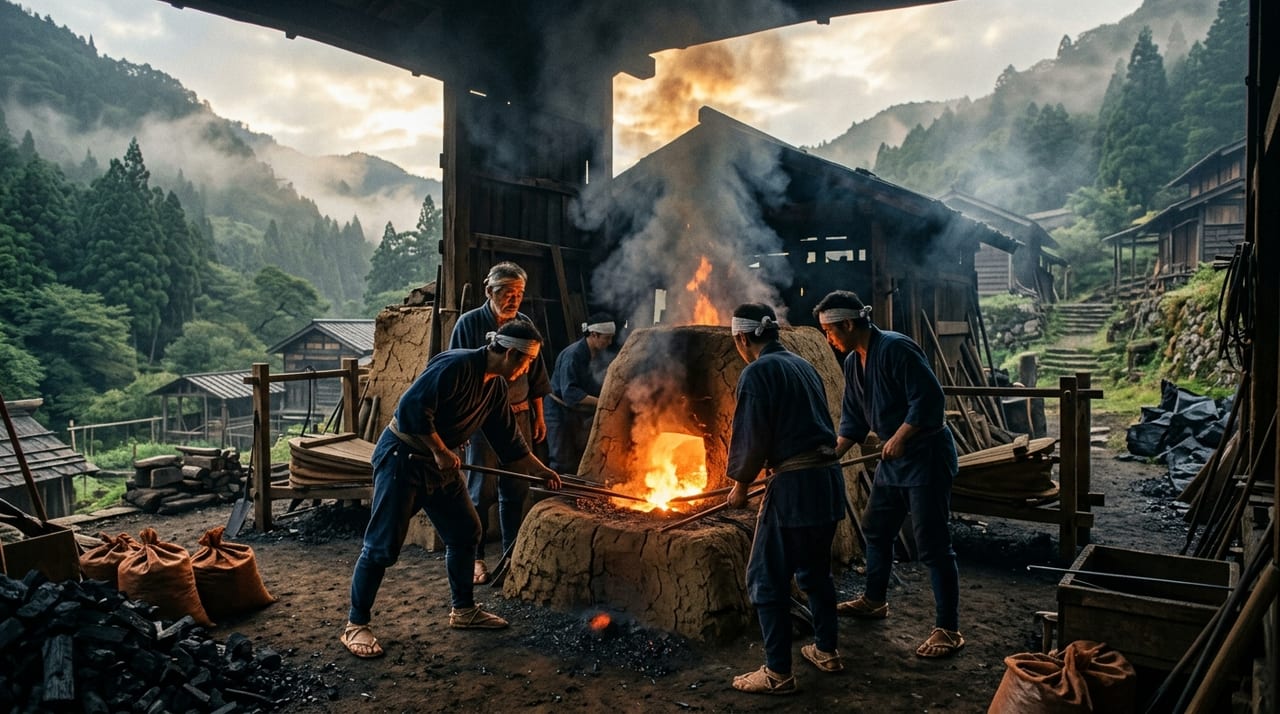
 * Image is for illustrative purposes only.
Tatara Ironmaking and the Material of the Japanese Sword
たたら製鉄と日本刀の素材
Tatara ironmaking—the uniquely Japanese smelting process that produces tamahagane (jewel steel) for Japanese swords—developed primarily in the Okuizumo region of Shimane Prefecture. This entry explores how the distinctive process using iron sand and charcoal created a sword-steel unmatched anywhere in the world.
Description
What Is Tatara Ironmaking?
Tatara ironmaking is a uniquely Japanese iron-smelting technique that uses satetsu (iron sand) and mokutan (charcoal). Satetsu and charcoal are charged in alternating layers into a clay furnace built inside a building called a takadono. A huge foot-operated bellows system (tenbin fuigo) supplies the air needed to keep the temperature high. Over three days and three nights of operation, this produces an iron mass (kera). The highest-quality steel contained in this kera is called tamahagane, and it has the best properties of any material for Japanese swords.
Iron Culture of Okuizumo
The Okuizumo region of Shimane Prefecture (including Okuizumo Town in Nita District) has long been known as a treasure trove of iron sand, and it produces abundant mountain iron sand from the Chūgoku Mountains. The combination of rich forest resources for the charcoal and iron sand resources made this region grow into Japan's largest tatara ironmaking area. It is also known as the birthplace of Yasugihagane (Yasugi steel), and the technical tradition of tatara ironmaking is inherited by the Yasugi Works of Hitachi Metals (now Proterial).
Metallurgical Characteristics of Tamahagane
The carbon content of tamahagane is roughly 0.5 to 1.2%. Because several kinds of iron with different carbon contents are obtained from a single kera, both hard steel (kawagane, skin iron) and mild steel (shingane, core iron) are produced in one smelting operation. Swordsmiths combine these using a distinctive laminated forging technique called tsukurikomi, which creates blades that combine hardness and toughness. Tamahagane contains very small amounts of impurities (especially sulfur and phosphorus). It is further refined by drawing out during forging, which forms its distinctive surface pattern (hada).
Operating System of Tatara Ironmaking
In the Edo period, ironmasters (tetsushi) procured satetsu, charcoal, and clay from a wide area including Izumo, Hōki, and Iwami, and they operated under a highly organized division-of-labor system. Among the ironmasters, the Tanabe, Itohara, and Sakurai houses flourished especially in the late Edo period. They were known as the Three Great Ironmaster Houses (tetsushi gosanke) and were economically dominant.
Connection Between Production Regions and Swords
Hōki Province (present-day central and western Tottori Prefecture) was an advanced ironmaking region that produced famous master smiths such as 'Yasutsuna' and 'Sanemori' from ancient times. It is a good example of the correlation between the technical level of tatara ironmaking and the quality of swords.
Modernization and the Decline and Revival of Tatara Ironmaking
With the introduction of Western-style iron smelting (the blast furnace method) after the Meiji era, tatara ironmaking lost its economic competitiveness and declined rapidly. Commercial tatara production ended in 1923 (Taishō 12), and the Yasukuni Tatara, which produced steel for military swords, stopped operating in 1945. However, the demand for tamahagane for making Japanese swords led to its revival as the Nittōho Tatara (operated by the Japan Art Sword Preservation Society in Okuizumo Town, Shimane Prefecture). The tamahagane it produces is distributed to swordsmiths across Japan.
Characteristics of This Era
- Iron-sand origin: Japanese tatara uniquely uses iron sand rather than iron ore, fundamentally distinguishing it from the world's major ironmaking methods; the low impurity content of iron sand directly accounts for tamahagane's quality.
- Carbon-range and tsukurikomi technique: Actively exploiting the range of carbon content produced in a single smelt, smiths developed the tsukurikomi lamination technique combining hard kawagane and tough shingane.
- Ji-hada surface pattern: Repeated folding and hammering stratifies the metal structure, producing distinctive itame, masame, and mokume surface patterns on the blade—also used as identifying markers in appraisal.
- Forest dependence of charcoal ironmaking: the large-scale consumption of charcoal requires vast forest resources, so tatara ironmaking regions developed a forestry management system involving planned tree planting and felling cycles.
- Use of slag (tetsusai) and the Kanayago faith: slag, the waste left after ironmaking, was used as stone and building material for farming. Its ties to the Kanayago faith were also strong, and ironmaking was also a religious activity.
- Regional economic pillar: Edo-period teshi families were among the largest economic actors in Izumo, operating vertically integrated industrial complexes spanning iron-sand mining, charcoal production, smelting, and distribution.
- Modern tamahagane supply: The revival of Nittoho Tatara maintains a supply of genuine tamahagane for working swordsmiths today, embodying both cultural-property preservation and the perpetuation of living swordsmithing technique.