New Arrivals — Browse our catalog for the latest authentic Japanese sword arrivals. Browse →
June 19, 1333 (Genkō 3, 5th month, 7th day)
Rokuhara, Kyoto, Yamashiro Province (present-day Higashiyama Ward, Kyoto City, Kyoto Prefecture)
Forces
Ashikaga Takauji, Akamatsu Norimura, Sasaki Dōyo and anti-shogunate forces
Rokuhara Tandai (Kamakura Shogunate)
About 14 min read
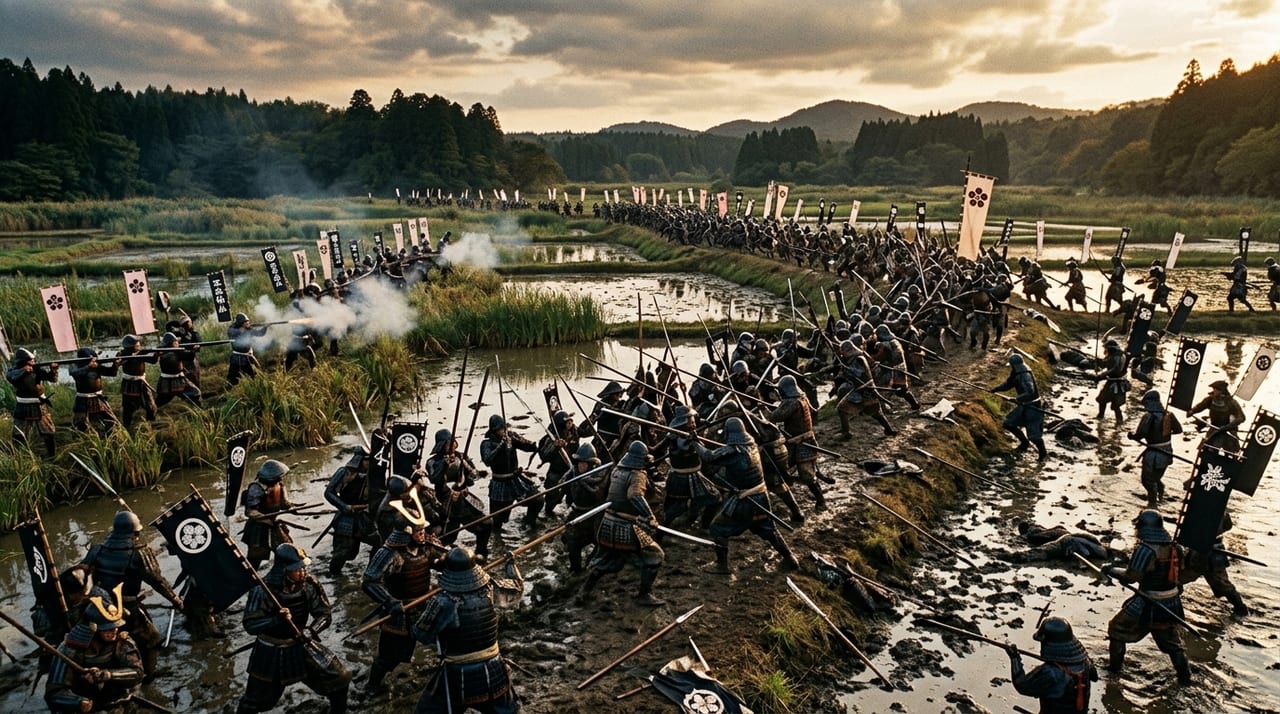
The Fall of Rokuhara Tandai was an incident in which Ashikaga Takauji raised the banner of revolt against the shogunate on the 7th day of the 5th month of Genkō 3 (1333), attacking and destroying the Rokuhara Tandai in Kyoto. The Rokuhara Tandai, the "western eyes" of the Kamakura shogunate, had dominated Kyoto for about 110 years since the Jōkyū War (1221). Its collapse was the decisive prelude to the fall of the Kamakura shogunate on the 22nd day of the 5th month of the same year. The incident was the moment when Emperor Go-Daigo's campaign to overthrow the shogunate bore fruit, and it also marked the dawn of a new upheaval, the Nanboku-chō period. In the history of Japanese swords, it is an important event that stands at a turning point in sword culture, leading to the ōdachi and naginata boom of the Nanboku-chō period.
In Genkō 1 (1331), Emperor Go-Daigo plotted to overthrow the shogunate, failed (the Genkō War), and was exiled to the Oki Islands. However, in the intercalary 2nd month of Genkō 3 (1333), the emperor escaped from the Oki Islands and raised arms again at Mount Senjō in Hōki Province. The shogunate dispatched a punitive force under the prominent gokenin Ashikaga Takauji as its commander. As a scion of the prestigious Minamoto line, Takauji had the ability to later found the Muromachi shogunate, and he commanded the expectations of many gokenin. However, on his way to Kyoto, Takauji stopped at Shinomura Hachiman Shrine in Tanba Province, and on the 29th day of the 4th month of the same year, he suddenly raised the banner of revolt against the shogunate. This "uprising at Shinomura Hachiman Shrine" is famous as a turning point in Japanese history. Takauji declared his loyalty to Emperor Go-Daigo and issued a call to arms to warriors across the provinces.
When Ashikaga Takauji raised troops at Shinomura Hachiman Shrine, anti-shogunate forces responded in concert, including Akamatsu Enshin of Harima and Sasaki Dōyo of Ōmi. On the 7th day of the 5th month, Takauji's army and the forces of Akamatsu closed in on Kyoto from two sides, and the Rokuhara Tandai's forces were overwhelmed. The southern Tandai, Hōjō Tokimasu, was ambushed by nobushi (irregular warrior bands) near Higashiyama while fleeing and died in battle. The northern Tandai, Hōjō Nakatoki, fled eastward while escorting Retired Emperor Go-Fushimi, Retired Emperor Hanazono, and Emperor Kōgon. However, the fleeing Tandai forces had nowhere to go at Banba (present-day Maibara, Shiga), and on the 9th day of the 5th month, Hōjō Nakatoki and 432 people under him took their own lives (the "Banba collapse"). Having taken control of Kyoto, Ashikaga Takauji made preparations to welcome Emperor Go-Daigo's return to the capital.
The collapse of the Kamakura shogunate, symbolized by the fall of Rokuhara Tandai, and the Nanboku-chō upheaval (1336–1392) brought dramatic changes to the shape of Japanese swords. The tachi of the Kamakura period had deep curvature and an elegant form optimized for mounted combat, but in the Nanboku-chō period the character of warfare changed rapidly. Large-scale group battles unfolded on the battlefield, and enormous swords known as the "Nanboku-chō ōdachi," with blades measuring from 90 cm to over 120 cm, appeared. The ōdachi functioned as large weapons: mounted warriors swung them downward from horseback, and foot soldiers wielded them two-handed. In addition, centered on the Enbun and Jōji eras, many tachi were made with broad blades and a large, majestic style.
The year 1333, when Rokuhara Tandai fell, overlaps with the era in which the swordsmith Masamune was active. Masamune was a legendary swordsmith based in Kamakura in Sagami Province (present-day Kanagawa Prefecture). The Sōshū tradition established by Masamune is a distinctive technique that combines the toughness of the jigane (steel base) with vigorous, active nie in the hamon, and it had a decisive influence on later sword-making techniques. Masamune's style was passed down to his disciple Sadamune. In later ages, master smiths such as Kaneshige were linked to Masamune as the "Ten Great Disciples of Masamune" (Masamune Juttetsu). However, because their periods of sword-making do not overlap, it is held that they had no actual master-disciple relationship. When the Kamakura shogunate collapsed, Kamakura's sword industry, which had flourished under its patronage, also reached a turning point. Nevertheless, the Sōshū techniques spread to smiths in Bizen, Yamashiro, and Yamato, and became the foundation of sword culture from the Nanboku-chō through the Muromachi period.
Following the fall of Rokuhara Tandai, Nitta Yoshisada advanced on Kamakura. On the 22nd day of the 5th month of Genkō 3 (1333), Hōjō Takatoki, the last tokusō (head of the Hōjō main line), killed himself at Tōshō-ji, and the Kamakura shogunate fell. Emperor Go-Daigo began the Kenmu Restoration (1333–1336), but policies centered on court nobles provoked discontent among warriors, and Ashikaga Takauji broke away. In Engen 1 (1336), Takauji defeated Kusunoki Masashige at the Battle of Minatogawa, took control of Kyoto, installed a Northern Court, and founded the Muromachi shogunate. Emperor Go-Daigo established a Southern Court in Yoshino (Nara), and the Nanboku-chō period began. The Nanboku-chō upheaval continued until the Meitoku reconciliation of 1392, and these 56 years of warfare had a profound and rich impact on the form, techniques, and spiritual culture of Japanese swords.
The fall of Rokuhara Tandai is an event that symbolizes the transition from the warrior and sword culture of the Kamakura period to the Nanboku-chō and Muromachi periods. The era in which smiths of Bizen Osafune, Yamashiro, Yamato, and Sagami flourished under the patronage of the Kamakura shogunate came to an end, and a new era began in which demand for Japanese swords grew explosively within the new context of the Nanboku-chō upheaval. The large-scale battles of the Nanboku-chō period encouraged the enlargement of swords, such as the "ōdachi" and "nodachi," while demand for refined, celebrated swords for appreciation also continued. The collapse of Rokuhara Tandai and the Nanboku-chō upheaval hold an indispensable place in sword history as a turning point, at which Japanese swords followed a distinctive path of development that pursued both "functionality as weapons" and "value as art objects and spiritual symbols" at the same time.
The "uprising at Shinomura Hachiman Shrine," in which Ashikaga Takauji raised the banner of revolt against the shogunate, is one of the most dramatic "decisions made before a deity" in medieval Japanese history. For warriors, Hachiman occupied a special position as a god of war and the protective deity of warrior houses, and an oath made before a Hachiman shrine was the weightiest pledge a warrior could make, one that staked life and death on the battlefield. Takauji's act of declaring rebellion against the shogunate before the deity was itself a practice of bushidō, in which the warrior's resolve was firmed through an oath to the gods. Medieval warriors, when setting out for battle, prayed for victory by dedicating fine swords to their clan deities or protective deities, and after returning in triumph, they had a custom of making thank-you offerings. The uprising at Shinomura Hachiman Shrine, which became the starting point of the major historical event that was the fall of Rokuhara Tandai, stands as a symbolic scene in which warriors, the gods, and swords united to move the destiny of medieval Japan. It occupies a place at the intersection of sword history, religious history, and political history.
Ashikaga Takauji
Defected from the shogunate to Emperor Go-Daigo's cause and destroyed the Rokuhara Tandai
Kusunoki Masashige
Fought for Emperor Go-Daigo in the campaign to destroy the Rokuhara Tandai
Nitta Yoshisada
Led the attack on Kamakura that ended the Kamakura shogunate simultaneously with the Rokuhara Tandai's fall