New Arrivals — Browse our catalog for the latest authentic Japanese sword arrivals. Browse →
1333–1336 CE (Genkō 3 – Kenmu 3)
Kyoto, Yoshino, Kamakura, and throughout Japan
Forces
Emperor Go-Daigo / Southern Court loyalists
Ashikaga Takauji / Northern Court
About 12 min read
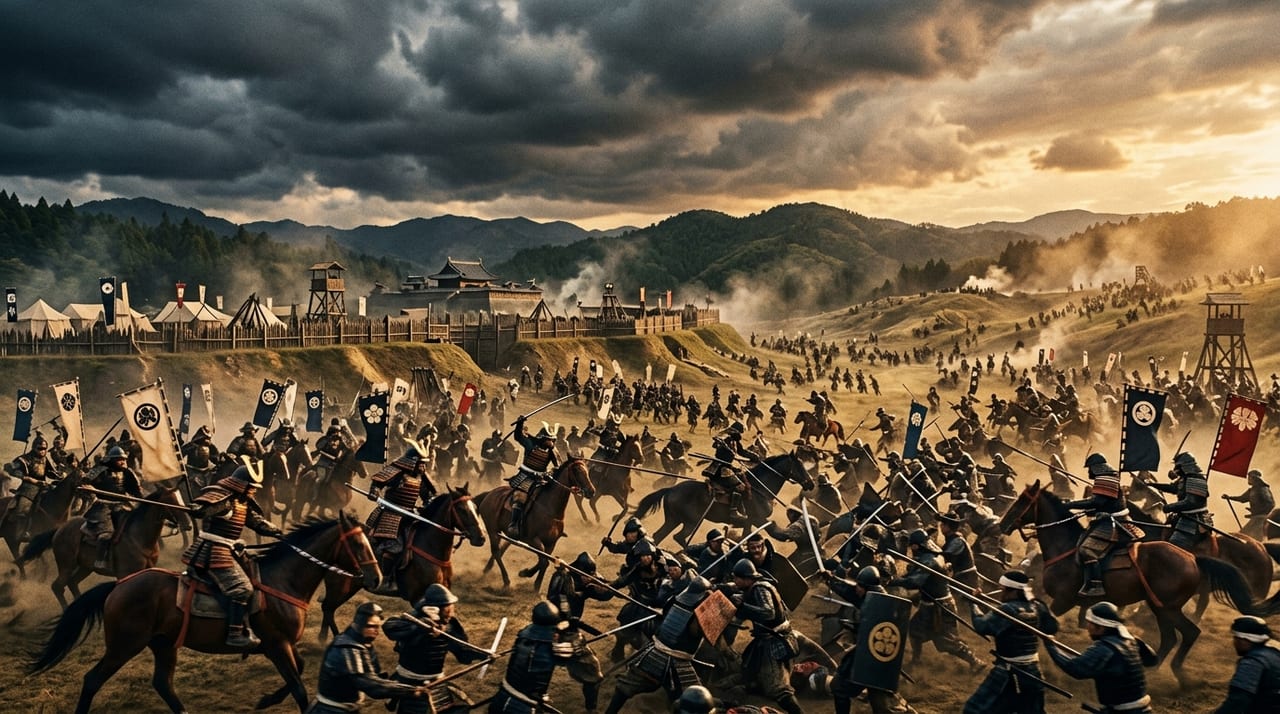
The Kemmu Restoration (Kemmu no shinsei) was Emperor Go-Daigo's attempt, from Genkō 3 (1333) to Kenmu 3 (1336), to establish a government of direct imperial rule after the overthrow of the Kamakura shogunate. Because the regime continued policies that betrayed the expectations of the warrior class, it collapsed through the revolt of Ashikaga Takauji, opening a new era of the Nanbokuchō period and the founding of the Muromachi shogunate.
Since his accession, Emperor Go-Daigo had sought to restore direct imperial rule and tried to resist the Kamakura shogunate. After failures in the Shōchū Incident of Shōchū 1 (1324) and the Genkō Incident of Genkō 1 (1331), he was exiled to the Oki Islands but did not abandon his intention to overthrow the shogunate. In Genkō 3 (1333), while Kusunoki Masashige resisted the shogunate's forces at Chihaya Castle and Akasaka Castle, warriors across the country rose against the shogunate in response to Go-Daigo's call. Ashikaga Takauji, a prominent gokenin of the Kamakura shogunate, defected to Go-Daigo and captured Rokuhara Tandai. Nitta Yoshisada raised an army in the Kantō and attacked Kamakura. Hōjō Takatoki and the rest of the Hōjō clan killed themselves at Tōshō-ji, and the Kamakura shogunate fell. During this overthrow, the legend of the "Miracle of Inamuragasaki" arose: Nitta Yoshisada threw a gold-mounted tachi into the sea at Inamuragasaki and prayed to the gods. The legend that the tide receded and allowed him to cross Inamuragasaki is a well-known anecdote showing that swords carried the religious meaning of offerings to the gods.
After the fall of the Kamakura shogunate, Emperor Go-Daigo established a government centered on the emperor, known as the Kemmu Restoration. However, Go-Daigo's policies favored court nobles (kuge), and the insufficient and unequal rewards given to warriors who had contributed to the overthrow of the shogunate provoked widespread discontent among the warrior class. Newly established organs such as the Kirokusho and the Zasso Ketsudansho also failed to function in practice, and confusion continued. The sword Kiku-ichimonji, said to have been a treasured possession of Kusunoki Masashige, has been handed down at Matsuho Shrine on Awaji. In later ages it was retold again and again as a story of a loyal retainer.
During the Kemmu Restoration, Kusunoki Masashige stood out as a warrior who embodied absolute loyalty to Emperor Go-Daigo. Among the swords said to have been worn by Masashige is Koryū Kagemitsu, a work of the Bizen Osafune smith Kagemitsu, which is in the collection of the Tokyo National Museum. Later, at the Battle of Minatogawa (Kenmu 3 / 1336), Masashige was defeated by Ashikaga Takauji's forces and killed himself together with his younger brother Masasue. This "sashichigae" (mutual stabbing) of Masashige and Masasue is a scene in which the brothers are said to have simultaneously plunged their swords into each other's chests and died. The Taiheiki describes it in detail as one of the most moving scenes symbolizing the honor of the warrior and the bond between brothers. In this scene the sword rises in meaning from a weapon of combat to a means of honorable death, and it shows the ultimate union of death and honor in Japanese sword culture.
In Kenmu 2 (1335), Ashikaga Takauji suppressed the Nakasendai Rebellion (the uprising of Hōjō Tokiyuki, which aimed to restore Kamakura). He then began to act independently, defying Emperor Go-Daigo's orders. Takauji gathered the discontent of the warrior class and rose in revolt against Go-Daigo. In Kenmu 3 (1336), he defeated Kusunoki Masashige at the Battle of Minatogawa and drove Go-Daigo to Mount Hiei. Takauji then installed a new emperor, Emperor Kōmyō, founded the Northern Court, and laid the foundations of the Muromachi shogunate. Go-Daigo fled to Yoshino and established the Southern Court, and the turbulent Nanbokuchō period began.
The turmoil of the failed Kemmu Restoration and the Nanbokuchō conflict sharply increased the demand for swords and made the spiritual meanings invested in them more complex and profound. In an era divided between loyalty and treachery, and between the Southern and Northern Courts, warriors kept fighting, each putting their own "justice" into their swords. Amid this upheaval, swordsmiths of Bizen Osafune, Sōshū, Yamato, and Mino met the strong demand by producing enormous numbers of blades, and the sword styles of the Nanbokuchō period were established: large points (ō-kissaki), bold blades, and changes in taihai. In particular, the ō-kissaki tachi made by renowned Nanbokuchō masters, such as Kanemitsu and Motoshige of Bizen Osafune and Hiromitsu and Akihiro of Sōshū, were prized in later ages as "Nanbokuchō-mono," and their grand beauty is regarded as the pinnacle of the warrior age. The Kemmu Restoration lasted only three years, but the long-term Nanbokuchō turmoil it set off is an era that sword historians regard as an important turning point, one that produced one of the richest periods of blade production in Japanese history.
The war chronicle Taiheiki, which depicts the Kemmu Restoration and the Nanbokuchō turmoil, is an important literary work that describes in detail the relationship between swords and warriors. It portrays many dramatic scenes involving swords, including Kusunoki Masashige's valiant fighting, his mutual stabbing with Masasue, and Nitta Yoshisada's casting of his sword at Inamuragasaki. These depictions had a major influence on later views of bushidō and of swords.
From the Kemmu Restoration (1333–1336) through the Nanbokuchō turmoil (to 1392), Japanese sword production reached an unprecedented level in both quality and quantity. Because fighting continued across the country, large numbers of swords were needed by warriors, court nobles, and temples and shrines alike. Among the swordsmiths who met this demand, the most famous is Masamune of Sōshū. Masamune is renowned in later ages as "the greatest swordsmith under heaven," and his disciples and grand-disciples spread the Sōshū-den throughout the country as the Masamune Juttetsu (the Ten Disciples of Masamune). Some of Masamune's works are designated National Treasures and are held in museums. That the political upheaval of the Kemmu Restoration was the direct background to the age that produced the greatest masterpieces of Japanese swords is an irony of history, and a symbolic fact showing the paradoxical richness of sword culture.
鎌倉幕府崩壊直前の元弘・正慶年間における刀剣様式の変化と、南北朝期大太刀化の前触れを考察する。
2026-05-20
建武の新政(1333〜1336年)による鎌倉幕府滅亡と直後の南北朝動乱が、日本刀の形態と生産体制に与えた転換。幕府の庇護を失った刀工たちが新たな後援者を求める中、刀身の大型化と地域的刀工集団の台頭が始まった過程を解説する。
2026-05-12
後醍醐天皇の倒幕運動から建武の新政(1333〜1336年)に至る激動の3年間を軸に、鎌倉末期の刀剣文化がいかに変化したかを解説。猪首切先から豪壮な太刀へ、公武の刀剣観の分裂と統合を追う。
2026-04-29
長巻は刀身と同程度の長さを持つ長柄を特徴とする日本刀の一形態で、南北朝から戦国時代に騎馬武者や歩兵が戦場で用いた。薙刀・野太刀との違い、現存する名品、拵えの構造を詳しく解説する。
2026-07-09