New Arrivals — Browse our catalog for the latest authentic Japanese sword arrivals. Browse →
8th month of Genkō 1 (1331) – 5th month of Genkō 3 (1333)
Kasagi Mountain (Yamashiro Province), Chihaya Castle (Kawachi Province), Kamakura (Sagami Province), and across Japan
Forces
Anti-Shogunate Forces (Emperor Go-Daigo)
Shogunate Forces (Hōjō / Tokusō Regime)
About 17 min read
In the 8th month of Genkō 1 (1331), Emperor Go-Daigo holed up at Mount Kasagi in Yamashiro Province and issued a rinji (imperial edict) calling for the overthrow of the shogunate. This was the beginning of the Genkō Disturbance. This uprising, which on the surface looked like the rebellion of one emperor alone, led within just two years to the fall of the Kamakura shogunate, which had lasted 140 years. It was an outcome no one had expected.
The Genkō Disturbance was not a mere "political coup." It fundamentally shook the era in which warriors had held the real reins of power since the late Heian period, and ultimately drew Japan into decades of civil war known as the Nanbokuchō turmoil. Kusunoki Masashige, Nitta Yoshisada, Ashikaga Takauji, and the others who played active roles in this war are all remembered by later generations, and the swords they wore have been handed down to the present day as witnesses to history.
Emperor Go-Daigo (reigned 1318–1339) was strongly dissatisfied with the shogunate's rule from the very beginning of his reign, and he was determined to restore direct imperial rule. In Shōchū 1 (1324), in the Shōchū Incident, his attendants Hino Suketomo and Hino Toshimoto drew up a plan to overthrow the shogunate, but the plan was discovered beforehand and ended in failure.
Go-Daigo, however, did not give up. In Genkō 1 (1331), the plan was discovered again, and the shogunate dispatched troops to pursue him. The emperor escaped from Kyoto and raised an army, holing up at Mount Kasagi in Yamashiro Province (present-day southern Kyoto Prefecture). Mount Kasagi was a natural stronghold surrounded by steep cliffs. For a time, court nobles, monks, and warriors gathered there and set up defensive positions, but they were surrounded by the shogunate's large army and fell the following month. Go-Daigo was captured, and the following year he was exiled to Oki (present-day Shimane Prefecture).
Even after Go-Daigo was exiled to Oki, the flames of rebellion against the shogunate did not go out. In Genkō 3 (1333), the battle for Chihaya Castle (Chihayajō) in Kawachi Province (present-day southeastern Osaka Prefecture) became one of the most famous siege battles in Japanese military history and has been passed down to later generations.
Kusunoki Masashige came to Emperor Go-Daigo at Mount Kasagi in Genkō 1 (1331) and was a warrior of Kawachi who raised an army at Akasaka Castle. Although his court rank was low, his outstanding strategic vision, his skill in using terrain, and what might be called his talent for "masterful unorthodox tactics" became subjects that military thinkers in later ages studied again and again.
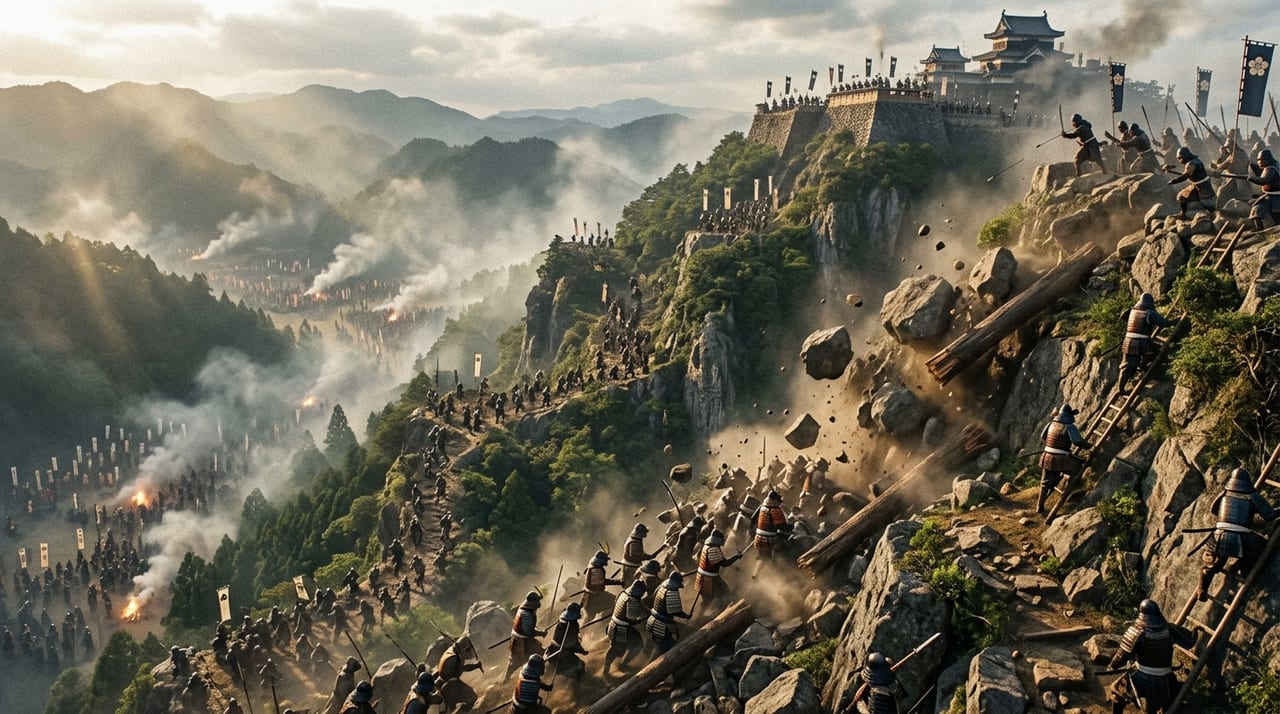
The shogunate sent a great army to Chihaya Castle, numbering from several tens of thousands to around a hundred thousand (the Taiheiki claims it numbered one million, but this is considered an exaggeration), yet Masashige, with fewer than a thousand men, kept them off balance. His tactics overturned common sense: the "rockfall tactic" that made use of the steep slopes of the mountain, the "scarecrow tactic" of placing dummies made of rice straw along the castle walls as decoys, and surprise attacks under cover of night.
The most famous is the scene of the "great log drop." At the moment the besieging army secured a route to the castle walls, Masashige smashed the enemy's tightly packed formation with huge logs and boulders rolled down the slope. The Taiheiki depicts this scene in detail, and it conveyed to later readers the core of the warrior ethos that "wisdom and conviction surpass numbers."
The siege of Chihaya Castle, which lasted about three months, had significance beyond its immediate tactical results. The sight of the shogunate's great army unable to take a single small castle spread among warriors across the provinces the recognition that "the shogunate is not invincible," and it played a role in raising the momentum for its overthrow in various regions.
While Chihaya Castle held out, Emperor Go-Daigo, who had escaped from Oki, issued a rinji calling for the overthrow of the shogunate again from Mount Senjō (Tottori), appealing to warriors across the country. At this time, Ashikaga Takauji, who had been sent against him as a commander of the shogunate's forces, suddenly switched sides to Go-Daigo's camp. In the 5th month of Genkō 3 (1333), he attacked Rokuhara Tandai, the shogunate's regional branch in Kyoto.
Ashikaga Takauji's defection was fatal for the shogunate. Takauji was a prominent warrior of the Kantō region, descended from the head lineage of the Minamoto clan, and his prestige and military strength formed the core of the shogunate's power. At around the same time that Rokuhara Tandai fell, Nitta Yoshisada raised an army in Kōzuke Province (present-day Gunma Prefecture) and, adding forces from various parts of the Kantō, began to march south toward Kamakura.
On July 3, 1333 (Genkō 3/5/21), Nitta Yoshisada's army broke into Kamakura from Inamuragasaki (present-day Kamakura, Kanagawa Prefecture). The "miracle at Inamuragasaki," a famous scene in the Taiheiki in which Yoshisada threw his sword into the sea and the tide receded, opening a path, is a legendary embellishment added in later times. In reality, it is thought that he advanced along the coastline by taking advantage of low tide. In any case, this breakthrough sealed the fall of Kamakura.
On the 22nd day of the 5th month, Hōjō Takatoki, the supreme authority of the shogunate, set fire to Tōshō-ji (present-day Kamakura, Kanagawa Prefecture) and killed himself along with more than 800 members of his clan and retainers. The power of the Hōjō family, which had wielded enormous authority for about 110 years since the Jōkyū War of Jōkyū 3 (1221), came to an end here.
The Genkō Disturbance also occupies an important turning point in the history of the Japanese sword.
The swords worn by Kusunoki Masashige, Nitta Yoshisada, Ashikaga Takauji, and others who were active in this period belong to the finest works of the late Kamakura to Nanbokuchō periods. In this era, the Japanese sword was passing through a transition from the refined, slender, and elegant tachi of the "Kamakura golden age" toward larger and more imposing blades, in response to the intensification of actual combat.
Among the sword culture that flourished in the Nanbokuchō period around the Genkō Disturbance, the development of the Sōshū tradition in the Enbun–Jōji era deserves special mention. The styles of Hiromitsu and Akihiro of Sōshū, and the so-called Sōden-Bizen, a style in which Bizen smiths such as Kanemitsu and Chōgi adopted the Sōshū tradition, raised both the practical utility of weapons and the value of works as art objects at the same time during this age of civil war.
The significance the Genkō Disturbance left in Japanese history can be organized from three perspectives.
First, there is "the collapse of the warrior government and the revival of imperial rule." During the Kenmu Restoration (1333–1336), Emperor Go-Daigo realized direct imperial rule, but within just two and a half years it collapsed due to the rebellion of Ashikaga Takauji, who gathered the discontent of the warrior class. This failure revealed the limits of the concept of governing directly through the emperor in place of a warrior government, but at the same time it proved that the symbol of "imperial authority" could not be ignored even by warriors. This contradiction was elevated into the Nanbokuchō conflict (1336–1392), a civil war lasting more than fifty years.
Second, there is "the deepening of the concept of loyalty in the way of the warrior." Kusunoki Masashige never bent his loyalty to Emperor Go-Daigo in the slightest, right up until he took his own life after defeat by Ashikaga forces at the Battle of Minatogawa (1336). This conduct was positioned by Confucian scholars of the Edo period as a "model of absolute loyalty," and he was deified as "Dainankō." After the Meiji Restoration, Kusunoki Masashige was raised up as a national hero, a symbol of loyalty to the Emperor, and enshrined at Minatogawa Shrine (Kobe).
Third, there is "the position of Nanbokuchō swords in sword culture." The Nanbokuchō conflict that began with the Genkō Disturbance consumed large numbers of swords on the battlefield, and as warriors who had lost their patrons traveled across the country carrying swords, technical exchange among sword smiths in various regions was promoted. The Five Traditions, namely the Sōshū, Bizen, Yamato, Mino, and Yamashiro traditions, influenced one another, and it can be said that the flourishing of Nanbokuchō swords, which formed the peak of Japanese swordsmithing, could not have arisen without the upheaval of the Genkō Disturbance.
The historical door opened by the Genkō Disturbance was a vast upheaval that fundamentally questioned the shape of Japan as a nation. The great army that Kusunoki Masashige looked down upon from the rock walls of Chihaya Castle, and the tachi that the Taiheiki says Nitta Yoshisada threw into the waves as he broke into Kamakura: the story of "conviction and the sword" embedded in these scenes is carved into a place close to the very core of the spiritual history of the Japanese sword, which Tōkenza conveys today.
Kusunoki Masashige
Defender of Chihaya Castle who pinned down the shogunate's army; embodiment of absolute loyalty to Go-Daigo
Nitta Yoshisada
Commander who stormed Kamakura via the Inamuragasaki approach and brought down the shogunate
Ashikaga Takauji
Defected from the shogunate and captured the Rokuhara Tandai; later founded the Ashikaga shogunate
Kitabatake Akiie
Imperial prince who led forces from Mutsu Province to support the anti-shogunate cause
Kitabatake Chikafusa
Court noble who supported Go-Daigo, accompanied the army to Mutsu, and later wrote the Jinnō Shōtōki
Akamatsu Norimura
Warrior of Harima Province who joined Go-Daigo's cause early and secured western support