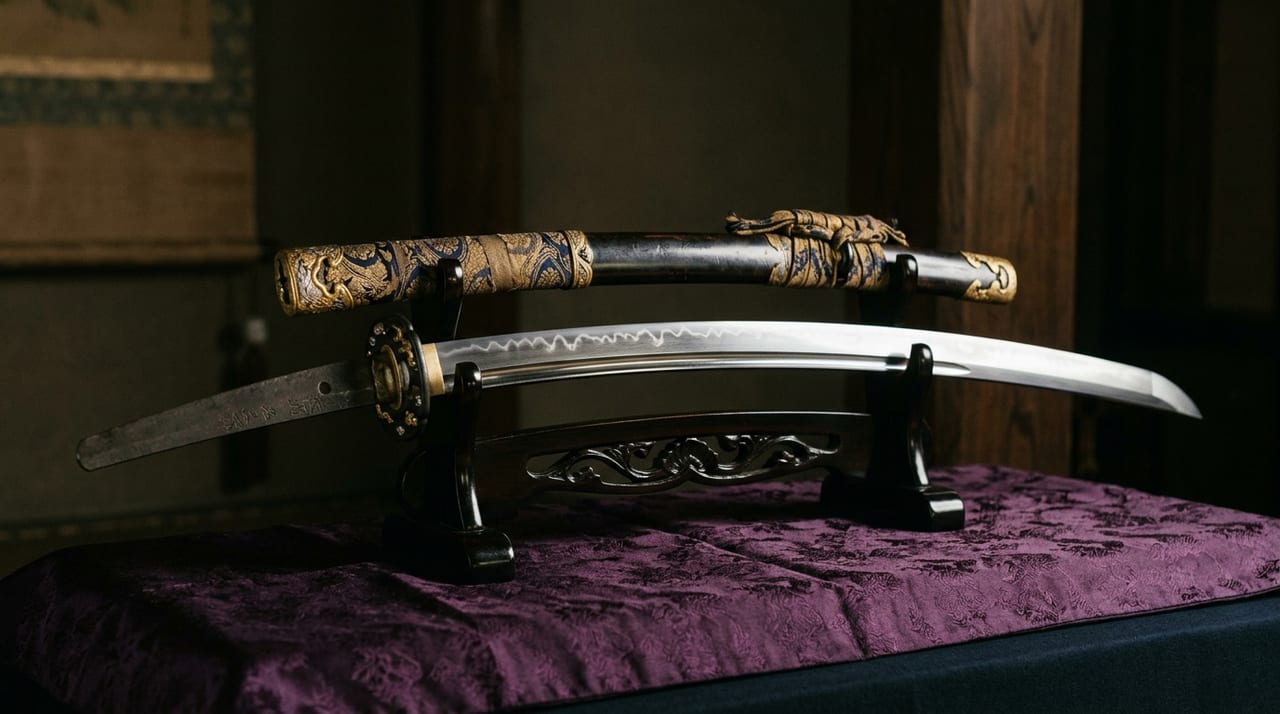
 * Image is for illustrative purposes only.
Ishikirimaru
石切丸
Also known as: The Divine Sword of Ishikiri Shrine; the Blade That Cuts Illness
Description
Ishikiri Tsurugiya Shrine and Ishikirimaru: The Sacred Blade That Severs Tumors and Illness
Ishikiri Tsurugiya Shrine (Ishikiri Tsurugiya Jinja), enshrined in Higashiōsaka City, Ōsaka Prefecture, is an ancient shrine that commands deep faith throughout the Kansai region as the "god of tumors and swellings" (dekimono no kami). Its divine treasure, the tachi "Ishikirimaru", is one of the most distinctive sacred swords in Japan's sword culture. The place name Ishikiri, as its name suggests, means "cutting stone." The shrine's principal deities, Nigihayahi no Mikoto and Umashimade no Mikoto, are ancient gods said to be descendants of the heavenly deities who descended to Yamato before the Tenson Kōrin in Japanese mythology. Ishikirimaru, handed down as the sacred sword of this shrine, is revered under its commanding name, "that which cuts through even stone," as a divine sword with the spiritual function of "severing illness and tumors." Even today, worshippers seeking recovery from illness continue to visit the shrine without end as the "god of dekimono (tumors and swellings)."
Making and Style of Ishikirimaru: A Masterpiece Tachi of the Kotōki (Ancient Sword) Period
Ishikirimaru is a tachi from the kotōki (ancient sword period), said to have been made in the Heian period (12th century), and its maker is traditionally said to be Arinari. Arinari is a swordsmith said to have been either a disciple or a son of Sanjō Munechika. Because his style is said to be in line with the Yamashiro blades of an older era, a connection with the Sanjō school has been pointed out. Ishikirimaru is a long tachi with a blade length of about 76 cm, and its blade is said to be a re-tempered blade (yakinaoshi). In 1939 (Shōwa 14), it was designated an Important Art Object, and it is carefully preserved as a sacred treasure of Ishikiri Tsurugiya Shrine.
Ohyakudo Mairi and Faith in Ishikirimaru: Religious Practice Continuing to the Present
Ishikiri Tsurugiya Shrine has long drawn popular faith as the "god of denbo (tumors and swellings)," and visitors performing ohyakudo mairi can still be seen on the shrine grounds today. Ohyakudo mairi is an ancient religious practice in which one prays by walking back and forth one hundred times between the main hall and the hundred-circuit stone. Families often perform it on behalf of relatives with serious illnesses. The ohyakudo mairi at Ishikiri Shrine is especially well known in the Kansai region as a practice for seeking recovery from internal illnesses, such as tumors, swellings, and cancer (gan; from the modern era onward). Even in this age of thriving modern medicine, many worshippers continue to hold faith in Ishikirimaru's spiritual power. This faith in Ishikiri Shrine as the "god of tumors and swellings" arose from the image of Ishikirimaru as a "sharp blade that cuts through stone" combined with its faith-based function of "cutting away illness." It is noted in folk belief research as a typical example in which the sword's function of "cutting" was elevated into the religious and magical function of "severing illness."
Ishikirimaru and Touken Ranbu: The Revival of a Sacred Blade in Modern Culture
Ishikirimaru appeared as a personified sword character in the browser and smartphone game Touken Ranbu (Tōken Ranbu Onrain), which began service in 2015, and suddenly became well known among younger generations. In the game, Ishikirimaru's character is set as "gentle, nurturing, and possessing healing power," and the faith-based function of "healing illness," which it holds as a sacred sword, is skillfully reflected in the character's attributes. After Ishikirimaru's appearance in Touken Ranbu, visits to Ishikiri Tsurugiya Shrine increased markedly. The shrine itself also carried out official collaboration with Touken Ranbu, and it drew attention as a point of contact between young sword fans and traditional shrine faith. This phenomenon vividly illustrates the intersection of Japanese tradition and the present day, as a rare cultural case in which the single sacred blade Ishikirimaru transformed from an "ancient divine sword" into an "icon of contemporary pop culture" while continuing to maintain its ties to shrine faith.
Ancient Deities of Yamato and Legends Before the Tenson Kōrin
In the records of the Kojiki and Nihon Shoki, Nigihayahi no Mikoto, the principal deity of Ishikiri Tsurugiya Shrine, is an unusual deity said to have descended to the land of Yamato before the heavenly grandchild (Ninigi no Mikoto, grandson of Amaterasu). As an ancient god who ruled Yamato before Ninigi's descent, he occupies a distinctive mythological position. Nigihayahi no Mikoto is said to have descended from heaven riding the "Ama no Iwafune" (heavenly rock boat). He took as his wife the younger sister of Nagasunehiko, who led the forces of Yamato. When Emperor Jinmu's eastern expedition arrived, he tried to persuade Nagasunehiko, and when that failed, he himself executed Nagasunehiko and submitted to Emperor Jinmu. This is a complex mythological course. This mythological status of Nigihayahi no Mikoto, as the "heavenly god who ruled Yamato before the Tenson Kōrin," forms the deep background to the religious authority of Ishikiri Tsurugiya Shrine and Ishikirimaru. As the sacred sword of this ancient god, Ishikirimaru bears the religious significance of being "the material embodiment of the oldest divine authority in Japanese mythology."
Legends & Stories
The mythology surrounding Ishikirimaru is inseparable from the remarkable deity enshrined at Ishikiri — Nigihayahi no Mikoto, one of the most theologically intriguing figures in the entire Kojiki/Nihon Shoki corpus. According to tradition, Nigihayahi descended to the Yamato plain in a 'heavenly rock boat' (ama-no-iwafune) before the main line of divine descent arrived — making him, in effect, an earlier generation of heavenly ruler than the imperial lineage. When the ancestral Emperor Jimmu advanced on Yamato in his legendary conquest, Nigihayahi sided with the native hero Nagasunehiko until persuaded otherwise, then finally submitted to Jimmu's line, integrating this parallel divine descent into the imperial framework. This 'earlier heaven-descended god' is the deity to whom Ishikirimaru belongs as a sacred sword — a talisman from before the beginning of the imperial age, from a time even older than the oldest recorded royal mythology. The sword's name adds another layer: a blade that cuts stone can cut anything, including disease, bad fortune, spiritual pollution. The hyakudo-mairi pilgrims who walk their hundred circuits today in the shadow of the Osaka hills are participants in a religious practice older than Japanese history as we know it — carrying prayers to a god who remembers a Japan before Japan, through a sword whose name promises the impossible: to cut through the hardest things that stand between a person and their healing.