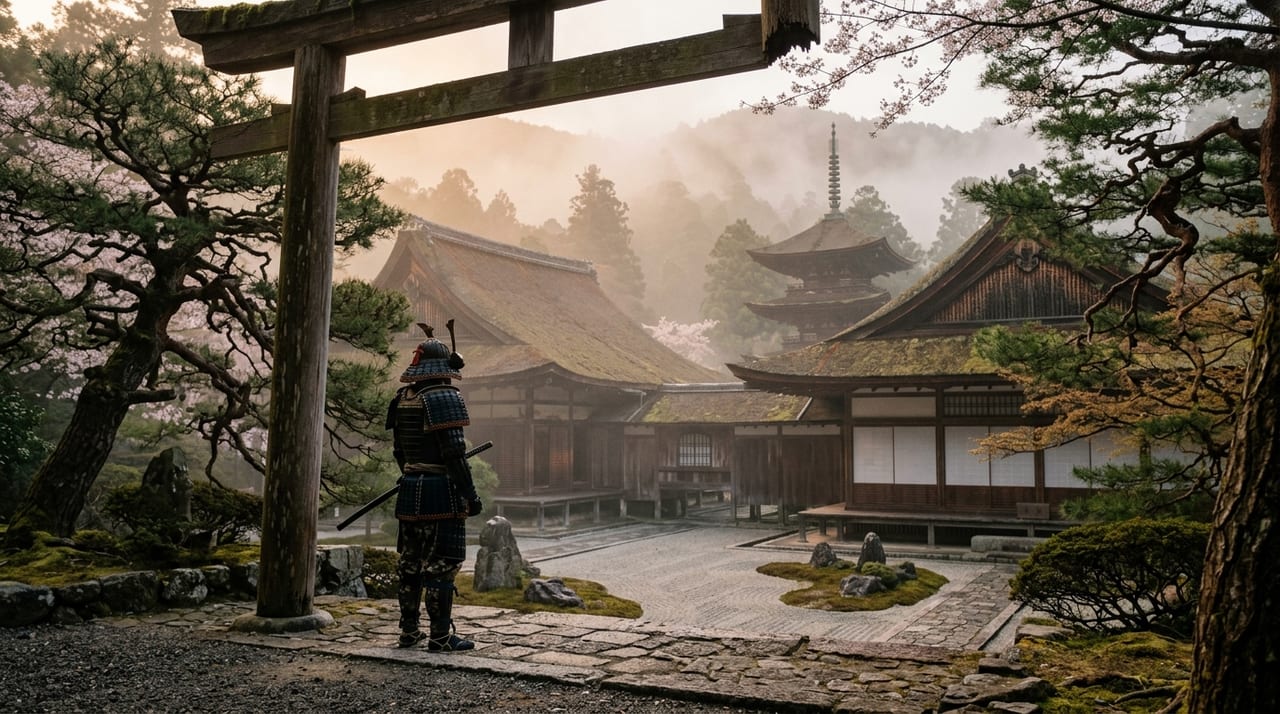
 * Image is for illustrative purposes only.
Heian-Kamakura
平安〜鎌倉
The most important period in the history of Japanese swords, when the Japanese sword was born and perfected. The elegance of Heian aristocratic culture and the sturdiness of Kamakura warriors fused, producing tachi with graceful curvature. Four of the Gokaden (Five Traditions) were established, and it was a golden age that produced unprecedented and unsurpassed master smiths, including the Tenka Sansaku (Three Great Smiths).
Description
The Birth of the Blade
In the late Heian period (around the end of the tenth century), a historic transition took place from straight swords imported from the continent to curved blades (wantō), and the prototype of the Japanese sword was born. This change is said to have arisen from the practical demands of mounted combat, where swords were drawn in a single stroke (nuki-uchi). By giving the blade a curvature, its cutting power rose dramatically. Early curved swords began with the format known as kenukigata tachi, in which the handle and tang were formed as one piece, and later developed into tachi with separately made handles. In Kyoto, Sanjō Munechika was active in the mid-Heian period and forged the Tenka Goken (Five Great Swords under Heaven) piece Mikazuki Munechika. Munechika's works feature itame-hada jigane and ko-midare hamon, and are known for their fantastic beauty, with a crescent-shaped uchinoke appearing within the hamon. The Awataguchi school that followed, with its six brothers (Kunitomo, Hisakuni, Kuniyasu, Kunikiyo, Arikuni, and Kunitsuna), was a major school that established the Yamashiro tradition. Tōshirō Yoshimitsu was counted among the Tenka Sansaku (Three Great Smiths) as a master of tantō. Yoshimitsu's tantō show a fine forging texture called nashiji-hada in the jigane, and are characterized by a refined sugu-ha hamon with ko-ashi. Many meibutsu have been handed down, including "Ichigo Hitofuri," "Atsushi Tōshirō," and "Honebami Tōshirō."
Prosperity in the Kamakura Period
With the start of the Kamakura period, Minamoto no Yoritomo established a warrior government in Kamakura, and the samurai became the leading force in politics. Reflecting an age of war, demand for tachi surged, and Bizen Province (present-day Okayama Prefecture) flourished as Japan's largest sword-producing region. The hallmark of the Bizen tradition was a mass-production system built on abundant high-quality sand iron and pine charcoal, and several smith groups in the Yoshii River basin, including Osafune and Hatakeda, competed with one another. Mitsutada, founder of the Osafune school, was known for his bold chōji-midare hamon. His son Nagamitsu perfected the splendid ō-chōji-midare and established the golden age of Bizen blades. Nagamitsu's masterpiece "Daihannya Nagamitsu" was valued at 600 kan of coin in the Muromachi period, and is now designated a National Treasure. Kagemitsu created the distinctive hamon known as kataochi-gunome.
The Founding of the Sōshū Tradition
The Sōshū tradition was founded in Kamakura by Shintōgo Kunimitsu. Kunimitsu is said to have been either a son of Awataguchi Kunitsuna or a disciple of Kunimune of Bizen, and many masterpieces, particularly tantō, survive. His disciple Masamune is the most celebrated smith in the history of the Japanese sword. He established an innovative style with bold nie-deki hamon showing complex workings such as kinsuji, sunagashi, and chikei. Masamune's techniques spread throughout the country through ten senior disciples known as the Masamune Juttetsu (Ten Disciples of Masamune), greatly advancing Japanese swordmaking. Gō Yoshihiro developed the Sōshū tradition in Etchū and is counted among the Tenka Sansaku (Three Great Smiths). Yet no signed works survive, and he is so rare that it is said, "No one has ever seen a Gō or a ghost."
Other Traditions
The Yamato tradition developed centered on the temples and shrines of Nara, and five schools are known: Taima, Senjuin, Shikkake, Tegai, and Hōshō. Its works are practical in orientation, meeting the demands of sōhei (warrior monks). Many are simple, robust works with masame-hada jigane and a sugu-ha or chū-sugu-ha temper. The Yamashiro tradition has a refined and elegant style that reflects the culture of Kyoto. Rai Kunitoshi and his son Rai Kunimitsu reached its peak in the mid-to-late Kamakura period. Rai Kunitoshi's tachi feature a tightly forged ko-itame-hada jigane with a deep-nie sugu-ha, and surpass others in dignified quality.
The Influence of the Mongol Invasions
In the late Kamakura period, the Mongol invasions (Genkō: the Bun'ei campaign of 1274 and the Kōan campaign of 1281) had a major impact on the development of swords. To counter the group tactics of the Mongol forces and their leather armor, bold tachi were demanded, with broad mihaba, thick kasane, and extended kissaki. The powerful form of tachi from this period forms an important transitional phase leading to the great tachi of the Nanboku-chō period.
Collecting Value
Swords from the Heian and Kamakura periods survive in extremely small numbers. Signed examples in particular include many designated as National Treasures, Important Cultural Properties, or Important Art Objects. Every element, including the hada of the jigane, the workings of the hamon, the functional beauty of the curvature, and the fineness of the horimono, is fused at a high level. This established the ideal that later smiths pursued endlessly. For collectors, it is the supreme object of collecting that touches the source of the Japanese sword, and owning a single blade can be a lifelong dream.
Characteristics of This Era
- Heian-period tachi are slender with deep koshi-zori, and they have an elegant form with a ko-kissaki (small kissaki). The courtly refinement of aristocratic culture is reflected in the blade, and functional beauty and decorative beauty merge beautifully.
- In the mid-Kamakura period, broader tachi with ikubi-kissaki appeared, and powerful forms emerged. As if symbolizing the establishment of the warrior government, the construction shifted toward sturdy, practical designs.
- The mid-Kamakura period was the golden age of the Japanese sword. The jigane's hada mixes itame, mokume, and masame in complex ways, and the hamon blossomed into diverse expressions such as sugu-ha, ko-midare, and chōji-midare.
- In the late Kamakura period, following the Mongol invasions of 1274 and 1281, the form changed to broad mihaba, thick kasane, and extended kissaki. The practical demand to cut through Mongol leather armor is reflected in the form.
- Four of the Gokaden (Five Traditions), Yamashiro, Yamato, Bizen, and Sōshū, were established (the Mino tradition rose only from the Nanboku-chō period onward). Each tradition had its own forging methods, hardening techniques, and aesthetic sense, and the climate and history of each production region are strongly reflected in its style.
- In the Bizen tradition, white shadows on the jigane called utsuri appear as a characteristic feature. This is a Bizen-specific phenomenon created by temperature control during hardening and the composition of the iron, and it is a technical achievement that is extremely difficult to reproduce.
- In the Sōshū tradition, hamon with strong nie show complex workings such as kinsuji, sunagashi, and chikei, creating scenery that is both wild and beautiful. This technique, established by Masamune, greatly expanded the range of expression in the Japanese sword.
- Signed blades in which the nakago remains ubu (in its original, unaltered state) are extremely rare. Signed Heian-period tachi in particular survive in small numbers, and some are designated as National Treasures.