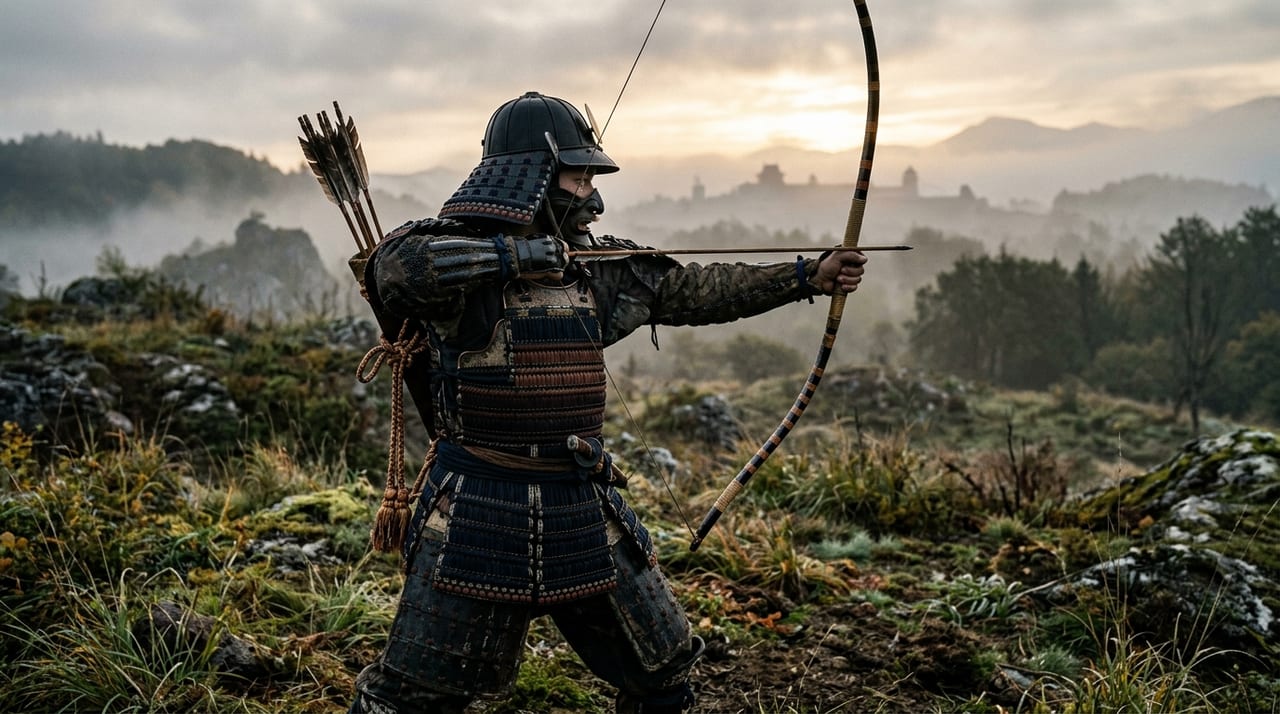
 * Image is for illustrative purposes only.
Fujiwara no Hidesato
藤原秀郷
Tawara Tōta — Slayer of Taira no Masakado and the Giant Centipede
Description
Tawara Tōta's Birth and Fame as a Hero of the Eastern Provinces
In the mid-Heian period, Fujiwara no Hidesato, who was based in Shimotsuke Province (present-day Tochigi Prefecture), was a warrior widely known by the nickname "Tawara Tōta." Although he belonged to the Hokke branch of the Fujiwara clan, he stood apart from the courtly culture of the capital and was a typical provincial warrior who honed his martial skills on the frontier lands of the east. The story of his life intertwines legend and historical fact in complex ways, and it exerted a great influence on the military chronicles and tales that followed. In the context of Japan's heroic legends, Hidesato's name holds an unshakable place as a master archer and a general of both wisdom and courage.
The Taira no Masakado Rebellion and Hidesato's Exploits
In the 2nd year of Tengyō (939), Taira no Masakado, a Bandō chieftain based in Shimōsa Province, subdued the wider Kantō region, proclaimed himself "New Emperor" (Shinnō), and launched a rebellion against the imperial court. In response to this Taira no Masakado Rebellion, the court ordered Taira no Sadamori and Fujiwara no Hidesato to pursue and subdue him. In the 3rd year of Tengyō (940), Hidesato allied with Sadamori, defeated Masakado's army at the battle of Kitayama in Shimōsa Province, and succeeded in killing Masakado. For this achievement, Hidesato was appointed provincial governor of Musashi and Shimotsuke and received many rewards. Hidesato's martial prowess in defeating Masakado established his fame as "the foremost warrior of the east," and it also laid the groundwork for the many legends that would later arise.
The Legend of the Centipede Slayer
The most famous legend about Hidesato is "Tawara Tōta's Slaying of the Centipede." One night, as Hidesato was crossing the Seta no Karahashi bridge, a huge serpent blocked the bridge in his path. While many people feared it and avoided it, Hidesato calmly stepped over the serpent and crossed. The next morning, a beautiful woman appeared and said to him, "I am the daughter of the dragon god who lives in Lake Biwa. I have seen your courage, and I have a request for you." The dragon god's daughter pleaded with him to slay a giant centipede that was tormenting the Dragon Palace in Lake Biwa. Hidesato agreed, nocked an arrow to his bow, and shot at the centipede. The first two arrows bounced off, but when he shot a third arrow coated with his saliva, it struck true and killed the centipede. As a token of gratitude, the dragon god gave him various treasures. Among them was a rice bag that never runs out (tawara), and according to the legend, this is why he came to be called "Tawara Tōta" from then on.
Kenukigata Tachi and Sword Culture
Among the swords particularly noteworthy for their connection to Fujiwara no Hidesato is the kenukigata tachi (tweezers-shaped tachi). The kenukigata tachi is a distinctive tachi style of the Heian period, featuring an openwork carving on the hilt (tsuka) resembling tweezers (a tool for plucking hair). Ise Jingū (Ise Grand Shrine) holds a kenukigata tachi said to have been given by the dragon god as thanks for the centipede slaying, and Hōgonji temple on Chikubushima holds a kenukigata tachi said to have been dedicated by Hidesato. Both are designated Important Cultural Properties. The tachi favored by Heian-period warriors had a curved blade with sori (curvature), which became the prototype of the later Japanese sword, and it embodied the dignity and aesthetic sense of the warrior. Hidesato's era was an important transitional period in which Japanese swords shifted from the straight-bladed sword (chokutō) to the curved sword (wantō), and Hidesato was precisely a warrior who lived through the dawn of that sword culture.
Renown as a Master of the Bow and Arrow
Hidesato was renowned not only for his swordsmanship but also as a master of the bow and arrow, and the use of arrows in the legend of the centipede slaying is emblematic of this. For warriors of the Heian period, the bow and arrow was an even more important weapon than the sword, and the technique of kisha (mounted archery), drawing the bow from horseback, was the core military skill of the warrior. The combination of this archery skill with a bold and steadfast spirit is the fundamental reason Hidesato was passed down through later generations as the ideal Heian warrior.
The Hidesato Line and the Spread of Warrior Families
The descendants of Fujiwara no Hidesato spread across the Kantō and Tōhoku regions as the Hidesato line of the Fujiwara clan, forming many powerful warrior groups. Many of the eminent eastern warrior families that were active throughout the medieval period, including the Sano clan, Oyama clan, and Yūki clan, claimed descent from Hidesato. The spread of this lineage shows that Hidesato was revered as the spiritual founder of the eastern warriors, and it is also evidence that his martial renown and legends were passed on across generations. In sword culture as well, the spirit of eastern warrior swordsmanship established in Hidesato's era became one of the distant wellsprings of the sword worship in the later warrior society.
Notable Swords
- Kenukigata tachi: a tachi with a tweezers-shaped openwork carving on its hilt, a style unique to the Heian period. Examples said to be connected to Hidesato remain at Ise Jingū (Ise Grand Shrine) and Hōgonji temple on Chikubushima. It is a symbolic sword of the Heian warrior, representing the transition from straight swords to curved swords
- Bow and arrow (ōyumi): the weapon Hidesato used in the legend of the centipede slaying. It was the main weapon of Heian-period warriors, and Hidesato was celebrated as its foremost master