New Arrivals — Browse our catalog for the latest authentic Japanese sword arrivals. Browse →
935–940 (Jōhei 5 – Tengyō 3)
Kantō region centered on Shimōsa and Hitachi provinces (present-day Ibaraki, Chiba and Saitama prefectures and surrounding areas)
Forces
Taira no Masakado's Forces
Imperial Court / Fujiwara Hidesato / Taira Sadamori Coalition
About 13 min read
From Jōhei 5 (935) to Tengyō 3 (940), the Taira no Masakado Rebellion unfolded in Bandō (present-day Kantō region). It was the first major uprising in Japanese history in which the warrior class made its full entrance onto the political stage. Masakado subdued the eight provinces of Bandō by force and declared himself "Shinnō" ("New Emperor"), attempting to establish an independent royal authority. This incident was more than a mere regional rebellion. It exposed the limits of the Heian court's control over the provinces and opened the door to the era of warrior governments that would last for centuries, marking a historic turning point.
Taira no Masakado was a warrior of the mid-Heian period. He came from the Kanmu Taira lineage, descended from Emperor Kanmu. His father, Taira no Yoshimasa, was a warrior of the line of Prince Takamochi, based in Shimōsa Province. Masakado went up to the capital at a young age, served Fujiwara no Tadahira, and honed his martial skills. After returning to his home region of Bandō, he was drawn into local territorial disputes and conflicts among relatives, and gradually deepened his opposition to the powerful warriors of Bandō.
Masakado's rebellion was not, from the start, a revolutionary act aimed at overthrowing the royal authority. It began as a very private land dispute. Each time Masakado suppressed by force the forces that opposed him, he found himself, before he knew it, in a position to control all of Bandō. The declaration of "Shinnō" was made in the form of receiving a divine oracle through a shrine maiden, and it expressed Masakado's awareness of having a "heavenly mandate." No clear historical record remains of the tachi that Masakado carried.
Swords of the mid-Heian period were in a transitional phase, moving from straight blades to the curved tachi. The years 935 to 940, when Masakado was active, coincide with the moment when the prototype of the Japanese sword was taking shape. The Dōjigiri Yasutsuna, forged in the Heian period by the swordsmith Yasutsuna of Hōki Province (present-day Tottori Prefecture), is designated a National Treasure as one of the oldest surviving curved tachi.
Since Jōhei 5 (935), Masakado had fought repeatedly with members of his own family, including Taira no Kunika, Taira no Sadamori, and Yoshikane. In the 11th month of Tengyō 2 (939), he attacked the provincial office of Hitachi, and then went on to subdue the provincial government offices (kokuga) in Shimotsuke, Kōzuke, and other parts of Bandō one after another. By the end of Tengyō 2 (939), he had taken control of the eight provinces of Bandō from his base in Shimōsa, bringing under his rule the provincial offices of Musashi, Sagami, Kazusa, Shimōsa, Hitachi, Kōzuke, Shimotsuke, and Awa.
In the 12th month of the same year, Masakado declared himself "Shinnō" and proclaimed the establishment of his own imperial governmental organization. This declaration shook the court in the capital. For the aristocrats and warriors of the capital, the emergence of a separate imperial authority in the distant land of Bandō was an unprecedented shock. In this upheaval, later recorded as the Jōhei-Tengyō Disturbances, Masakado is remembered in history as the first person to demonstrate that "warriors could stand independently as political agents."
In response, the court issued an order for pursuit and commanded the warriors of the Kantō region to put Masakado down. Those who answered this command were Fujiwara no Hidesato (Tawara Tōda) and Taira no Sadamori, Masakado's cousin. Hidesato was a warrior based in Shimotsuke Province, and he later became famous as the hero of the Centipede-Slaying legend.
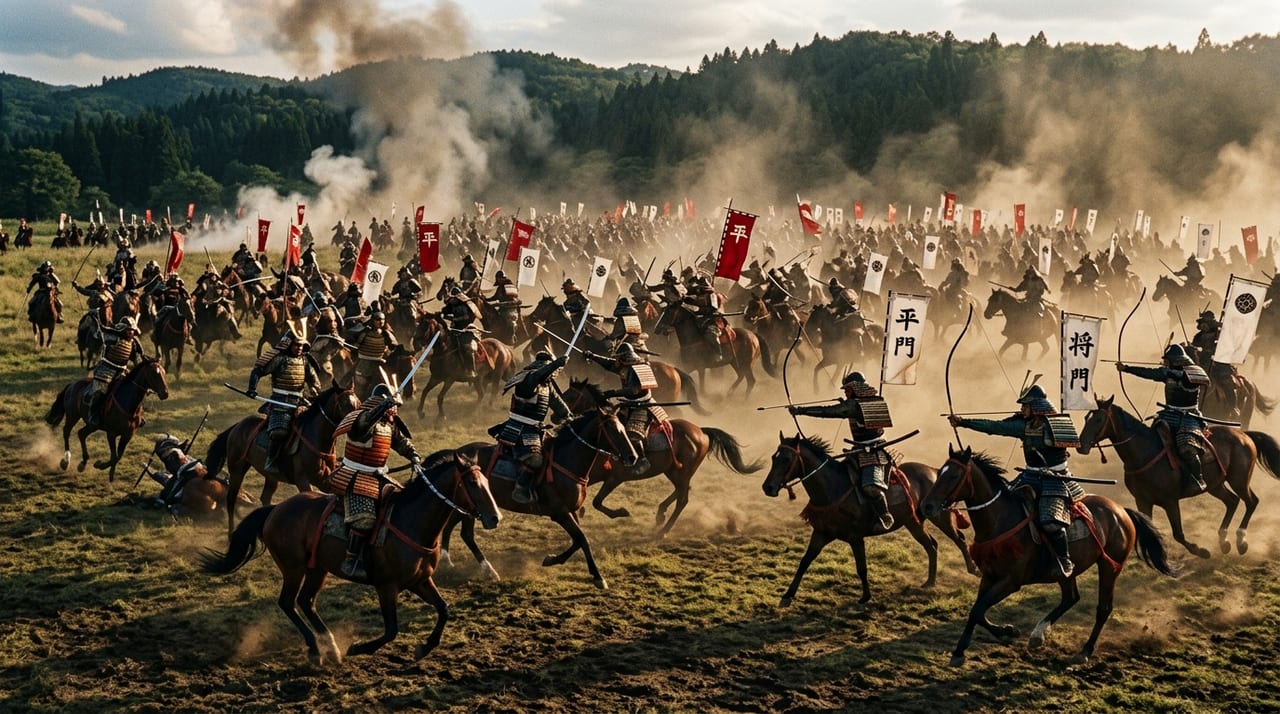
In Tengyō 3 (940), the combined forces of Fujiwara no Hidesato and Taira no Sadamori closed in on Masakado's home base. The decisive battle was fought on a plain in Sashima District (present-day Bandō City, Ibaraki Prefecture), in Shimōsa Province. Masakado led several hundred elite riders to face Hidesato's forces, but he is said to have been killed in action after being struck by an arrow.
In recognition of his merit in suppressing this rebellion, Fujiwara no Hidesato was appointed provincial governor of Shimotsuke and Musashi, and he would be remembered in later ages as "Tawara Tōda." No detailed record remains of the bows, arrows, or swords that Hidesato used.
In the mid-Heian period, when this battle took place, the use of swords was mainly limited to close combat as a supplement to archery by mounted warriors. Battles in Masakado's time generally followed a pattern in which warriors first shot arrows at each other from horseback, and then moved to close combat with uchimono (swords and other striking weapons). Accordingly, the record that Masakado was ultimately brought down by an arrow is consistent with the style of warfare of this era.
After Masakado was killed, his head was sent to the capital and publicly displayed. However, a legend arose that the head had flown back to the Kantō region. Masakado's head mound (Masakado-zuka) still exists today in Ōtemachi, Chiyoda Ward, Tokyo, where it is revered as a special spiritual presence. He is also enshrined as a deity at Kanda Myōjin. Masakado has been passed down through the ages as the "guardian deity of the eastern provinces" and "a symbol of the warrior's soul."
This concept of Masakado as a vengeful spirit resonates deeply with the faith that Japanese swords have a "spirit dwelling within them." Masakado's actual sword does not survive, but one of the origins of the image of the "warrior's soul, the sword" lies precisely in the Taira no Masakado Rebellion. As the warrior class worked to establish its own identity, the sword became a spiritual symbol that went beyond a mere weapon.
The most important historical significance of the Taira no Masakado Rebellion is that it marked the starting point of a transformation in which warriors went from being "servants of the court" to "independent political agents." The later development of the warrior bands of the eastern provinces became the foundation for the Genpei War and the establishment of the Kamakura shogunate.
As the starting point of the core Japanese cultural proposition that "the warrior's soul lies in the sword," the Taira no Masakado Rebellion carries an immeasurable historical weight, however small it may appear. It is no exaggeration to say that Masakado's soul, which scattered on the fields of Bandō, became a force that moved the history of Japanese swords thereafter. About 250 years after Masakado's rebellion, Minamoto no Yoritomo, who united the warrior bands of the same Bandō region, established the Kamakura shogunate and completed the age of the warrior. The origin of that lineage certainly lies in the Masakado Rebellion.
Fujiwara no Hidesato
Fujiwara no Hidesato (Tawara Tōda) — the loyalist warrior who killed Masakado under imperial commission
Taira no Masakado
Taira no Masakado — the rebel who proclaimed himself New Emperor and seized eight eastern provinces
Minamoto no Yorimitsu
Minamoto no Yorimitsu — Masakado's contemporary, legendary demon-slayer and owner of the famous Dōjigiri Yasutsuna blade
平安中期に勃発した「承平天慶の乱」——東国では平将門の乱(939年)、西国では藤原純友の乱(939〜941年)が同時並行して展開した。この二つの反乱が東国・西国武士団の刀剣文化に与えた影響、当時の刀剣形態(上古刀末期から古刀草創期)、武士が「刀を主武器とする戦士」として確立する転換点としての位置づけを解説する。
2026-05-04
平安初期に製作されたと伝わる名刀「小烏丸(こがらすまる)」の歴史・形態・伝承を解説。「両刃(もろは)と片刃(かたは)の中間形態」という独特の刀身構造、桓武平氏の伝来刀としての来歴、現在の所蔵場所(宮内庁三の丸尚蔵館)と文化財的価値、そして小烏丸が日本刀形成史に占める重要な位置づけを詳述する。
2026-05-03