Kogarasumaru (小烏丸)—The Imperial Household Agency Treasure: How the Taira Clan's Heirloom Sword Tells of the Birth of the Japanese Blade
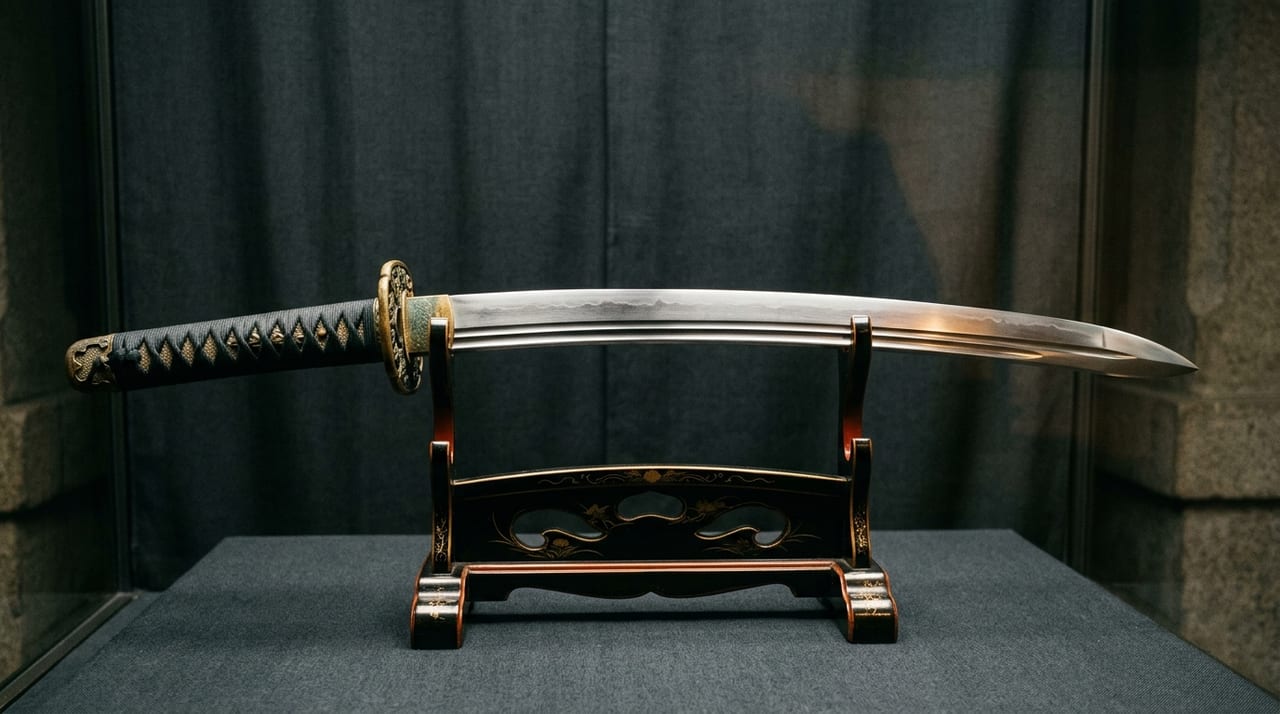 * Image is for illustrative purposes only.
Table of Contents
What is Kogarasu Maru—the "Missing Link" in Sword History
Kogarasu Maru is a renowned sword that occupies an exceptionally unique position in the history of Japanese swords. This blade, said to have been forged in the early Heian period (around the 9th century), was a sword that existed at the most important turning point in the formation history of Japanese swords—the transitional period "from straight swords (chokutou) to curved swords (wantou)."
Today it is housed by the Imperial Household Agency's Sannomaruitakagura-kan (in Higashigyo-en, the East Gardens of the Imperial Palace, Tokyo) as an imperial treasure (gyobutsu), and opportunities for public viewing are limited. However, its distinctive form and the mystique of its provenance are passed down with great interest among sword enthusiasts and researchers.
The Provenance of Kogarasu Maru—the Kanmu Taira Clan's Hereditary Treasure Sword
The "Clan Sword" of the Kanmu Taira
Kogarasu Maru is transmitted as the "hereditary treasure sword of the Kanmu Taira (Kanmu Heishi)." It is said to have been passed down through generations by the leaders of the Taira, descendants of Emperor Kanmu (reigned 781-806).
According to legend, it is also said to have been granted by the gods of Ise Shrine to Taira no Takamochi (the founder of the Kanmu Taira who descended to the eastern provinces and became a warrior). As a sword with mythological provenance, it was deeply connected to the authority and sanctity of the Taira clan.
With the Taira Clan—Before and After Dannoura
In the final decisive battle of the Gempei War—the Battle of Dannoura (1185)—the Taira clan perished by throwing themselves into the sea. At this time, the "Kusanagi Sword," one of the "Three Imperial Regalia," is also said to have sunk into the sea.
It is unclear through what circumstances the Taira clan's hereditary treasure sword Kogarasu Maru was transmitted to later generations, but at least one sword came to be transmitted by the name "Kogarasu Maru," and in modern times it was presented to the imperial household to become an imperial treasure.
The Form of Kogarasu Maru—the Mystery of "Between Double-Edge and Single-Edge Construction"
The Distinctive Blade Structure
The greatest characteristic of Kogarasu Maru is its distinctive blade structure. It possesses an "intermediate form" that is neither a typical Japanese sword (single-edged with curve) nor an old straight sword (double-edged or single-edged without curve).
The specific formal characteristics are as follows.
- Fusion of double-edge (moroha) and single-edge: Approximately one-third near the kissaki (blade point) is double-edged (having edges on both sides in a sword-like form), while the majority of the blade is the normal single-edge (with an edge on one side only). This is an intermediate form between "morohazukuri (double-edge construction)" and "single-edge construction," which is extremely rare in Japanese sword history.
- The presence of curve (sori): The blade has a curve and is not a completely straight sword. It has a tendency toward a waist curve and exhibits a prototypical form of the tachi from the Heian period.
- Blade length: It is said the cutting edge length is approximately 71 cm (about 2 shaku 3 sun 5 bu).
This form embodies "the transitional period from straight swords (double-edged swords) to wantou (curved single-edged swords)" and is an extremely important tangible resource for understanding the formation process of Japanese swords.
Technical Level "Before Old Swords"
The manufacturing period of Kogarasu Maru (early Heian period, around the 9th century) corresponds to the transitional period from "jokoutou (ancient swords)" to "kotou (old swords)" in the standard chronological division of Japanese swords.
Jokoutou refers to straight swords from before the Nara period, while kotou refers to curved swords (tachi, uchigatana, etc.) from the mid-Heian period onward. Kogarasu Maru, with its "bridging" form between these two eras, is precisely the missing link in Japanese sword history.
The Mystery of Japanese Sword Birth Revealed by Kogarasu Maru
Why Did Japanese Swords Develop a Curve?
One of the greatest mysteries in the formation history of Japanese swords is "why the transition from straight swords to curved swords occurred." The existence of Kogarasu Maru provides one answer to this mystery.
- Cavalry tactics adaptation theory: The theory that as warriors of the Heian period came to prioritize mounted combat, "waist-curved swords" suitable for drawing and slashing from horseback were advantageous. The waist curve of Kogarasu Maru embodies this "adaptation to cavalry warfare."
- Forging technique evolution theory: The theory that as folding and hammer-welding technique evolved, "naturally occurring curves" began to develop due to differences in carbon distribution in the steel. The difference in thermal expansion between the edge section (high-carbon steel) and the spine section (low-carbon steel) creates the curve.
- Independence from continental influence theory: A transition from imitation of the continent (Tang dynasty) in the Nara period to Japan's unique sword forms.
The form of Kogarasu Maru—double-edged kissaki, mostly single-edged blade, with waist curve—can also be interpreted as an "experimental form" embodying the trial and error of this transitional period.
Kogarasu Maru in the Modern Era—Its Value as a Cultural Property
As an Imperial Treasure Held by the Imperial Household Agency
Kogarasu Maru today is an imperial treasure (gyobutsu) held by the Imperial Household Agency's Sannomaruitakagura-kan. Its display to the general public is limited, though it may be exhibited at special exhibitions and similar occasions.
Its value as a cultural property is immeasurable. As the "oldest extant example of a curved sword from the early Heian period," it is a unique and irreplaceable resource in the study of Japanese sword formation history.
Its Position in Sword Research
Sword researchers and sword historians regard Kogarasu Maru as "material evidence demonstrating the establishment period of Japanese swords." It is extremely rare for swords with similar forms to exist today, and it has great academic significance as a resource that directly demonstrates the level of forging technology and sword design from the early Heian period.
Furthermore, its unique form as an "intermediate form between double-edge and single-edge" is noted from a comparative cultural perspective as demonstrating the interface between continental sword culture and Japan's unique tou culture.
Traditions and Culture Surrounding Kogarasu Maru
Connection to Myths and Legends
As its name "Kogarasu" (small crow) suggests, Kogarasu Maru is said to be connected with the sacred crow (messenger of the gods, Yatagarasu). The tradition that it was granted by the gods of Ise Shrine embodies a thought in Japanese culture that swords are not mere weapons but "vessels for sacred power (yorishiro)."
Kogarasu Maru in Kabuki and Literature
The name Kogarasu Maru appears in kabuki and Japanese literature. In the kabuki play "Genpei Nunobi-ki no Taki," it appears as a renowned sword of Taira no Kiyomori, with its mystical provenance dramatically depicted.
Attributed to Amakuni and "Kissaki Morohazukuri"—Two Keys That Characterize Kogarasu Maru
In discussing Kogarasu Maru, the tradition regarding its creator and the name of its blade form are essential.
Although Kogarasu Maru is unsigned, it has traditionally been transmitted as "attributed to Amakuni." Amakuni is a legendary swordsmith said to have been active from the Nara through early Heian periods and is counted among the founders of Japanese swords. However, since it is believed that Amakuni's works include some with signatures, there has long been debate about whether the unsigned Kogarasu Maru can truly be definitively attributed to Amakuni, and it is most appropriate to understand it as "creator by tradition."
The blade form is called "kissaki morohazukuri." A certain range near the kissaki becomes double-edged (moroha), while below that is the normal single-edge—a distinctive structure created during the transitional period from straight swords to wantou. Since Kogarasu Maru is the representative work of this form, kissaki morohazukuri is also known by the alternate name "kogarasuzukuri." The fact that a blade form style is named after the sword itself eloquently speaks to the symbolic position that Kogarasu Maru occupies in sword history.
In terms of provenance, recent research has filled in details. It is said to have been granted to Taira no Sadamori, who quelled the Taira no Masakado Rebellion, by the imperial court, and subsequently became a treasured possession of the Taira clan. From the Muromachi period onward, it passed into the hands of the Ise clan, and later into those of the Tsushima domain lord Sou. Then in Meiji 15 (1882), when the head of the Sou family presented it to Emperor Meiji, it became an imperial treasure, and so it remains today.
Conclusion—Kogarasu Maru is a Witness to Japanese Sword Birth
Kogarasu Maru is often spoken of as "a renowned sword from the early Heian period," but its essential significance lies in its being "an extant sword embodying the transitional period from straight swords to wantou."
Its form, with coexisting double-edge and single-edge sections and a waist curve, eloquently tells how Japanese swords were born. This single blade, protected as an imperial treasure by the Imperial Household Agency, is living evidence of the moment when Japanese smiths more than a thousand years ago produced the Japanese swords that Japan is proud to present to the world.
If you are interested in the history and provenance of swords, please also check out our column list.