Mekugi-Ana Drilling and Precise Nakago Finishing — The Kaji Techniques Behind the Joint Between Blade and Tsuka
 * Image is for illustrative purposes only.
Table of Contents
What Is a Mekugi-Ana? — The Small Hole That Connects Blade and Tsuka
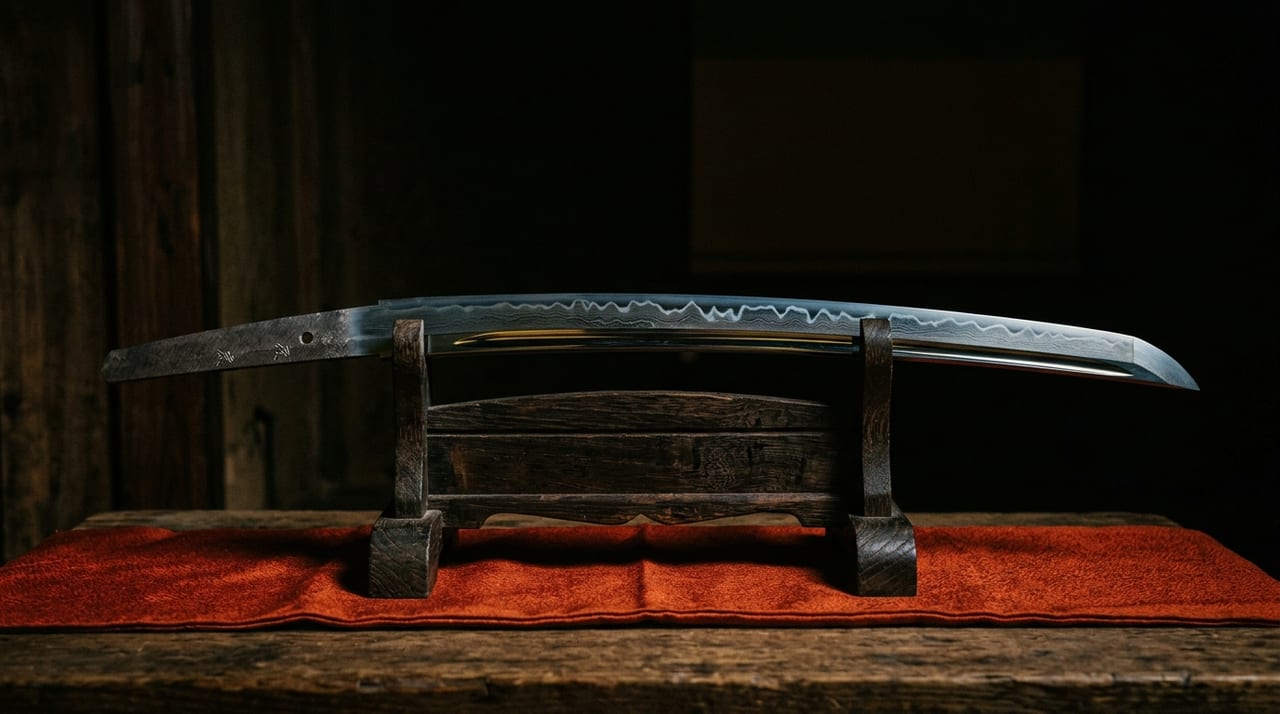
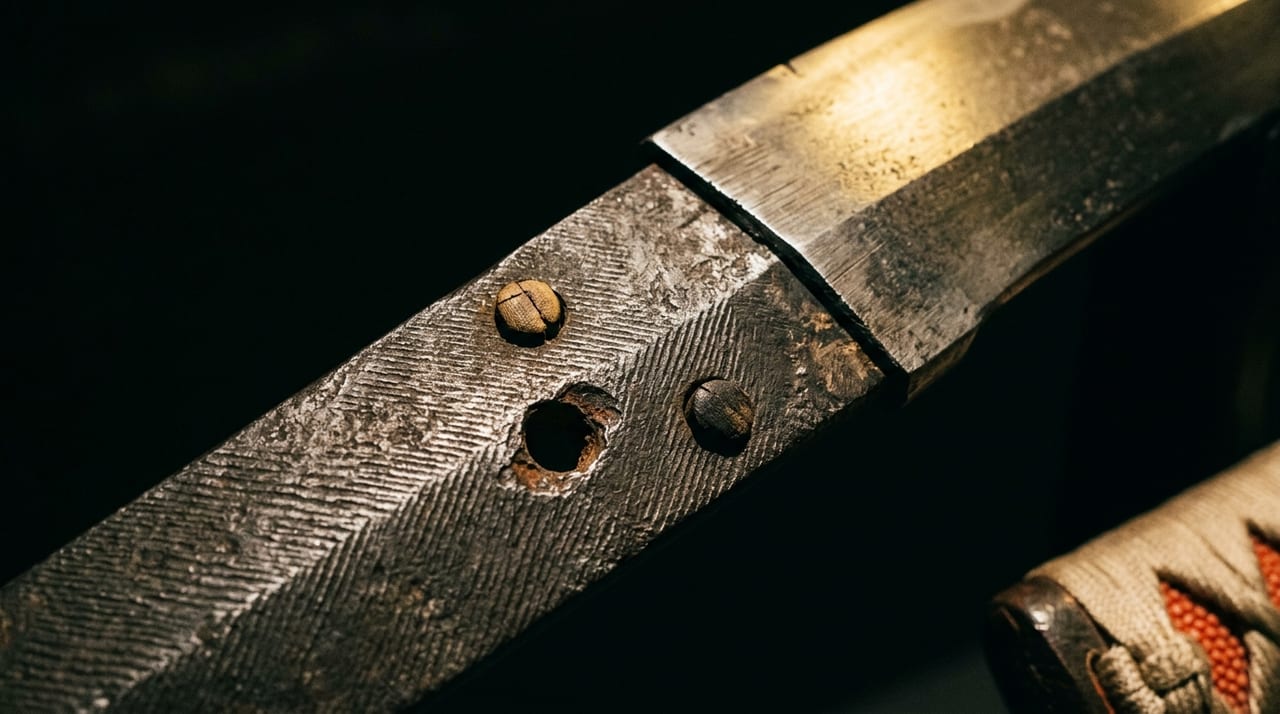
A "mekugi-ana" is a hole drilled in the nakago (tang: the part of the blade inserted into the tsuka) of a Japanese sword. After the nakago is inserted into the tsuka, a thin rod called a "mekugi" (usually made of bamboo) is passed through the side of the tsuka to secure it. As long as the mekugi does not come free, the nakago cannot separate from the tsuka.
This small hole is in fact of great importance to the sword's function, safety, and provenance estimation. The specialized role of the craftsman who handles the mekugi itself is also covered in detail in The Role, Techniques, and History of the Mekugishi Craftsman.
The Material and Role of the Mekugi — Why Bamboo?
The most common material for mekugi is "bamboo (take)." Metal mekugi also exist (mainly for ceremonial or decorative use), but bamboo is the standard for practical swords.
The reasons bamboo is chosen as a mekugi material are as follows.
Appropriate hardness and elasticity: Bamboo is hard and resistant to breaking, yet has sufficient elasticity to absorb shocks.
Ease of procurement and replacement: Bamboo was readily obtainable even on the battlefield or during campaigns, allowing mekugi to be replaced on the spot if one broke.
Safety valve function: When excessive force is applied (such as the sword striking something hard), the bamboo mekugi breaks first, functioning as a "fuse" that minimizes damage to the nakago and tsuka.
Positioning the Mekugi-Ana — A Critical Judgment by the Tōkō
The position of the mekugi-ana is determined by the tōkō (swordsmith) during the finishing stage of the nakago. The following considerations are required for positioning.
The Nakago's Strength and the Position of the Hole
Since the mekugi-ana is a hole that passes through the nakago, it must be placed in a position that does not compromise the nakago's strength.
Basic principle: The hole is placed at the center of the nakago (at the midpoint of the nakago's width). An off-center position makes the nakago prone to breaking.
Vertical position: A position set some distance from the machi (the boundary between the nakago and the blade) — typically about 5–8 cm — is common. This distance varies depending on the sword's purpose (practical or ceremonial), period, and school.
Alignment with tsuka length: If the tsuka length and the nakago length and mekugi-ana position are not aligned, the tsuka will not fit properly onto the nakago. The tōkō sometimes consults with the tsuka maker to determine the optimal position.
Historical Changes — Period Trends in Position
There are period-based trends in the placement of the mekugi-ana on the nakago. In general, older swords (Kamakura and Nanbokuchō periods) tend to have the hole positioned closer to the machi (nearer the base of the nakago), while newer swords (Edo period) tend to shift it slightly further away (toward the middle of the nakago). This is, however, a generalization, and varies widely depending on school and tōkō.
Techniques for Drilling the Mekugi-Ana — How the Hole Is Made
Drilling the mekugi-ana is one of the final steps in the nakago finishing process.
Tools Used
Mekugi-kiri (mekugi drill): A drill specifically for mekugi-ana. Unlike ordinary drills, specialized tools matched to the shape of the hole (round or square) are used.
Drilling procedure
- Mark the mekugi-ana position on the nakago with sumi (ink) or a tagane (chisel)
- Drill gradually with the mekugi-kiri (proceeding carefully, as the nakago steel has hardened since before yaki-ire (quenching))
- Carefully remove the burr around the edge of the hole and finish so that the mekugi passes through smoothly
Hole Shape — Square Holes and Round Holes
The cross-sectional shape of a mekugi-ana comes in two types: "square hole (kaku-ana)" and "round hole (maru-ana)."
Square hole (square cross-section): Bamboo mekugi are often shaped with a square cross-section, and square holes matched to this are the traditional form. A square hole prevents the mekugi from rotating and provides stable fixing force.
Round hole (circular cross-section): A more modern form, common when metal mekugi (rivet or pin style) are used. Round holes are also seen in gendaitō and iai swords.
From an authentication standpoint, the shape, size, and finish quality of the hole provide material for estimating the period and school.
The Significance of Multiple Mekugi-Ana — Evidence of Suriage
When a nakago has multiple mekugi-ana, each hole carries a different meaning.
Evidence of Suriage (Shortening)
The most significant case is "suriage (shortening)." When a long tachi is cut down and converted into an uchigatana or wakizashi, the position of the original mekugi-ana changes, making it necessary to drill a new hole.
The old hole from before suriage either remains as an "ume-ana (filled hole)" or survives near the new hole. From these multiple holes, it can be determined that the sword underwent suriage.
Significance in authentication: Because the nakago has been shortened by suriage, the original tōkō's mei (signature) may have been cut away. Many swords authenticated as mumei (unsigned) have had their mei lost through suriage.
Evidence of Tsuka Repair or Replacement
When the tsuka is replaced and the original mekugi-ana no longer aligns, a new hole is added, also resulting in multiple holes.
Application to Provenance Estimation
The number, position, and shape of mekugi-ana are important elements in "reading the nakago." A skilled authenticator can estimate the following from the mekugi-ana:
- Whether and when suriage was performed
- The number of times the tsuka was replaced
- The size of the tsuka used (where on the nakago it was fixed)
Precise Finishing of the Nakago — Yasurime, Machi, and Shape
Alongside the mekugi-ana work, the tōkō's skill is concentrated in the overall finishing of the nakago.
Yasurime (File Marks)
These are the marks made by a file (yasurime) on the surface of the nakago. Yasurime are not merely a finish; they carry the following functions and meanings.
Non-slip function: When the nakago is inserted into the tsuka, the texture of the yasurime creates friction, preventing the nakago from slipping inside the tsuka.
Characteristics by school and period: The pattern of yasurime (yoko-yasuri, sujichigai-yasuri, ōgiri-yasuri, shiage-yasuri, etc.) has distinctive features by school and serves as material for authentication. For those who wish to read yasurime in detail, Yasurime Types and Authentication is also a useful reference.
Shape of the Machi
The machi is the boundary section between the nakago and the blade, consisting of two locations: the ha-machi (blade machi) and the mune-machi (mune machi). The shape of the machi (angle, depth, and finishing precision) is also an important authentication point.
Shape of the Nakago
The shape of the nakago itself (bō-nakago, kengata-nakago, asagi-nakago, funazoko-nakago, etc.) also indicates characteristics of school and period. The finishing of the nakagojiri is covered individually in Nakagojiri Shapes and Finishing Craft.
Conclusion — The Mekugi-Ana Is a Small but Important "Window of Information"
The mekugi-ana is a small hole of just a few millimeters, yet the technical and historical information contained within it is vast.
The tōkō invests in the position and shape of the mekugi-ana the sword's intended purpose, the demands of the era, and its alignment with the tsuka. The authenticator reads from the mekugi-ana the suriage, modifications, and history of use. The enthusiast knows that the number of mekugi-ana indicates "the time this sword has traveled."
If you ever have the opportunity to handle a Japanese sword, take a close look at the mekugi-ana in the nakago. Compressed into that small hole is the full life of a sword spanning hundreds of years.