The Mekugishi as a Trade — The Craft and Lineage of the Specialist Who Secures the Core of a Sword
 * Image is for illustrative purposes only.
Table of Contents
The Mekugishi — The Importance of an Invisible Craft
In the nihonto, the small component that secures the blade (nakago) to the tsuka is called the mekugi. It is generally made of bamboo and passes through a hole called the mekugi-ana, penetrating the nakago and the hole in the tsuka-wood to unify the entire sword. The craftsman who specializes in making this mekugi is called the mekugishi, yet even within the sword industry today there are few who know the name. For the practical work of other exterior fitting craftsmen, see also A Day in the Life of a Habakishi.
The mekugishi is one of the most unassuming yet functionally vital trades within the sword industry. If the mekugi is not properly fitted, the blade can separate from the tsuka during drawing — a fatal danger. For the nihonto as a weapon, this was an immediately life-threatening matter. The mekugishi's work was, for the samurai, quite literally entrusted with life.
Materials and Types of Mekugi — From Bamboo to Bone
The most widely used material for mekugi is bamboo. Bamboo mekugi are flexible, resistant to compression, and have the characteristic of hardening appropriately with age. Bamboo does not split easily along its grain and maintains a certain strength against lateral pressure. Tosho adopt bamboo mekugi as the standard because these properties are superior in practical terms.
However, bamboo is not the only material for mekugi. The materials used for mekugi and their characteristics are as follows.
- Bamboo: flexible, resistant to compression, and hardening appropriately with age. It does not split easily along its grain and maintains strength against lateral pressure, making it the choice for swords intended for actual combat.
- Ivory, whale baleen (hige), and water buffalo horn: these were also used for ceremonial or formal-dress swords.
- Metal (decorative pieces covered in gold or silver): applied particularly to the ceremonial swords of daimyo households, these formed part of the aesthetic of the koshirae. Unlike bamboo, they are prone to rust, though they offer greater strength in return. However, because they undergo thermal expansion, there is also a risk of loosening due to temperature changes, and they were used primarily on formal-dress swords intended for ornamental purposes.
The Technical System of the Mekugishi — Hole Alignment and Mekugi Adjustment
The mekugishi's principal skills fall broadly into two categories.
- Precise measurement of the mekugi-ana and cutting of the mekugi
- Checking and correcting the alignment of the nakago hole and the mekugi-ana in the tsuka-wood
In making bamboo mekugi, the mekugishi first carefully selects the bamboo to be used. Madake and mosochiku are most commonly used, but since strength varies with the spacing of nodes, the density of fibers, and the degree of dryness, skilled mekugishi also take care regarding the region and time of harvest. Bamboo harvested in winter is said to be superior as a mekugi material, as it contains less moisture and its fibers are more compact.
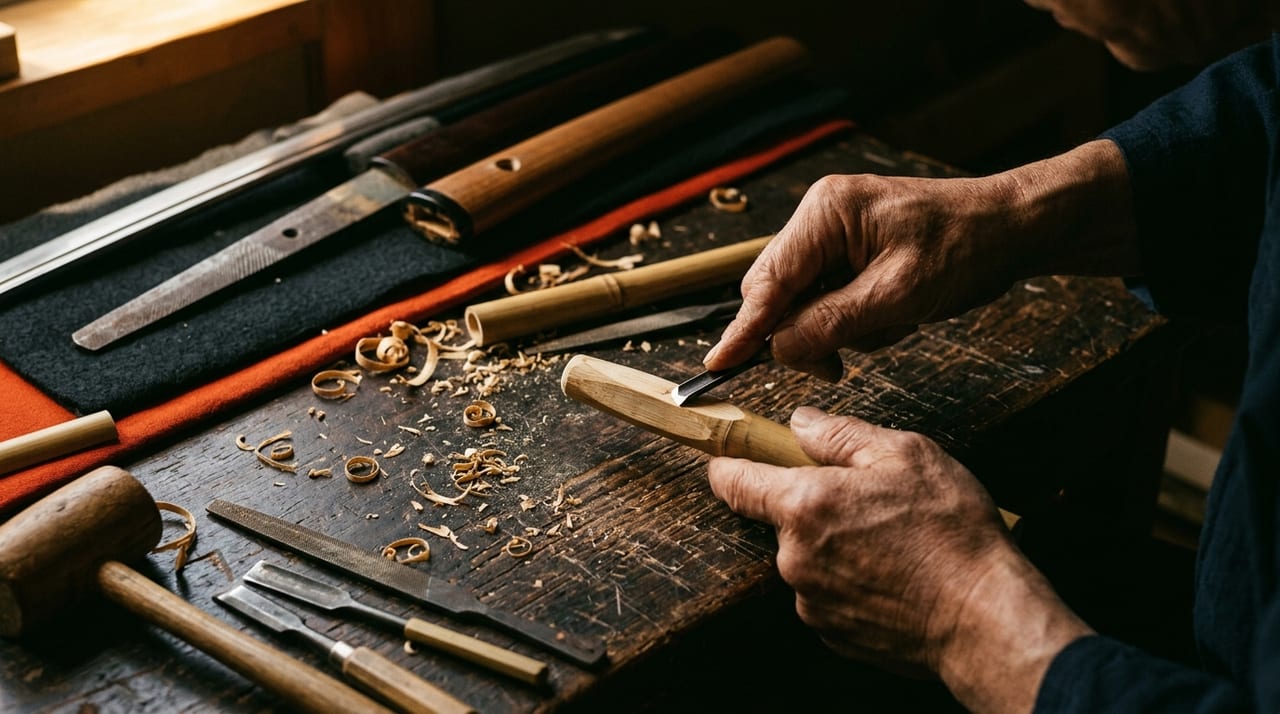
After roughly splitting the cut bamboo to the size of the mekugi, it is precisely shaped with a file and small knife. The cross-section of the mekugi is often elliptical, as this matches the shape of the mekugi-ana. An elliptical mekugi has a clear direction of fixation and is designed to prevent rotation within the tsuka.
In the final finishing, the mekugishi actually inserts it into the sword to confirm the holding strength. If the mekugi is too loose the blade will shift; if too tight it damages the mekugi-ana. It is said to take several years of experience to fully acquire the feel of this exquisite "kangō" (fit).
Historical Lineage — The Establishment and Differentiation of the Mekugishi
The establishment of the mekugishi as an independent trade is thought to have occurred around the mid-Edo period, when the division of labor among craftsmen in the sword industry had advanced. Before that, sayashi and tsukamakishi often also handled the making of mekugi. The background to this advancing division of labor lay in the flourishing of sword culture during the Edo period and the trend toward the elaboration and specialization of tosōgu within warrior society.
Even after establishing themselves as independent craftsmen, mekugishi maintained close collaborative relationships with sayashi and tsukamakishi. In completing the koshirae of a single sword, the work of each craftsman was mutually interdependent, and the dimensions of the mekugi were inseparably linked to the structure of the tsuka-wood and, further, to the shape of the nakago. The specialist who oversees the entire koshirae is discussed in The Koshiraeshi as a Specialist Craftsman.
The Sword Abolishment Edict (Haitōrei) of the late Edo and into the Meiji era (1876) dealt a severe blow to sword craftsmen as a whole, including the mekugishi. With demand falling sharply, many full-time mekugishi were forced to close their workshops, and there are not a few regions where the craft fell into extinction. Today, full-time craftsmen who call themselves mekugishi are exceedingly rare, and the technique is maintained in a tenuous form through its inheritance by sayashi and togishi.
The Practice of Mekugi Replacement — Knowledge the Owner Should Have
For sword owners, the mekugi is a subject of regular maintenance. Bamboo mekugi deteriorate with age, and expansion and contraction caused by drying and humidity changes gradually produce loosening. Replacement at an interval of approximately 10 to 20 years is recommended as a guideline, though this varies greatly depending on the storage environment.
Replacing a mekugi is not easy without specialist knowledge. Applying excessive force to the mekugi-ana can damage the nakago, and in the worst case the hole deforms and becomes difficult to restore. Because the mekugi can also induce rust at the junction with the blade, it is important to select a mekugi of appropriate material and dimensions.
The most reliable course is to ask a specialist sword dealer or togishi to check the condition of the mekugi. A properly maintained mekugi is the fundamental prerequisite for the safe storage, display, and use of a sword. The continuation of the mekugishi as a trade is also a basic condition for correctly handing down the nihonto as a cultural asset to the next generation.