The specialized craft of the fuchi-kashira maker — techniques for crafting the fuchi and kashira that adorn the sword tsuka, and the schools of the Edo period
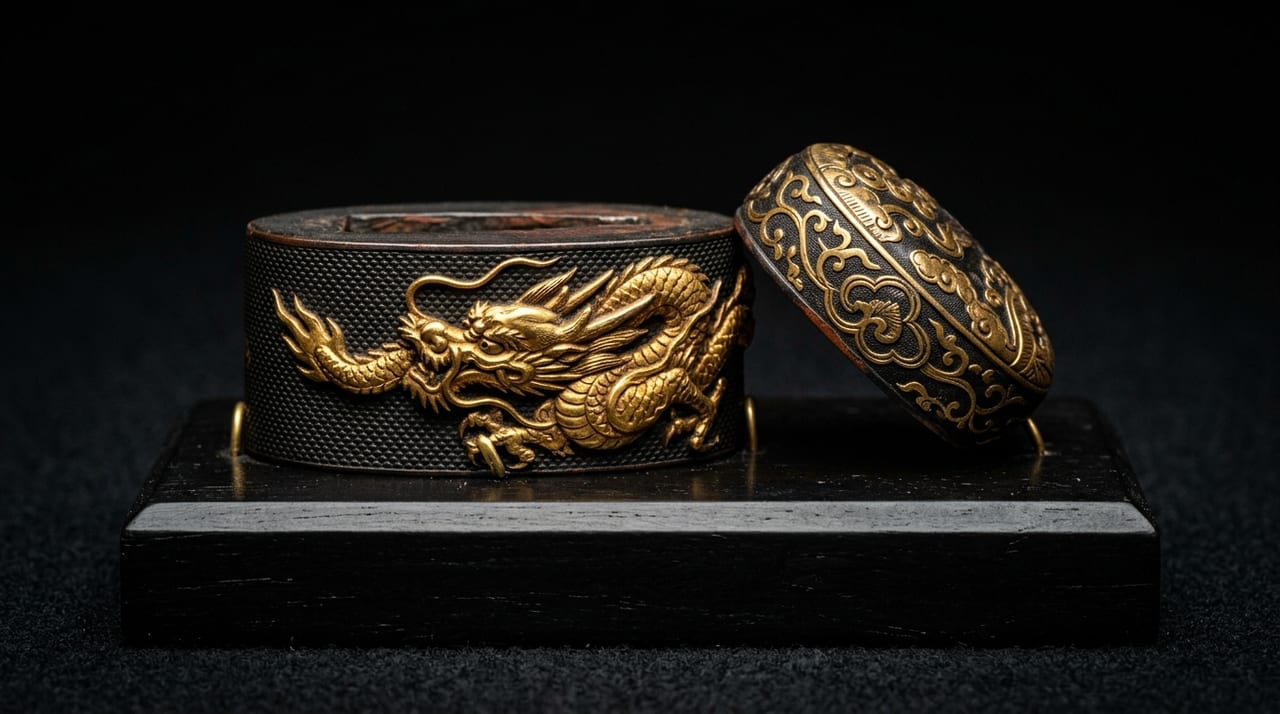 * Image is for illustrative purposes only.
Table of Contents
What is a fuchi-kashira maker? — A specialist craftsman within tōsōgu
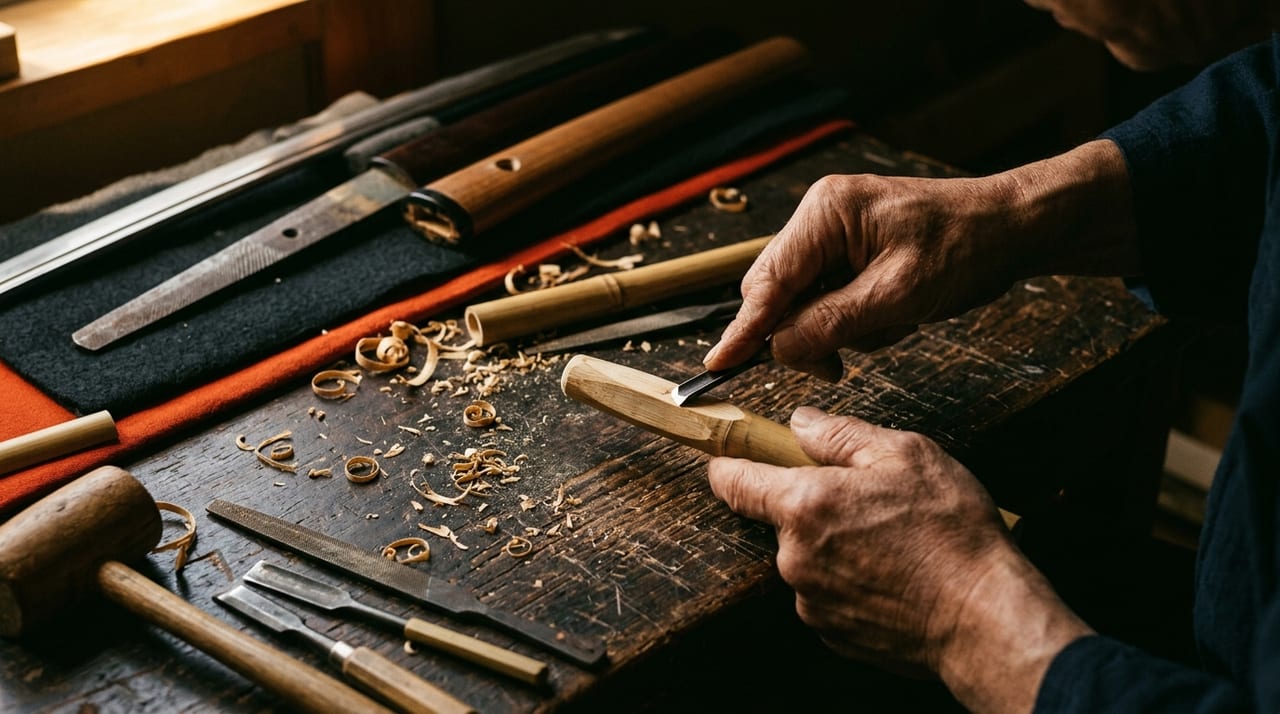
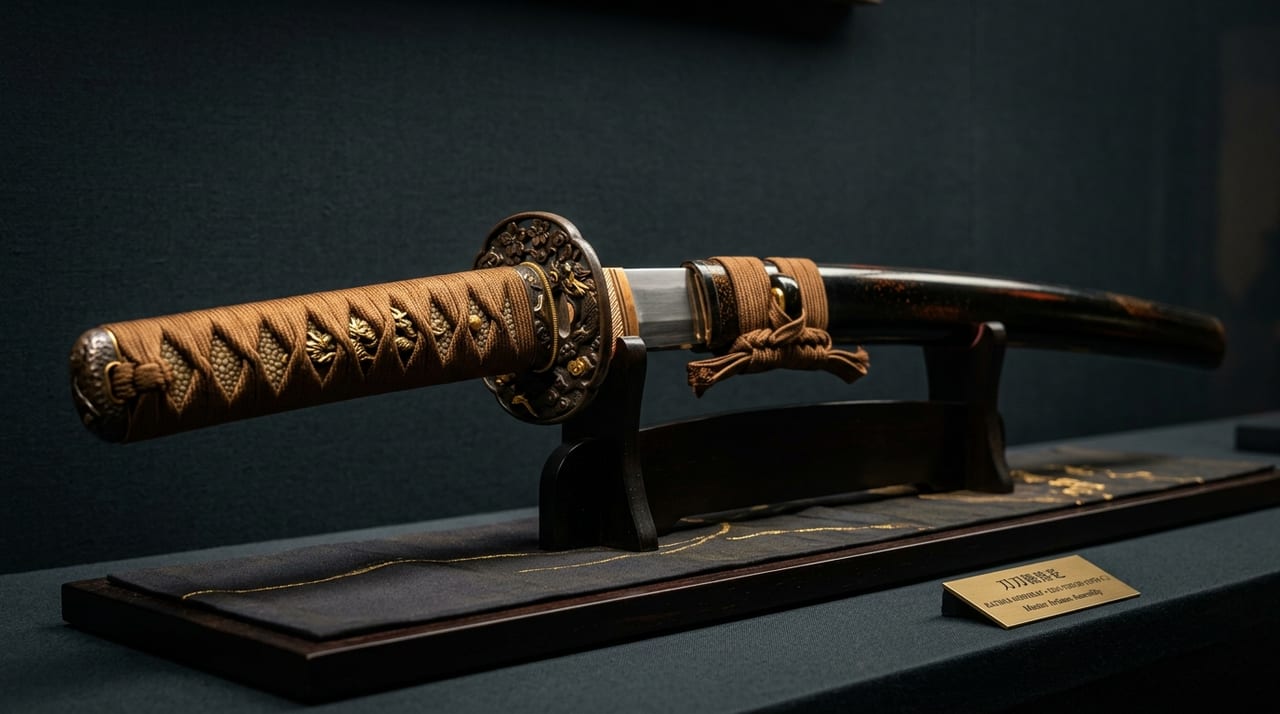
The koshirae (mounting) of a Japanese sword is composed of numerous components, including the tsuba (hand guard), fuchi-kashira, menuki, seppa, habaki (blade collar), saya (scabbard), and more. The craftsmen who produce these metal fittings are collectively called kinkōshi, but in the Edo period there were craftsmen who specialized in each individual component.
Among them, the craftsmen who specialize in making the fuchi and the kashira are the fuchi-kashira maker (fuchigashirashi). Alongside the menuki craftsmen who work on the tsuka itself, they played an important role in determining the overall design of the koshirae.
The function and structure of the fuchi and kashira
fuchi: A ring-shaped metal fitting fitted at the tsuba end of the tsuka (the end closest to the blade). It protects the mouth (kōguchi) of the tsuka and serves to secure the end of the tsuka wrapping.
kashira: A metal fitting fitted at the tip of the tsuka (the end farthest from the blade). It covers and protects the tip of the tsuka. Also called tsukagashira.
The fuchi and kashira are most often used as a pair and are handled together as a matched set of fuchi-kashira. Because they occupy a highly visible position on the sword's exterior, the elaborateness of their design greatly influences the overall dignity and aesthetic of the koshirae.
Materials for the fuchi-kashira maker — What are they made of?
The main materials used by fuchi-kashira makers are as follows.
Shakudō
An alloy of gold and copper (gold content 3–5%) that, through chemical treatment (niiro), takes on a beautiful lacquer-black color. It is considered the most prestigious material for high-quality fuchi-kashira. Shakudō nanako-ji — in which nanako work (a pattern of small granules) is applied to the shakudō ground before carving is added — represents the pinnacle of fuchi-kashira.
Shibuichi
An alloy of silver and copper (silver content 25%: one quarter). It has a subdued grayish tone. Considered slightly lower in prestige than shakudō, but valued for its distinctive character.
Gold and silver
Pure gold, pure silver, or alloys thereof. Used in the finest pieces.
Iron
As with the tsuba (hand guard), iron fuchi-kashira also exist. Characterized by a plain, martial quality, they were frequently made by craftsmen of the Higo (Kumamoto) tradition.
Carving techniques of the fuchi-kashira maker
The designs applied to the surface of fuchi-kashira — animals, plants, arms, mythological scenes, geometric patterns, and the like — are expressed through advanced carving techniques.
Kebori
The basic carving technique for incising the finest lines. Using a thin chisel or kebori chisel, hair-thin delicate lines are incised. Used for outlines and fine detail work.
Katakiri-bori
A technique in which lines are incised using a chisel beveled on only one side of the blade. Because one side of the line is vertical and the other angled, a gradation of light and shadow is created in the incised line. It is said that "katakiri-bori is the showpiece of sword metalwork," requiring a high level of skill.
Takabori
A technique in which the base metal is carved away to make the design stand out in relief (also called nikubori). Used for three-dimensional depictions of animals, figures, and the like. When the degree of relief is great, it is called marubori.
Zōgan
A technique in which grooves or holes are carved into the base metal (shakudō, iron, etc.) and different metals (gold, silver, shakudō, etc.) are inlaid. Nunome-zōgan — in which fine crosshatch scratches are made on the surface and thin sheets of gold or silver are pressed in to fix them — is widely used in fuchi-kashira.
Nanako-uchi
A technique in which the base metal is struck evenly with a round-tipped chisel (nanako chisel) to create small granular depressions arranged in a regular pattern. Named because the granules resemble fish roe (nanako). Often applied to the ground (background area) of shakudō or shibuichi fuchi-kashira, it is an extremely painstaking task.
Schools of fuchi-kashira makers in the Edo period
In the Edo period, fuchi-kashira makers (sword-fitting metalwork craftsmen) were active within the following representative schools. For those who wish to know more broadly about the overall lineage of tōsōgu (sword fittings) as a whole, the world of tōsōgu woven by kinkōshi is also helpful.
The Goto family — The pinnacle of sword-fitting metalwork
The head family of sword-fitting metalwork, continuing for 17 generations from the Muromachi period through the Bakumatsu era. As the retained kinkōshi of the Ashikaga shogunal house and the Tokugawa shogunal house, they held the highest prestige.
The Goto family's fuchi-kashira are characterized by takabori and kin'iroe (gold pictorial work) on a shakudō nanako-ji ground. Designs frequently feature flora and fauna or classical subjects, and they were regarded as being in a class of their own as "Goto-ya-mono." The fuchi and kashira were invariably made as a matched pair with a unified design, and "a matched daisho set of Goto-mono" was synonymous with the finest koshirae.
The Nara school — Opening a horizon of individual artistry
A school founded in the mid-Edo period by three masters known as the Nara Sansaku: Sugiura Jōi, Nara Toshinaga, and Tsuchiya Yasuchika. Unbound by the formality of the Goto family, they developed free designs and techniques as individual artists.
The Nara school's fuchi-kashira are known for their realistic depictions of animals, bold compositions, and advanced takabori technique; in particular, "Tsuchiya Yasuchika's dragon fuchi-kashira" inspired many followers in later generations.
Higo kinkō — An aesthetic of martial plainness
A lineage of kinkōshi who served the Kumamoto domain (Higo domain). The four families of Hayashi, Nishigaki, Hirata, and Shimizu are the most representative. The full lineage of Higo kinkō explains in greater detail the differences in each of the four families' styles.
Higo kinkō fuchi-kashira make extensive use of iron and are characterized by plain, martial designs. They excel in the distinctive iron-ground gold-and-silver inlay technique known as Higo-zōgan, embodying a Zen-influenced, warrior-class aesthetic.
Appreciating and authenticating fuchi-kashira
Points of interest
The main points to look for when appreciating fuchi-kashira are as follows.
Ground finish: Whether the nanako granules are even; whether the color of the ground (the lacquer-black of shakudō or the gray of shibuichi) is uniform.
Quality of carving: Whether the kebori lines are fine and uniform; whether the sense of relief in the takabori is natural; whether the level of the zōgan inlay is carefully finished.
Unity of fuchi and kashira: Whether the design, material, and technique are consistent between the fuchi and kashira (important for Goto-mono and others).
Checking the mei: The maker's mei (signature) may be inscribed on the inside of the fuchi or the inside of the kashira.
The difficulty of authentication
Famous works of the Goto family, the Nara school, and other noted lineages had many imitations and later copies made of them in subsequent generations. The following points are important for authenticating them:
- Quality of the carving lines (imitations tend to be mechanical and overly uniform)
- Age-related changes in the material (the color of shakudō deepens with the passage of time)
- The calligraphic style and manner of incising the mei (each school has its characteristic features)
Conclusion — Fuchi-kashira makers as bearers of sword-mounting culture
In the koshirae of a Japanese sword, the fuchi-kashira are "metal fittings in a prominent position that convey the sword's rank." The fuchi-kashira maker is a specialist craftsman who pours advanced carving skill, knowledge of materials, and design sensibility into these small fittings.
The prestigious shakudō nanako-ji of the Goto family, the free individual artistry of the Nara school, the martial iron of Higo kinkō — each fuchi-kashira is not merely a component of a sword, but a small work of art embodying the pinnacle of Japanese metalwork art. In appreciating swords, reading the design of the fuchi-kashira — just as one reads the hamon (temper line) and jigane (steel of the blade surface) — is an important perspective for savoring the depth of Japanese sword culture.