All Lineages of Higo Kinko — The Austere Aesthetic Embodied by the Hayashi, Nishigaki, Hirata, and Shimizu Schools
 * Image is for illustrative purposes only.
Table of Contents
The Birth of Higo Kinko — Bushido and Craft in the Hosokawa Domain
Higo kinko is the collective name for the group of metalworkers who flourished under the rule of the Kato and Hosokawa clans in Higo Province (present-day Kumamoto Prefecture). It was especially after the Hosokawa clan (540,000 koku following the Battle of Sekigahara) took over governance in the early Edo period that the domain lord's bushido spirit and aesthetic sensibility profoundly influenced the culture of metalwork.
Hosokawa Tadaoki (1563–1646), a distinguished disciple of Sen no Rikyu, possessed a deep understanding of the tea ceremony, and it is said that the spirit of wabi and sabi was reflected in the style of Higo kinko. Rejecting lavish ornamentation and pursuing the essential beauty of materials — this is understood as the fundamental philosophy of Higo kinko.
Representative characteristics of Higo kinko:
- Iron ground dominant: Minimizing gold, silver, and inlay to bring out the beauty of iron itself to the fullest
- Austere functional beauty: A design philosophy that prioritizes practical silhouette over decorativeness
- Distinctive iron texture: A characteristic surface treatment known as "Higo iron"
- Dote-sukashi: A technique of raising the border of a cutout to create a three-dimensional effect (described below)
The Hayashi School — Founding Lineage and Supreme Authority of Higo Kinko
The most renowned lineage within Higo kinko is the Hayashi school.
First-generation Hayashi Matashichi: The founding ancestor of the Hayashi school, said to have been active in the early Edo period (first half of the 17th century). He is recorded as one of the first Higo kinko metalworkers to serve the Hosokawa clan. Works by Matashichi are few in number, and fine examples command high esteem. They are characterized by the austere beauty of the iron ground and simple yet powerful sukashi patterns.
The Hayashi lineage: From Matashichi onward, the techniques of the Hayashi school were passed down across multiple generations. The name "Hayashi Matashichi" is a natori (hereditary name) used across multiple generations, and distinguishing works of the first, second, third, and later generations is an important task in connoisseurship. Determining the generation of a tsuba bearing the Hayashi mei requires a comprehensive assessment of the quality of the iron ground, the style of the sukashi, and the condition of the patina.
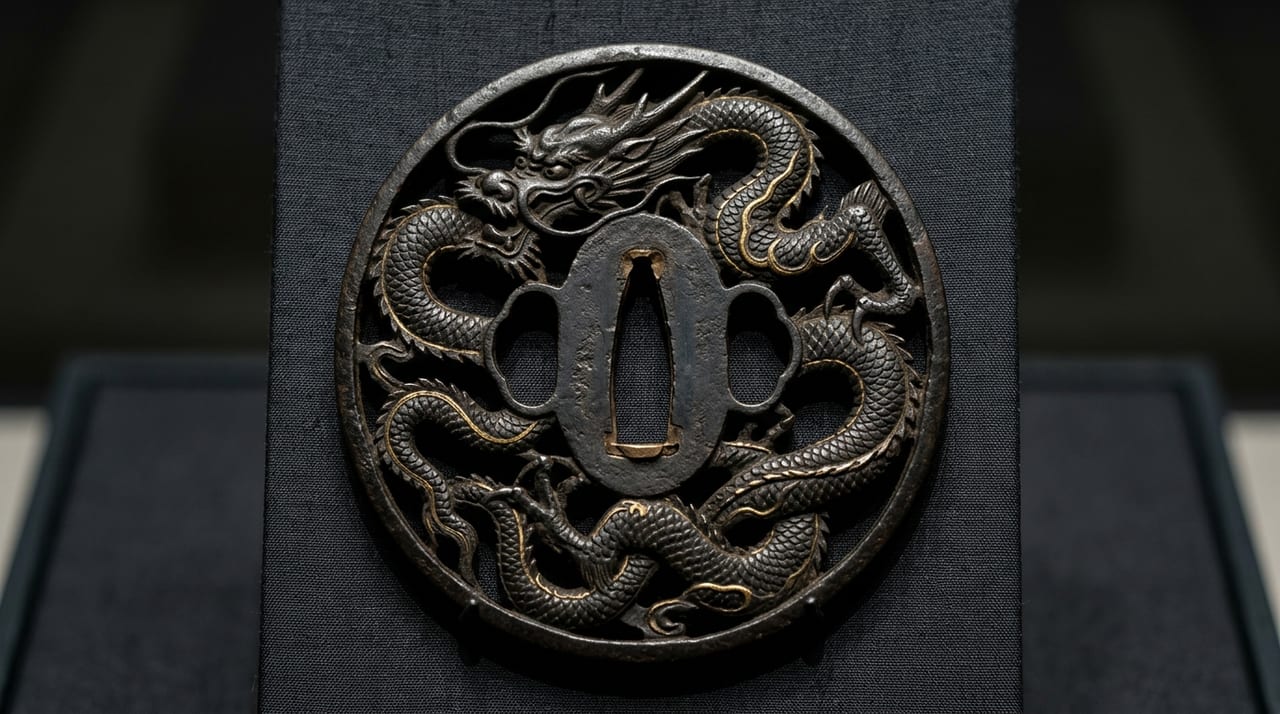
Representative style of the Hayashi school: Circular or mokko-shaped iron tsuba with geometric or botanical sukashi arranged simply. The rim (mine) is somewhat thick, giving a solid, composed bearing. While maintaining an essentially iron-ground-dominant austere composition, the school is known for its skilled use of gold inlay on a nunome-zogan (fabric-pattern inlay) ground.
The Nishigaki School — Coexistence of Delicacy and Austerity
The Nishigaki school stands alongside the Hayashi school as one of the representative lineages of Higo kinko, tracing its origins to Nishigaki Kanshiro, a disciple of Hirata Hikoza. It is often characterized by a more delicate finish than the Hayashi school.
Tsuba of the Nishigaki school are particularly carefully worked in the treatment of the iron ground, and many examples have a well-refined kitae-hada (forging grain) on the surface. Sukashi patterns are somewhat more complex than those of the Hayashi school, and the use of botanical and animal motifs can also be seen. The calligraphic style of the mei also has characteristics unique to the Nishigaki school, which serve as evidence in connoisseurship.
For those who wish to trace the lineage of Higo tsuba craftsmen person by person, reading Master Craftsmen and Lineages of Higo Tsuba alongside this article will provide a clearer picture.
The Hirata School — Innovators Who Brought Shippo to the Tsuba
The Hirata school occupies a unique position even within Higo kinko.
Application of shippo: A major characteristic of the Hirata school is its reputed use of shippo — a technique of firing glassy glaze onto a metal surface to produce color — in the decoration of tsuba. Shippo is a technique normally used for small craft items such as pouches, tobacco pouches, and inro, and examples of its application to tsuba are noted in association with the Hirata school.
The shippo tsuba of the Hirata school produce a distinctive visual effect by partially embedding shippo into the iron ground to add colors such as blue, green, red, and white. While possessing a decorativeness that sets them apart from other Higo kinko, they inherit the spirit of Higo kinko in that the iron ground remains fundamental.
The Shimizu School — Inheritors Who Preserved the Austere Tradition
The Shimizu school traces its origins to Shimizu Nihei, the nephew of Hirata Hikoza, and is a lineage that maintained a particularly austere and sturdy style even among Higo kinko. It is also said to be the lineage that inherited the spirit of the Hayashi school most faithfully.
Works of the Shimizu school generally eliminate ornamentation to the greatest possible degree, heightening the perfection of the tsuba through the beauty of the iron ground and the power of the sukashi alone. As examples in which the Higo spirit of "venerating the martial" is most purely embodied, they are favored by collectors who resonate with the bushido spirit.
Dote-sukashi — The Three-Dimensional Technique Unique to Higo Kinko
A characteristic technique common to all of Higo kinko is dote-sukashi.
In an ordinary sukashi tsuba, the border of the cutout lies on the same plane as the surface of the tsuba (or is slightly recessed), but in dote-sukashi the border of the cutout is raised higher than its surroundings (dote), creating a three-dimensional effect in which the cutout appears to be sunken. This technique causes the sukashi, which was merely a "hole," to function as "sculptural relief," giving the entire tsuba a powerful sense of three-dimensionality.
Dote-sukashi is one of the important characteristics for identifying Higo kinko, and it serves as a powerful clue when distinguishing genuine works from imitations by other schools.
Collecting Higo Kinko — Acquiring the Aesthetic of "the Martial"
Higo kinko tsuba possess an aesthetic direction entirely different from the decorative metalwork tsuba of the late Edo period. They are especially favored by collectors who resonate with the philosophy that "beauty lies not in decoration but in the pure expression of material and form."
While fewer pieces circulate in the market than those of the Shoami school, fine examples from the Hayashi, Nishigaki, and Shimizu schools do appear from time to time at major sword fairs and auctions. Works that have passed NBTHK appraisal are easily referenced as a basis for authenticity, so when collecting, it is advisable to prioritize confirming the presence of appraisal and the provenance.
Conclusion — What the Beauty of Austere Solidity Continues to Ask
Higo kinko tsuba are one answer to the fundamental questions of "what is decoration?" and "what is beauty?" The spirit of the Higo kinko metalworkers who minimized gold and silver and pursued the highest beauty through the axes of iron ground, sukashi, and form continues to move the hearts of many admirers and collectors even today.