The Specialized Profession of the Tōshin Chōkokushi (Horimonoshi) — Techniques and History of Artisans Who Engrave Dragons, Bonji, and Hi onto Sword Blades
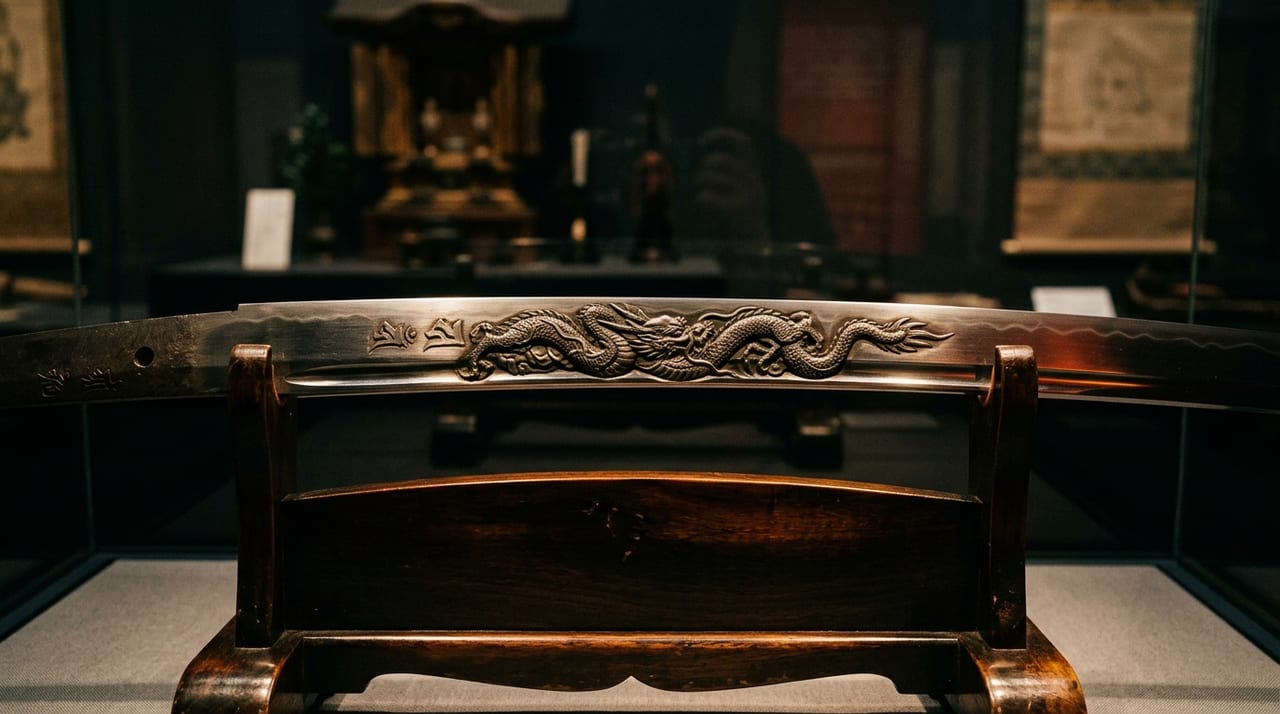 * Image is for illustrative purposes only.
Table of Contents
What Is Tōshin Chōkoku (Horimono)?
"Horimono" refers to the decorative and religious-motif carvings applied to the blade of a nihontō. Carvings have traditionally been applied to the ji (flat surface) of the blade and to the interior of the hi (groove cut into the blade), and include principally the following motifs.
Kurikara-ryū: The motif of a dragon coiling around the Kurikara-ken, the sword carried by Fudō Myōō. It is the most celebrated horimono motif on nihontō and is said to carry esoteric Buddhist significance.
Bonji: Japanese written representations of Sanskrit syllabic characters. Bonji symbolizing Fudō Myōō, Aizen Myōō, Yakushi Nyorai, and others are engraved onto blades as expressions of devotion and protection.
Hi: A longitudinal groove cut into the blade. In addition to its decorative role, it serves the practical functions of reducing blade weight and adjusting rigidity. Shapes range from simple straight grooves (bō-hi, soe-hi, etc.) to complex curves (kaki-nagashi-hi, koshi-hi, etc.).
Ken-maki-ryū: A motif of a dragon coiling around a sword; it is a variation of and related motif to the kurikara-ryū.
Sōka-moyō: Plant motifs such as cherry blossom, plum, chrysanthemum, and bamboo. Arabesque patterns such as botan-karakusa are also included.
The specialist artisans who carry out these horimono are called horimonoshi.
Cases Where the Tōkō Carves Personally versus Cases Where a Specialist Horimonoshi Is Commissioned
Horimono on nihontō have historically been applied through two broad routes.
Cases Where the Tōkō Carves Personally
Among renowned tōkō there exist "tōkō skilled in horimono" who handle everything from forging to carving.
Masamune of Sōshū-den: There are traditions holding that he carved kurikara-ryū horimono himself, but among extant swords bearing the Masamune mei and horimono, many examples are considered later additions, and solid historical documentary evidence that he carved them himself is scarce.
Nagasone Kotetsu: This master tōkō of the Edo shintō period is also said to have carved hi, bonji, and other horimono himself.
In the case of gendaitō smiths: Most contemporary tōkō have not received specialized training in horimono, so when horimono is required it is common to commission a specialist horimonoshi.
Cases Where a Specialist Horimonoshi Is Assigned
Cases in which the tōkō devoted himself to forging and entrusted horimono to specialist artisans have existed since ancient times. Particularly from the Edo period onward, as division of labor advanced, the tōshin-horimonoshi established itself as an independent specialized profession.
Commissions to horimonoshi took place in the following circumstances.
- When the tōkō himself did not possess horimono skills
- When the horimonoshi's artistic standard was high and clients requested them by name
- When the patron (samurai, daimyō, or temple or shrine) specified a particular horimonoshi
The Horimonoshi's Tools — The Craft of Delicate Blades
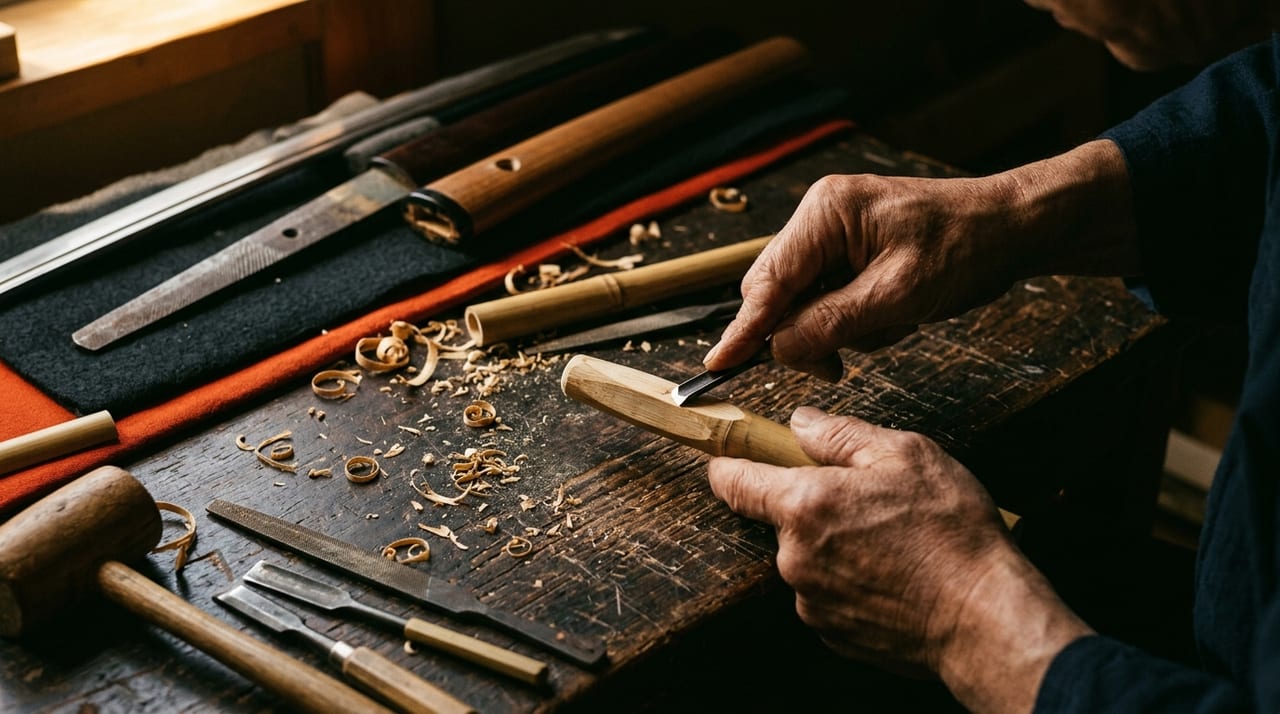
The horimonoshi's tools partially overlap with those of the tōsō metal-fittings craftsmen (tsuba smiths and fuchi-kashira smiths), but because the steel of the blade itself is being carved, harder cutting implements and specialized techniques are required.
Nomi (Chisel)
This is the most frequently used tool; several types are selected according to their purpose.
Hira-nomi: A standard chisel with a flat cutting edge, used for flat-surface carving and outline lines.
Maru-nomi: A chisel with a curved cutting edge, used for the curved sections of a dragon's body and wings and of sōka-moyō motifs.
Sankaku-nomi: A chisel with a triangular cross-section cutting edge, used for fine line carving.
Kogatana
A small blade specific to the horimonoshi. Used for finishing fine details, removing burrs, and making minute adjustments to lines.
Kanatoko (Anvil) and Tsuchi (Hammer)
The nomi is placed against the blade and driven in by striking with a tsuchi (wooden mallet or metal hammer) as the work progresses. The weight of the tsuchi, the angle of the strike, and the degree of force determine the depth, width, and finish of the horimono.
Techniques of the Horimonoshi
Kebori
The fundamental technique for incising the finest lines. Used when rendering the outlines of bonji, lettering, and sōka-moyō motifs, and each individual scale of a dragon. The nomi is lightly placed against the steel surface and drawn across it to carve lines as fine as a strand of hair; it is one of the most demanding techniques, requiring great skill.
Nikubori / Takabori
A technique in which the jigane (the steel of the blade) is carved away to make the motif stand out in relief.
Usuniku-bori: Shallow carving in which the motif is raised only slightly, giving an overall impression of delicacy.
Marubori: Deep carving in which the motif rises dramatically in three-dimensional form. Used when expressing three-dimensional solidity, such as in the body of a kurikara-ryū.
How Hi Is Carved
Hi is a technique of carving a longitudinal groove into the blade, and the process generally proceeds in the following steps.
- Draw the outline of the hi on the designated area of the blade using ink (or pencil).
- Use a small nomi to make shallow guide cuts along the outline.
- Use a nomi suited to the required width and depth to carve the groove.
- Finish the interior of the groove carefully with files and whetstones to give it a polished luster.
The precision of the hi's finish greatly affects the overall quality assessment of the sword.
Religious and Artistic Significance of Horimono
The Esoteric Buddhist Background of the Kurikara-ryū
The kurikara-ryū derives from the "Kurikara-ken" (Kurikara sword) carried by Fudō Myōō. Fudō Myōō has long gathered devotion from warriors as a deity of "gōbuku" (subjugation), who burns away all earthly passions and evil.
Carving a kurikara-ryū onto a blade is regarded as an act of prayer to "enshrine the power of Fudō Myōō in this sword," and it is said that warriors heading to battle commissioned the horimono as an amulet of invincibility.
The Religious Role of Bonji
Bonji are engraved onto blades as "shuji" (seed syllables) symbolizing specific buddhas, bodhisattvas, and myōō.
The bonji of Fudō Myōō (Kān / Fūn): The most frequently used bonji, commonly engraved on the swords of warriors and soldiers.
The bonji of Aizen Myōō (Ūn): Said to have been favored by generals as signifying love, connection, and victory.
The Design Value of Sōka-moyō
Whereas the kurikara-ryū and bonji are primarily religious in significance, sōka-moyō such as cherry blossom, plum, and chrysanthemum are decorative horimono conceived with "the nihontō as a work of art" in mind.
In the peaceful era of the Edo period, demand shifted from practical swords to swords as "works of art to be appreciated and collected." Within this trend, beautifully carved sōka-moyō horimono came to be widely favored as gifts and collectors' items.
Succession of Tōshin Chōkoku in the Modern Era
A Crisis of Succession
In the modern era there are very few tōshin chōkokushi, and a shortage of successors has become a serious challenge. Tōkō licenses are administered by the Agency for Cultural Affairs, but no official licensing system exists for "tōshin chōkokushi" themselves, and the reality is that the craft depends on private succession through the master-apprentice system.
Horimonoshi Today
Most horimonoshi today acquire their skills through the following routes.
- Apprenticeship under an active horimonoshi (training period generally five to ten years)
- Artisans who switched from being a tōkō and now specialize in horimono
- Artisans who entered tōshin chōkoku by applying skills from woodcarving or metalworking
Demand for Horimono Today
The principal demands include horimono commissions for gendaitō (swords made by contemporary tōkō), restoration of horimono on kotō, and the addition of horimono to ceremonial swords. As of 2026, amid a growing interest in traditional crafts, movements to reappraise the cultural value of tōshin chōkoku are also visible.
Conclusion — The Tōshin Chōkokushi as "Bridge Between Sword and Faith"
The tōshin chōkokushi is a specialist who endows the blade with "religious power and artistic beauty" that forging alone cannot express. In each horimono — kurikara-ryū, bonji, hi, sōka-moyō — are engraved the faith, aesthetic sensibility, and values of the era of the warriors who carried them.
The delicacy seen at the pinnacle of the craft — "each individual kebori stroke gives birth to a dragon's scale" — stands alongside blade forging at the heights of artisanal achievement. In a modern era where successors are declining, how this technique is to be preserved and passed on will continue to be asked of Japanese sword culture as a whole.