A Day in the Life of a Habaki-shi — The Precision Work and Material Procurement a Metal Craftsman Puts into Each Habaki
 * Image is for illustrative purposes only.
Table of Contents
What Is a Habaki — The Lynchpin of the Tōsōgu and Its Unsung Workhorse
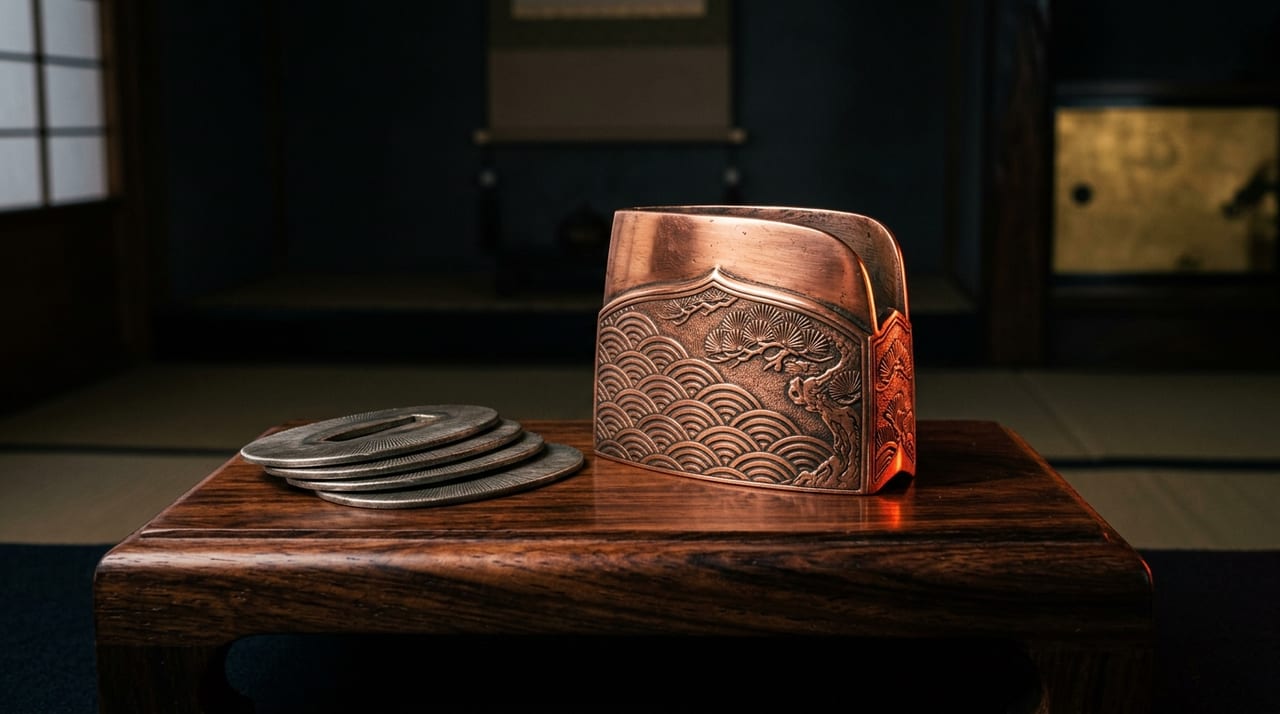
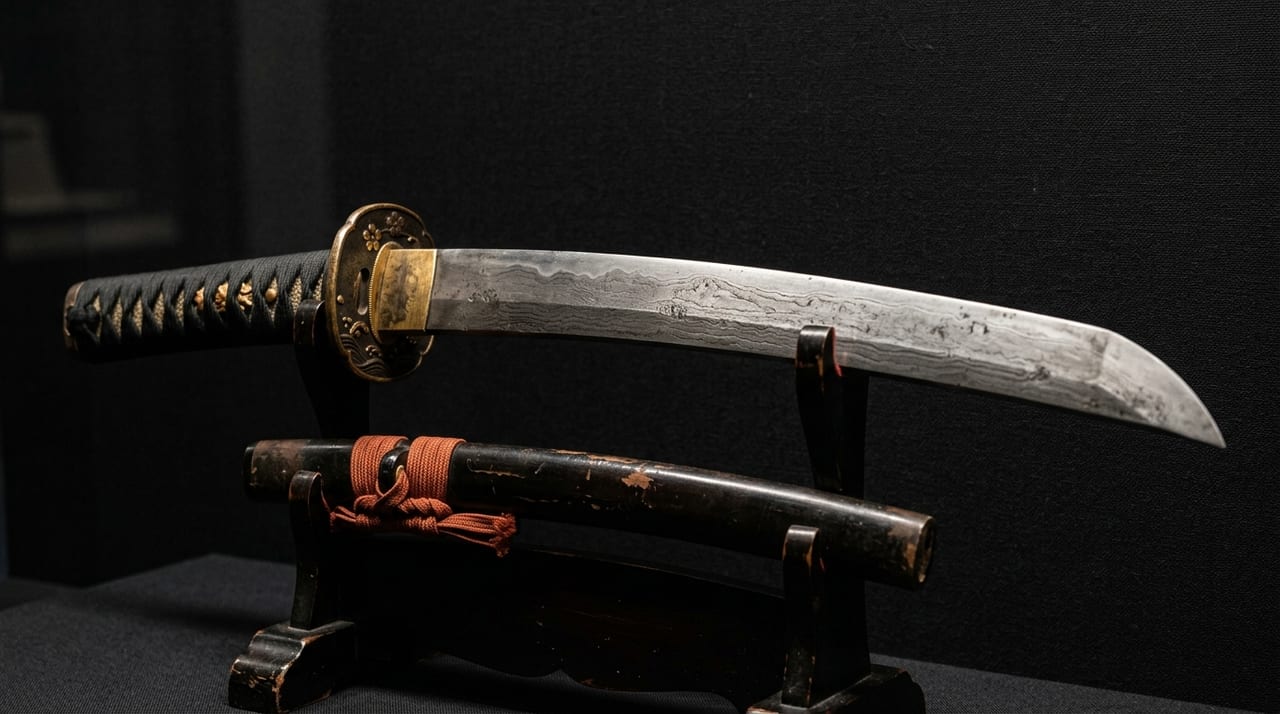
When appreciating a Japanese sword, attention tends to fall on the hamon and jihada of the blade, yet few people look as far as the habaki that supports the function of the koshirae. The habaki is a ring-shaped metal fitting fixed just above the base of the blade at the hamachi. It fits snugly against the koiguchi — the mouth of the saya — to hold the sword securely inside the saya and provide friction and alignment during drawing and sheathing.
It may seem an inconspicuous component, but poor precision in the habaki causes the sword to rattle inside the saya and damages the wood of the koiguchi during the draw. If the habaki fits too loosely, the sword can fly out of the saya accidentally. In terms of supporting the safety and operability of the mounting, the habaki can be called the lynchpin of the tōsōgu.
Habaki-shi as a Profession — The "Seam" in the Tōsōgu Division of Labor
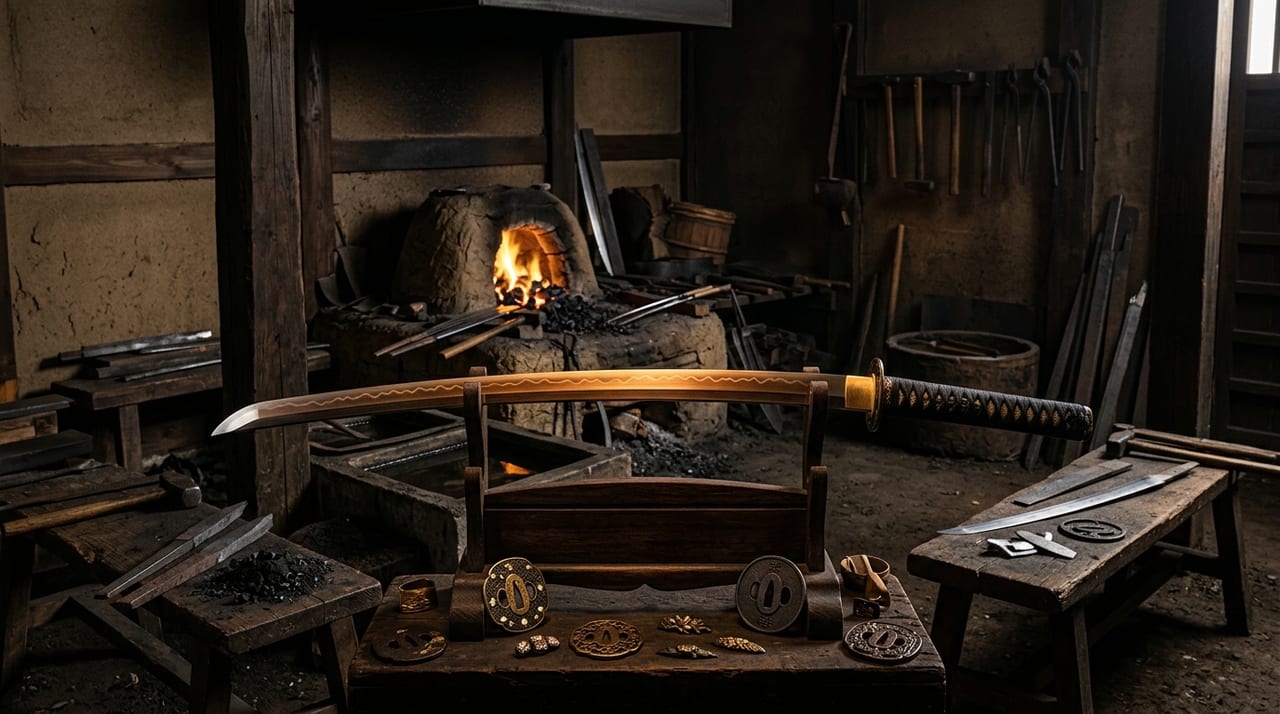
Koshirae production in the Edo period was highly specialized, with individual trades including tsuba-shi, menuki-shi, fuchi-kashira-shi, tsuka-maki-shi, saya-shi, and nuri-shi. Among these, habaki were conventionally the domain of metalworkers called shirogane-shi, and in modern times these craftsmen are often referred to as habaki-shi.
The work of a habaki-shi is precision metalworking fitted to the hamachi geometry of each blade. Because blade dimensions differ from sword to sword, a habaki is fundamentally made as a one-off piece. "Fitting work," in which an existing habaki is trimmed and adjusted to a blade, is also practiced, but for fine swords new fabrication is the standard.
The Start of the Day — Choosing and Preparing Materials
A habaki-shi's day begins with preparing materials. The materials used for habaki fall into three main categories.
| Material | Characteristics and Uses |
|---|---|
| Copper (akagane) | The most versatile and easiest to work; used for inexpensive habaki. Types with a thin layer of gold or silver applied to the surface — "gold-clad copper habaki" (kinkise-dō-habaki) and "silver-clad copper habaki" — belong to this category. |
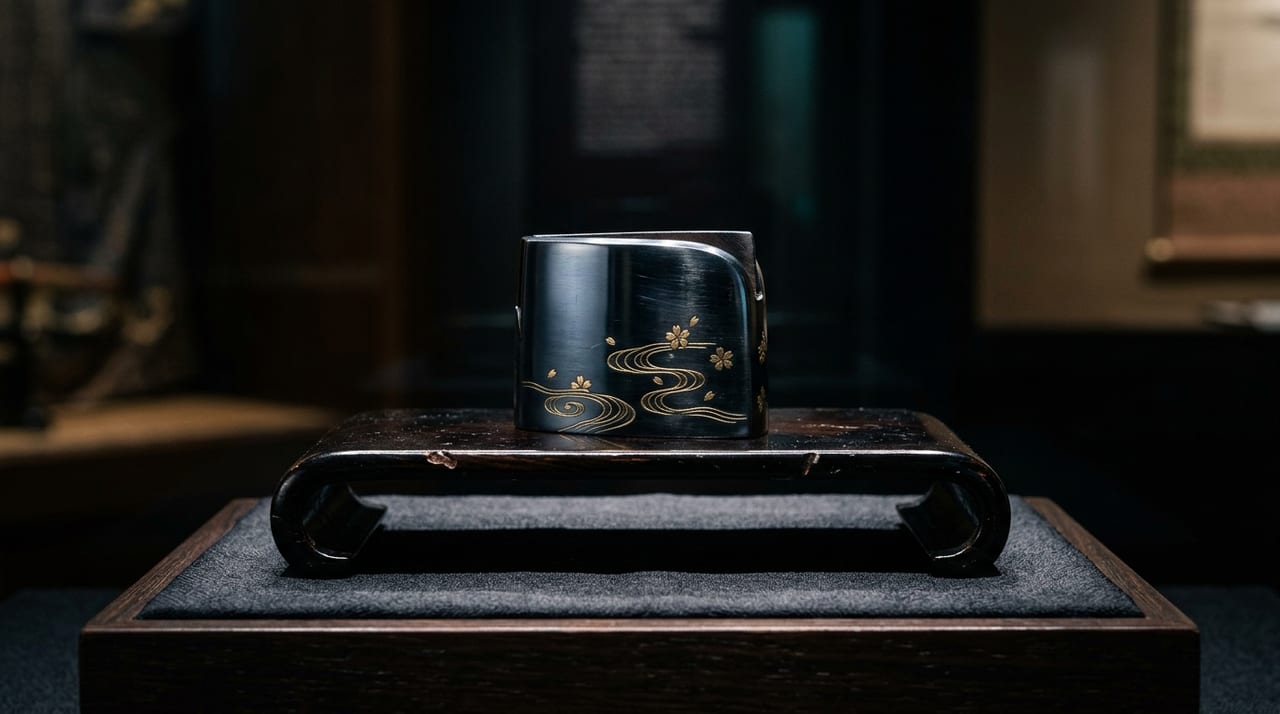
| Shakudō | An alloy of copper with a few percent of gold; when subjected to a chemical treatment called "niiro," it develops a distinctive deep black color. Widely used for habaki on high-grade koshirae, and also found on many old habaki from the Kamakura through Muromachi periods. |
| Silver (shirogane) | Used as a material expressing the dignity of the warrior class; "polished silver habaki" is characterized by a white luster. Modern craftsmen often use silver alloys that are easier to work than pure silver. |
The morning's work begins with bringing the stock sheet to the required thickness. The sheet metal is hammered out and cut to a size matching the hamachi width of the blade. Because precision at this stage governs every subsequent step, measurement with calipers and a scale is carried out with great care.
Morning Work — Shaping and Trial Fitting
The cut metal sheet is gradually shaped to match the cross-sectional profile of the blade. The habaki-shi uses a small hammer and a tagane (chisel) to bend, draw, and form the sheet.
Because the cross-section of a blade describes complex curves — in shinogi-zukuri, the angle differs between the ji face and the edge face on either side of the shinogi ridge — shaping a flat metal sheet to conform to it requires skilled handwork. This process of forming the interior of the habaki to follow the external profile of the blade is called "seme".
Once shaping is broadly complete in the morning, a "trial fitting" (kari-awase) is performed by placing the habaki on the actual blade to check for gaps or looseness. The habaki must be neither too tight nor too loose on the blade. A habaki-shi describes the right feel as "a moist resistance" — it slides in smoothly, yet a certain force is needed if pushed in lightly with a finger: a delicate balance.
Afternoon Work — Finishing and Surface Treatment
If the trial fitting reveals no problems, final fixing of the joint and surface finishing begin. A one-piece habaki is ideal, but in practice a method is also widely used in which the seam (hagime) of the wrapped metal sheet is joined by soldering (with silver solder, gold solder, or the like).
Subsequent surface treatment varies by material. For copper and shakudō, there is the "niiro" process — boiling the material in a mixture of ammonium chloride, vinegar, and water to promote oxidation and bring out a distinctive deep color. This color is a "chemical rust," and it has long-term stability.
For silver, polishing is the standard finish: coarse and medium whetstones are first used to remove scratches, then a tool called a "hera" (spatula) is used to compress the surface and produce luster. For the final mirror finish, friction polishing with powdered charcoal is employed.
Material Procurement and Contemporary Challenges
Modern habaki-shi face several challenges.
- Difficulty obtaining materials: Shakudō — a copper alloy to which a small amount of gold has been added — was procured from specialist metal suppliers in compositions suitable for tōsōgu, but as the tōsōgu industry as a whole has contracted, such specialist suppliers have been declining in number.
- Quality of silver solder: The purity and flow characteristics of the solder used for joining greatly affect the quality of a habaki, but suppliers who refine silver solder to traditional compositions are limited, and modern standardized products do not necessarily suit traditional techniques.
Movements have emerged in which multiple tōshō and tōsōgu craftsmen have joined together for shared purchasing and stockpiling of materials, with the Tōkyō Tōkenshō Kumiai and sword-preservation organizations around the country playing a certain role.
Succession Among Habaki-shi — The People and Places Transmitting the Craft
Today, specialist habaki-shi are estimated to number only several tens across Japan. Most work concurrently as shirogane-shi or general metalworkers handling tōsōgu broadly, and craftsmen who deal exclusively in habaki are even fewer.
Transmission of the craft follows the apprenticeship model, with the standard path being independence after several years as a trainee. However, accepting an apprentice requires the master to have stable enough work, and in recent years, as masters age, growing numbers have ceased to take on successors.
Events such as "Kodōgu no Kai" — exhibitions and sales fairs for tōsōgu — function to maintain craftsman networks, giving younger habaki-shi the opportunity to observe the work of senior masters up close. The role that a habaki-shi's precise work plays in completing a sword — efforts to pass that on to the next generation continue quietly today.