Minamoto no Yoshitsune and Hizamaru (Usumidori) — The Legends and Lineage of the Celebrated Tachi Worn by the Hero Who Vanquished the Taira
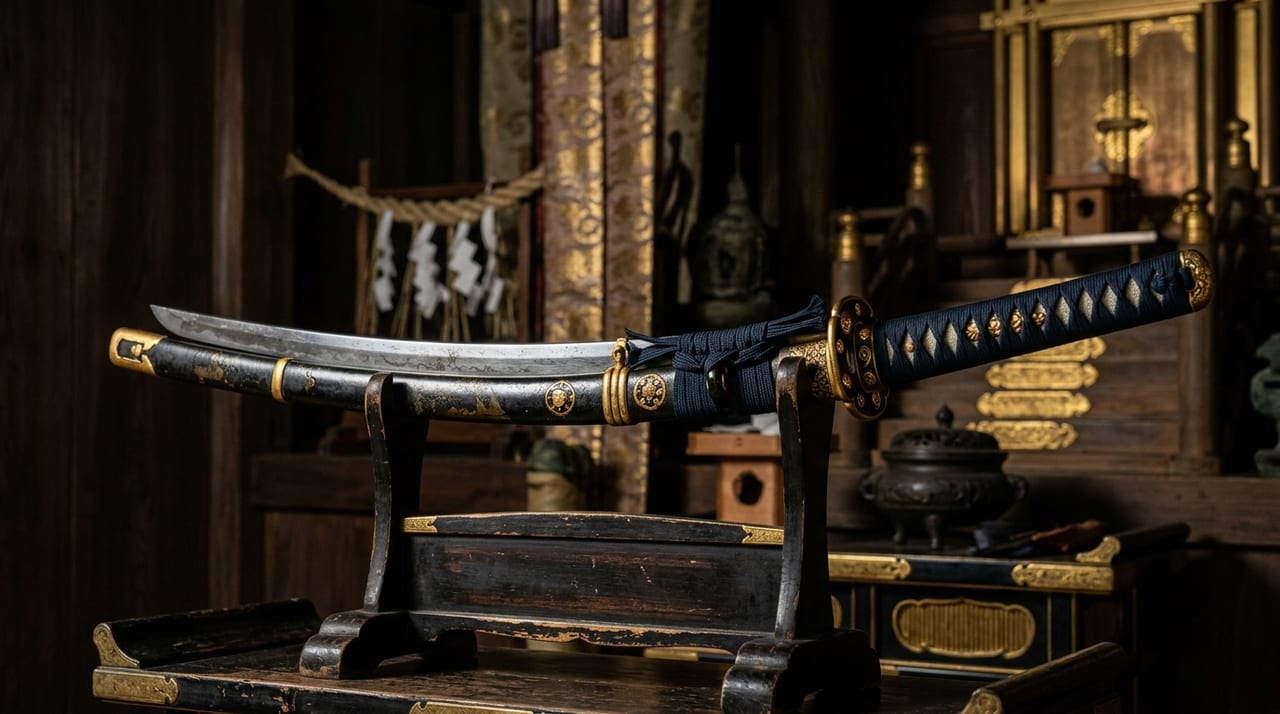 * Image is for illustrative purposes only.
Table of Contents
Minamoto no Yoshitsune and the Nihontō
Minamoto no Yoshitsune (1159–1189) was a warrior of the late Heian period who carved his name into history as a brilliant commander who supported his elder brother Minamoto no Yoritomo and led the vanguard in the campaign to vanquish the Taira. His valor has been celebrated in an endless stream of later works — nō, jōruri, kabuki, novels, and films — but his relationship with the "sword" also carries a legendary hue.
The weapon most famously associated with Yoshitsune is the tachi Hizamaru. Hizamaru has been spoken of since the Heian period as one of the treasured swords of the Minamoto clan, and it was also called Usumidori. This celebrated blade is deeply intertwined with the life of Yoshitsune and holds a special place in the history of the nihontō.
The Origins and Early History of Hizamaru (Usumidori)
Hizamaru is said to be a tachi commissioned by Minamoto no Mitsunaka (912–997), handed down through the generations as a treasured heirloom of the Minamoto clan. Mitsunaka was a warrior based at Tada in Settsu Province (present-day Kawanishi City, Hyogo Prefecture) and a figure who supported the rise of the Seiwa Genji.
There are multiple theories about the origin of the name Hizamaru. The most widely known is the tradition that the sword earned its name when it cleaved a condemned criminal down to the knees in a test cut. Its counterpart is the tachi known as Higekiri (also called Onikiri-maru), and the two are often spoken of together as the pair of treasured swords of the Minamoto.
As for the alternate name Usumidori, one theory holds that it came from the blade having such clear jigane and hamon that the steel appeared to glow a faint green; another holds that the color of the koshirae was pale green. In any case, it is an elegant name that reflects the aesthetic sensibility of the Heian period.
Yoshitsune's Connection — Ichi-no-Tani, Yashima, and Dan-no-ura
The accounts of Minamoto no Yoshitsune wearing Hizamaru rest primarily on the gunki monogatari (war tales). The name does not appear directly in the Heike Monogatari or the Gikeiki, but within the later legend of Yoshitsune it became established as the name of his beloved blade.
The scenes in which the sword is said to have played a role in Yoshitsune's major battles are as follows.
- Battle of Ichi-no-Tani (1184): The famous Hiyodori-goe no Sakaotoshi — a surprise attack launched from the clifftop on the Taira encampment set along the coastline of Settsu and Harima Provinces. It is celebrated as a reckless charge on horseback down a sheer cliff, and tradition holds that Yoshitsune drew his sword in this battle.
- Battle of Yashima (1185): A sea battle in Sanuki Province (present-day Kagawa Prefecture). The famous episode in which Yoshitsune dropped his bow into the sea and tried to retrieve it belongs to this battle, but there is almost no specific depiction of the sword.
- Battle of Dan-no-ura (1185): The final decisive battle in the Kanmon Strait of Nagato Province (present-day Yamaguchi Prefecture). In this historic sea battle — in which Emperor Antoku and the Three Imperial Regalia were lost to the sea — Yoshitsune completely destroyed the Taira. The sinking of Kusanagi-no-Tsurugi, one of the Three Imperial Regalia, was a momentous event that also affected the subsequent relationship between the imperial family and swords.
The Significance as the Treasured Sword of the Minamoto
The reason Hizamaru was regarded not merely as a weapon but as "the treasured sword of the Minamoto" lies in the political and ritual significance of swords in warrior society during the late Heian period. A treasured sword passed down through successive heads of the Minamoto was a symbol of the clan's legitimacy and martial power, and its bestowal, gift, or inheritance was a significant political act.
Yoshitsune ultimately came into conflict with Yoritomo and took his own life at Hiraizumi in Ōshū (1189), but the path by which the swords he carried passed on to later generations is unclear. The final years of Yoshitsune's life, spent under the protection of the Ōshū Fujiwara clan, are poorly documented, and the whereabouts of his belongings remain largely a mystery.
The Later History of Hizamaru
After Yoshitsune's death, swords calling themselves Hizamaru began to be spoken of in multiple lineages. From the Kamakura period onward, various warrior houses seeking to inherit the authority of the Minamoto made claims to having "succeeded to Yoshitsune's treasured sword," but it is difficult to reconcile these into a single blade.
In the Muromachi period, a tachi called Usumidori is recorded among the gyobutsu of the Ashikaga shogunal house, and whether this is the same blade as Yoshitsune's Usumidori is a matter of debate. It is certain that the Ashikaga shogunal house actively collected and lent authority to swords associated with the legend of Yoshitsune, in order to display its prestige as the legitimate successor to the Minamoto.
In the modern era, the most celebrated sword called Hizamaru is the one held by Daikaku-ji in Saga, Ukyō Ward, Kyoto (jūyō bunkazai, Important Cultural Property). However, its direct continuity with the sword worn by Yoshitsune has not been proven either, and it is carefully preserved as an important cultural property bearing the tradition of "Yoshitsune's Usumidori."
The Legend of Yoshitsune and the Culture of the Nihontō
The story of Yoshitsune is one of the most widely known heroic legends in the cultural history of Japan, and the traditions surrounding his sword also have an immense cultural reach. In the world of nō, Yoshitsune fights sword in hand in plays such as Funa-Benkei and Hashi-Benkei, and in kabuki, Yoshitsune Senbon Zakura has long been performed.
In novels and films from the Meiji period onward, Yoshitsune has continued to be depicted as a sword-wielding hero, and in modern games and anime, Yoshitsune-inspired characters are not rare. In Touken Ranbu, sword characters associated with Yoshitsune appear, offering younger generations an opportunity to become familiar with the relationship between Yoshitsune and the sword.
While physical evidence for Hizamaru (Usumidori) is scant, the legend of this celebrated blade continues to stir the Japanese aesthetic sense for swords and the imaginative engagement with history. As an embodiment of a core truth of nihontō culture — that a celebrated sword has a name and a story — Hizamaru will surely continue to be told and retold for generations to come.