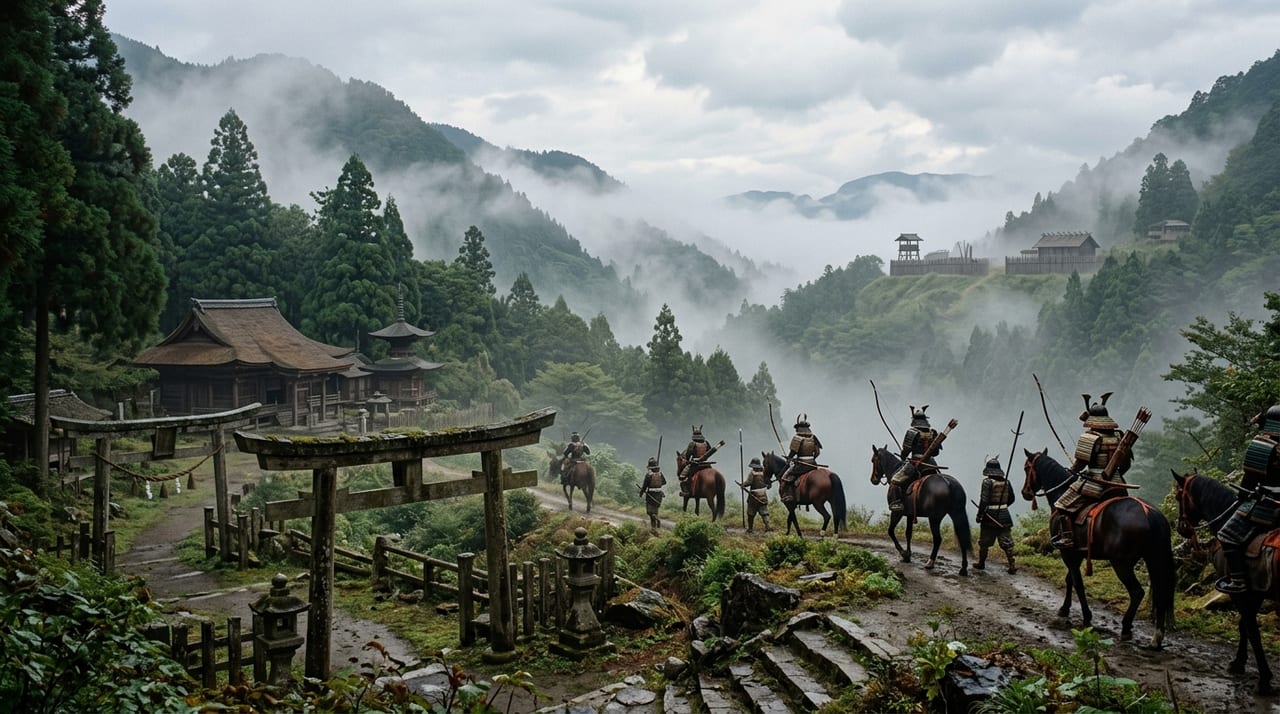
 * Image is for illustrative purposes only.
Jōhei-Tengyō Revolt Period
承平・天慶の乱期
The revolts of Taira no Masakado and Fujiwara no Sumitomo marked the decisive rise of the warrior class. The court's military limitations were exposed, and sword-bearing bushi stepped onto the historical stage, initiating early experiments with curved blade forms.
Description
The Background of the Rebellions and the Rise of the Warriors
The Jōhei-Tengyō Rebellions (935–941) were the greatest political crisis of the Heian period. Two large-scale armed uprisings broke out at the same time: Taira no Masakado's rebellion in the Kantō and Fujiwara no Sumitomo's rebellion in the Inland Sea. The imperial court had no military force of its own and was obliged to ask warriors who had already become local clan powers to suppress the revolts. Fujiwara no Hidesato and Taira no Sadamori, who defeated Masakado, and Minamoto no Tsunemoto, who destroyed Sumitomo, became pioneers of a new social class, the “warriors,” and laid the foundations of the warrior society that followed.
A Period of Experimentation in Sword Forms
This era is a transitional period in which the form of the Japanese sword began to shift from the straight-bladed chokutō to the curved wantō. Early curved swords with a curve at the waist are thought to have begun being trial-made for their usefulness in mounted combat, but very few surviving examples exist, and much of the actual picture remains unclear. Breaking away from the straight-sword forms of the early Heian period, it was a stage on the way to the elegant tachi perfected in the Kamakura period: an age of experimentation. The process by which warriors in Dazaifu and the eastern provinces improved blade forms through actual combat became an important foundation for the completion of the later Japanese sword.
Rising Demand for Swords on the Battlefield
In the Masakado Rebellion, the whole Kantō became a battlefield, and hand-to-hand fighting between mounted warriors unfolded. As such combat experience accumulated, the superiority of curved blades, which were better suited to drawing and cutting from horseback than straight swords, came to be recognized. Swords worn at the waist (the precursor of the later tachi) increased mobility on horseback and made possible “draw-and-strike” techniques, which were advantageous over straight swords even in ground combat. The Sumitomo Rebellion also saw swords used in the special circumstances of naval battle, and adaptation to varied combat environments spurred the evolution of sword forms.
Smith Activity and the Gap Between Center and Region
Almost no written records about smiths of this period survive, but it is presumed that smiths existed around the temples and shrines of Nara and in various parts of the Kinai region. While inheriting technology transmitted from the continent (Tang and the Korean Peninsula), a distinctive steelmaking and forging technology using Japanese iron sand and charcoal was developing. Hōki Yasutsuna is known as one of the earliest smiths with extant signed works, and he left famous blades including Dōjigiri Yasutsuna. However, Yasutsuna's actual date is considered to fall in the latter half of the Heian period, so he cannot be confirmed as a smith of this era. In the provinces, including the eastern provinces, the San'yōdō, and the San'indō, smithing developed to meet the demand of local warriors, and the seeds of the later Bizen-den and San'in smithing appear.
The Emergence of Martial Culture and the Social Status of Swords
After the Jōhei-Tengyō Rebellions, swords began to change from mere weapons into emblems of martial prestige that symbolized a warrior's status. The warriors who suppressed the Masakado and Sumitomo revolts were granted court ranks and offices as rewards. The source of the concept that the sword is the warrior's soul was formed in this period, and it can be said that the foundation of the spiritual and cultural significance swords held in the later warrior society was established.
Surviving Artifacts and Challenges in the Historical Record
Almost no swords from the Jōhei-Tengyō period survive, so research has to center on archaeological and textual-historical approaches. One can indirectly infer the sword styles of the time from picture scrolls (depictions of Heian-era warrior dress in later works), but confirmation through actual surviving objects is difficult. Dōjigiri Yasutsuna by Hōki Yasutsuna (National Treasure) is an important surviving work that conveys the dawn of the Japanese sword. However, Yasutsuna's actual date is considered to be the latter half of the Heian period, so it cannot be confirmed as a sword of this era.
Characteristics of This Era
- A transitional period from straight swords to curved swords. Early curved swords with a shallow curve at the waist began to be trial-made, and improved practicality in mounted combat was the main driver of the change in form.
- Blades are slender overall with a shallow curve. Compared with the elegant tachi of the late Heian to Kamakura periods, they have a plain, sturdy, rugged appearance.
- While influenced by the continent (Tang and Silla), smithing was still developing its own distinctive tamahagane method using native Japanese iron sand (masa-tetsu and yama-satetsu) and charcoal.
- Extant examples are extremely rare. Even Dōjigiri Yasutsuna by Hōki Yasutsuna (National Treasure) is considered to date from the latter half of the Heian period, and there are few physical materials conveying the technical level of this era.
- A period when swords began to function as status markers for warriors and as gifts, forming the prototype of the spiritual significance of the warrior's soul.