New Arrivals — Browse our catalog for the latest authentic Japanese sword arrivals. Browse →
797 (Enryaku 16): appointment as Sei'i Taishogun; 801–802 (Enryaku 20–21): decisive campaign
Isawa (Ōshū, Iwate Prefecture) and Shiwa (near Morioka, Iwate Prefecture)
Forces
Imperial forces
Emishi (non-subjugated peoples of northeastern Japan)
About 10 min read
Sakanoue no Tamuramaro was appointed Sei'i Taishōgun by Emperor Kanmu in 797 (Enryaku 16). As the first figure confirmed in the sources to have actually exercised the substantive functions of Sei'i Taishōgun, Tamuramaro occupies a normative position in the later history of military governments. His conquest of the Emishi was not merely a military victory; it was deeply connected to the formation of the warrior class in Japan and the development of sword culture.
From the Nara period into the early Heian period, the court repeatedly clashed intermittently with non-submitting forces in the Northeast (Mutsu and Dewa), known as the Emishi. The Emishi had their own social organization and resisted court rule. The court made Taga Castle (Tagajō) in Miyagi Prefecture a Chinjufu (Pacification Headquarters) and a base for administering the Northeast, but Emishi resistance continued.
Emperor Kanmu (reigned 781–806) made the subjugation of the Emishi an important policy alongside the relocation of the capital to Nagaoka-kyō and Heian-kyō, and dispatched large expeditionary forces on several occasions. In the first campaign, in 789 (Enryaku 8), a force of some 20,000 to 30,000 men suffered a defeat at the hands of an army led by the Emishi chief Aterui (Battle of Subuse). This crushing defeat drove home to Emperor Kanmu the need for a powerful commander and led to the appointment of Tamuramaro.
Sakanoue no Tamuramaro (758–811) came from a military family of immigrant (toraijin) descent; his father was Sakanoue no Karitamaro. Although he had an intimidating appearance, with a height of about 175 cm, unusually tall for the time, a flushed face, hawk-like eyes, and a golden chin beard, he is said to have been gentle in temperament and compassionate.
In the second campaign, in 794 (Enryaku 13), he served as deputy commander and gained combat experience. Building on this achievement, he was appointed Sei'i Taishōgun in 797 (Enryaku 16). Originally, Sei'i Taishōgun was an office meaning "a temporary general to subjugate the Emishi," but from Tamuramaro's appointment onward, the title became established in history as the highest post signifying the summit of military government.
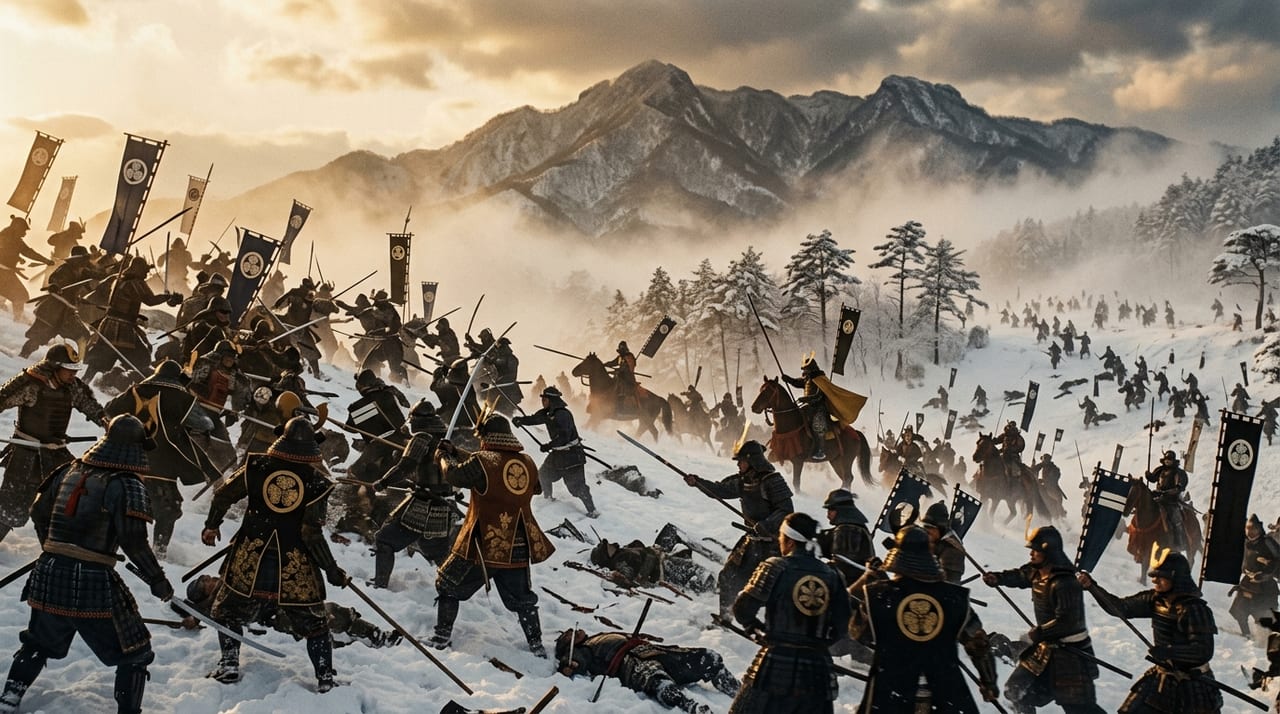
In 801 (Enryaku 20), Tamuramaro led an army of approximately 40,000 and began the third campaign. In 802 (Enryaku 21), during the construction of Isawa Castle, the Emishi chiefs Aterui and More, the central leaders of the Emishi, surrendered at the head of more than 500 people. There is also a view that this surrender came after repeated peace negotiations in addition to military subjugation by force.
That same year, Tamuramaro built Isawa Castle in Isawa (Ōshū, Iwate Prefecture), at the heart of the Emishi-controlled territory, and moved the Chinjufu from Taga Castle to Isawa Castle. Furthermore, in 803 (Enryaku 22) he built Shiwa Castle (near present-day Morioka, Iwate Prefecture) to extend control northward.
Aterui and More, after surrendering, were taken to Kyoto together with Tamuramaro. Tamuramaro petitioned that the two be sent home to bring the Emishi into submission, but court nobles opposed this, and the two were executed in Kawachi Province. This episode forms the core of the later legendary image of Tamuramaro as one who combined "strength as a warrior and compassion as a warrior."
The title "Sei'i Taishōgun" had its substantive meaning inscribed in history through Tamuramaro's campaigns, and in later military governments it came to carry enormous symbolic authority. Minamoto no Yoritomo, who founded the Kamakura shogunate (appointed 1192), Ashikaga Takauji of the Muromachi shogunate (1338), and Tokugawa Ieyasu of the Edo shogunate (1603) all invoked this title that Tamuramaro had established to assert the legitimacy of their military governments.
The early Heian period, when Tamuramaro was active, was a transitional era in which the form of the Japanese sword shifted from the chokutō (straight sword) to the wantō (curved sword). The chokutō of the Nara and early Heian periods evolved, along with changes in mounted combat, into the single-edged, curved wantō. This change in sword form accelerated from the late 9th century through the 10th century, and the prototype of the later Japanese sword was completed. It is thought that the incorporation of improvements to the warabitetō used by the Emishi was one factor in this evolution of sword form.
Groups of warriors who had gained combat experience in the Northeast became an important core in the later formation of the warrior class.
After the death of Emperor Kanmu in 806 (Enryaku 25), Tamuramaro continued to hold important posts, and he also distinguished himself in suppressing the Kusuko Incident (the Incident of Retired Emperor Heizei) in 810 (Daidō 5). He died in 811 (Kōnin 2) as Dainagon (Major Counselor) of Senior Third Rank and was posthumously granted Junior Second Rank.
Even after his death, Tamuramaro was venerated as a god of war and is known as the central figure in the founding legend of Kiyomizu-dera in Kyoto. According to tradition, Kiyomizu-dera began when Tamuramaro, visiting Mount Otowa on a deer hunt, met the monk Kenshin (later Enchin) and built a temple. He was also revered as "Guardian of the Imperial Capital" and "guardian deity of Heian-kyō." As a god of war to whom swords and armor were dedicated, he continued to attract the devotion of warriors after the mid-Heian period, when the warrior class took shape.