New Arrivals — Browse our catalog for the latest authentic Japanese sword arrivals. Browse →
19 January–5 February 1160 (Heiji 1/12/9–12/26)
Kyoto, Yamashiro Province (around Sanjo Palace and Rokuhara)
Forces
Fujiwara no Nobuyori / Minamoto no Yoshitomo's Forces
Taira no Kiyomori's Forces (Emperor's side)
About 15 min read
In the 12th month of Heiji 1 (1159; January–February 1160 in the Western calendar), Heian-kyō was once again stained with warrior blood. Just three years after the Hōgen Rebellion (1156), if that earlier war was the first occasion on which warriors entered central politics, the Heiji Rebellion is recorded in history as the first incident in which warriors seized control of the court by force. The outcome of this rebellion determined the course of the great river of history that followed: the Genpei War and the establishment of the Kamakura shogunate.
In the late Heian period, power struggles at court never ceased. After the Hōgen Rebellion, Fujiwara no Michinori (Shinzei), a close adviser to Retired Emperor Go-Shirakawa, ruled in an autocratic manner, provoking resentment among other courtiers. Fujiwara no Nobuyori, who had risen rapidly as a favorite of Retired Emperor Go-Shirakawa, and Minamoto no Yoshitomo, who had tied himself to Nobuyori through his connections with Musashi and Mutsu, found their interests aligned and joined forces. The alliance of Nobuyori and Yoshitomo, with opposition to Shinzei as a common goal, took action by exploiting the moment when Kiyomori had left the capital on a pilgrimage to Kumano.
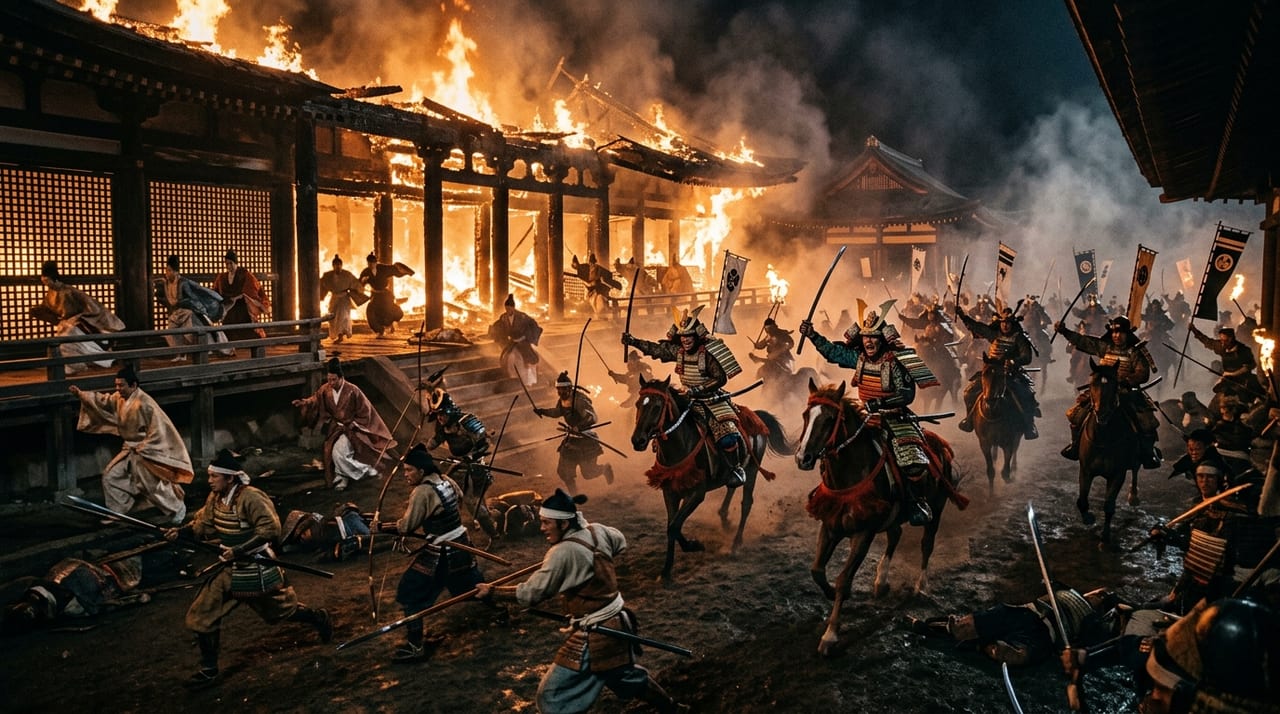
On the night of 19 January 1160 (Heiji 1/12/9), Yoshitomo's forces launched a surprise attack on Sanjō-dono Palace, where Retired Emperor Go-Shirakawa was staying. Under the pretext of striking down Shinzei, Yoshitomo's elite soldiers stormed in, setting fire to the palace as they advanced. The Retired Emperor was moved to the Ippon Gosho-dokoro in the Imperial Palace (Dairi) and placed under confinement. Shinzei fled into the mountains of Tawara in Yamashiro Province and hid underground, but just before he was dug out, he took his own life, and Minamoto no Mitsuyasu took his head. Shinzei's head was reportedly displayed at the execution ground. For a time, control of the rebellion was held in the hands of Nobuyori and Yoshitomo.
Japanese swords of this era were dominated by long tachi of the Ko-Bizen and Ko-Hōki traditions. The tachi, wielded by mounted warriors from horseback, was among the most important close-combat weapons in late Heian warfare. However, in the age of the Heiji Rebellion, many warriors first fought with bows and arrows, and then finished off enemies unhorsed with the tachi.
Minamoto no Yoshitomo was known as a general with the foremost military strategy of his day. Few detailed records survive of the tachi Yoshitomo carried, but as the commander of a famed Minamoto line who had survived numerous battles, it is not hard to imagine that his sword was a masterwork forged through practical combat.
Among the heirloom tachi of the Taira house, the “Kogarasu (Kogarasu-maru)” is known, cited in the Genpei Jōsuiki alongside “Karakawa” and “Nukemaru.” The Heiji Monogatari relates an anecdote that, in the battles of this rebellion, Taira no Yorimori drove back enemies with the heirloom tachi “Nukemaru,” though some view this as a fabrication meant to enliven the tale.
As for the lineage of swordsmiths active in this period, the names of the Ko-Bizen school (Tomonari, Masatsune, Kanehira, and others) are cited. The tachi forged by these smiths, who commanded the highest skill at the close of the Heian period, demonstrated their true worth in combat between warriors such as those of the Heiji Rebellion. The beautiful curvature of the blades and their keen cutting edges were optimized for the battles of mounted warriors, showing how carefully the warriors of this age attended to the quality of their swords.
When Nobuyori and Yoshitomo seized actual power in the capital, Taira no Kiyomori was away on his pilgrimage to Kumano. With the cooperation of Yuasa Muneshige and others in Kii, Kiyomori returned to the capital on the 17th day of the 12th month. He presented a name-register (myōbu) pledging allegiance to Nobuyori, outwardly showing submission, while secretly completing preparations for a military counterattack.
On the night of the 25th day of the 12th month into the early hours of the 26th, Emperor Nijō escaped from the Imperial Palace (Dairi) and moved to Kiyomori's residence in Rokuhara. Retired Emperor Go-Shirakawa also escaped from the Imperial Palace and moved to Ninna-ji. With both the Emperor and the Retired Emperor on Kiyomori's side, the rebellion of Nobuyori and Yoshitomo turned into a cause of subjugating the enemies of the court. On 5 February 1160 (Heiji 1/12/26), Kiyomori's forces and Yoshitomo's forces clashed around the Rokujō riverbank. Kiyomori's side overwhelmed Yoshitomo's in both numbers and momentum, and Yoshitomo's forces were routed.
Defeated, Yoshitomo fled eastward toward the provinces with a small number of attendants. However, when he reached Noma in Owari Province (present-day Mihama Town, Chita District, Aichi Prefecture), he was betrayed by Osada Tadamune, a former retainer, and attacked and killed while bathing. Yoshitomo's resentment at dying without even achieving a warrior's end is described in detail in the Heiji Monogatari.
“If only I had a single wooden sword.” This line, handed down through later generations as the words of Yoshitomo, who was killed without a sword in hand, clearly shows that a sword was more than a mere weapon for a warrior, a symbol of the soul. The regret of a commander who died empty-handed is deeply etched into the history of the Japanese sword. The sword defined the very existence of the warrior, and a death without one was not a warrior's death.
Yoshitomo's son Yoritomo, then aged 13, escaped execution and was exiled to Izu Province (present-day Shizuoka Prefecture). This is said to have been due to the petition of Ike no Zenni, Kiyomori's stepmother. It is hard to imagine that Kiyomori, at that time, could have foreseen that this act of mercy would, twenty years later, trigger the Genpei War and give birth to the new age of the Kamakura shogunate.
After the Heiji Rebellion, Taira no Kiyomori rapidly raised his political standing. In 1167 (Nin'an 2), he was appointed Daijō-daijin (Grand Minister of State), and he had his daughter Tokuko enter the palace as Chūgū (empress consort) to Emperor Takakura, becoming maternal grandfather and guardian of Emperor Antoku. Kiyomori's power came to surpass even that of the regent houses (Sekkan-ke), and the age epitomized by the saying “Those who are not of the Taira are not worthy to be called people” arrived.
However, Minamoto no Yoritomo, exiled to Izu after the Heiji Rebellion, raised his army in 1180 (Jishō 4) in response to a command from Prince Mochihito. From there began the five-year Genpei War, and in 1185 (Genryaku 2), at the Battle of Dan-no-ura, the Taira were destroyed.
The Heiji Rebellion set the precedent that warriors could seize political power by force. If the Hōgen Rebellion was an incident in which warriors intervened in conflicts within the court, the Heiji Rebellion was an incident in which warriors took the initiative to overthrow the government. This difference is significant. Moreover, this rebellion sharply exposed the questions of lord-vassal relations and loyalty in Japan's warrior society. Yoshitomo's assassination at the hands of Osada Tadamune revealed the limits of contractual loyalty in warrior society.
As for the significance of the Heiji Rebellion to the sword, it is confirmed that the practical tachi of this era, an older style with a long curvature, had become established as the principal close-combat weapon of warriors. Once the Kamakura period began, the forms of swords changed with the times, but the age of the Heiji Rebellion was also the last period when the elegant tachi style of the late Heian period still remained. Actually handling a tachi of this era, one can sense in the beauty of its hamon and the fineness of its jigane a level of craftsmanship that goes beyond a mere weapon.
Taira no Kiyomori
Taira clan leader who crushed the rebellion and emerged supreme
Minamoto no Yoritomo
Exiled to Izu; later founded the Kamakura Shogunate
Minamoto no Yoshitsune
Lost his father Yoshitomo in this war; later became the hero of the Genpei War
Taira no Tomomori
Kiyomori's fourth son, fought in the Heiji Rebellion and later at Dan-no-ura
保元の乱(1156年)と平治の乱(1159年)が日本刀史と武士文化に与えた影響を解説。二つの内乱が源平両氏の台頭を決定的にした経緯、当時の刀剣形態(腰反りの太刀)と実戦的要求、乱に登場した武将たちが使用した刀剣の記録、そして武士階級の刀剣文化が公家社会に浸透した過程を詳述する。
2026-05-03
平家物語や太平記に描かれた太刀は、どこまで史実として使えるのか。物語の型と実物の太刀を比べ、刀剣史に活用する際の手順を整理します。
2026-10-20
源平合戦(1180〜1185年)は、日本史上初めて全国規模の戦乱を長期間持続させた内戦だった。戦争が刀剣需要と職人の移動に与えた影響を、供給側(刀匠・刃物師)の視点から詳細に分析する。
2026-06-04
白河上皇から後白河法皇にかけての院政期(1086〜1185年)における刀剣文化を解説。院政権力が刀剣の奉納・収集を制度化した経緯と、源平の動乱が刀剣需要に与えた影響、院政期特有の刀身形態的特徴を紹介する。
2026-05-09