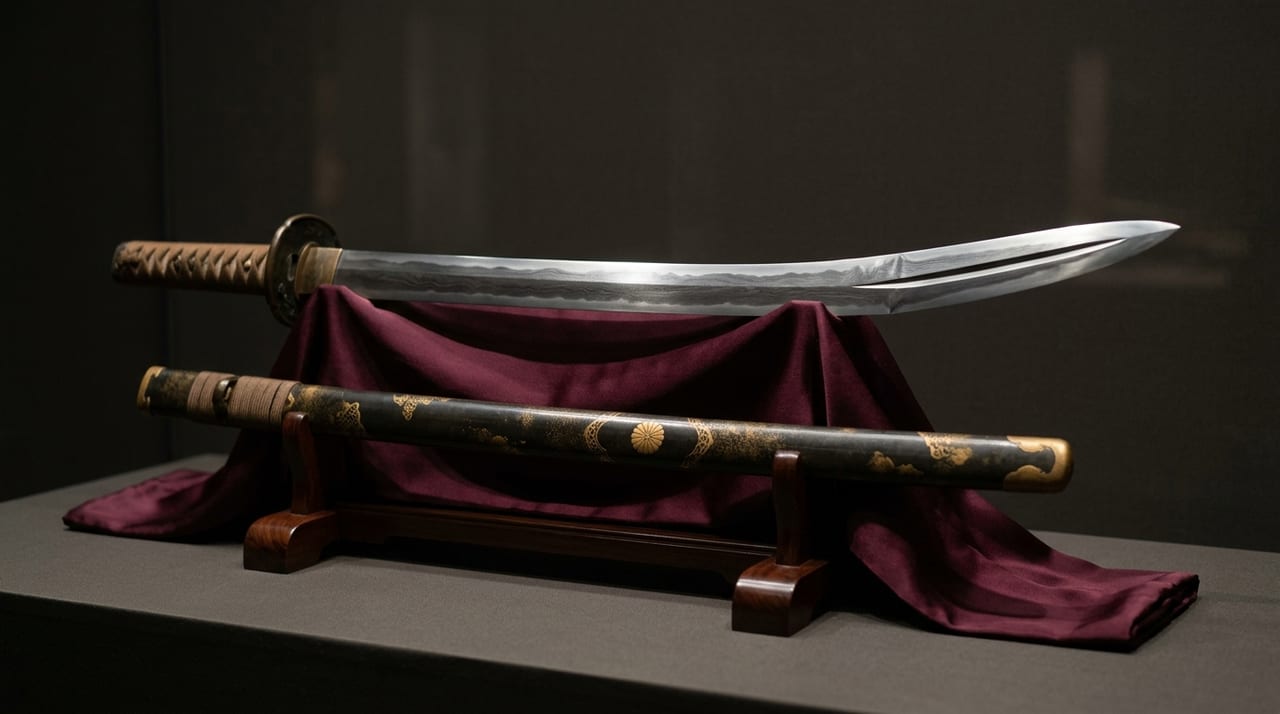
 * Image is for illustrative purposes only.
Kogarasu-maru
小烏丸
Also known as: Little Crow
Description
Overview of the Sword
An ancient tachi that embodies the very origin of the Japanese sword, and the most important blade in the history of swordmaking. With a blade length of approximately 62.8 cm, its curvature is shallow but definitely present, clearly showing the transition from the straight sword to the curved sword (nihontō). Its most distinctive feature is an extremely rare construction called kissaki-moroha-zukuri, in which the lower half of the blade has the usual single edge (shinogi-zukuri), whereas the upper half (the kissaki side) is double-edged. This construction combines, within a single blade, features of the straight sword (a double-edged sword) introduced from the continent and of the curved sword (a single-edged sword) developed independently in Japan, making it a “fossil of evolution” that physically demonstrates how the Japanese sword achieved its own distinctive evolution from continental swords.
Construction and Characteristics
The jigane shows ko-itame hada with a flowing grain, the hamon is straight (suguha) with rich activity (hataraki) within the blade, and there is a composed dignity within its classical simplicity. The legendary maker is said to be Amakuni. Amakuni is described as a swordsmith who lived in Yamato Province during the Nara period, and is passed down as the first person to forge Japanese swords; however, his historical existence has not been confirmed, and he is a semi-legendary figure. As for the actual date of manufacture, some view it as spanning from the late Nara period to the mid-Heian period, but no definitive conclusion has been reached.
Provenance
Its provenance belongs to the realm of myth. According to tradition, in the reign of Emperor Kanmu, a crow that flew in as a messenger of Ise Grand Shrine brought a single tachi to the Emperor, and this tachi is said to be Kogarasu-maru. Later, during the rebellion of Taira no Masakado, the warrior Taira no Sadamori of the Kanmu Heishi line is said to have received this tachi from the Emperor. The tradition that this tachi was bestowed through a messenger of Ise Grand Shrine gives Kogarasu-maru the significance of a “sacred treasure protecting the nation.” From then on, Kogarasu-maru was handed down through generations as a treasured heirloom of the Taira clan (Kanmu Heishi). After the Taira were destroyed in the Genpei War (1180–1185), it was considered lost, but in Tenmei 5 (1785) of the Edo period, it was found to have been passed down to the Ise family, which descends from the Taira line. After the Meiji Restoration it passed through the Sō family of Tsushima, and in Meiji 15 (1882) it was presented to Emperor Meiji and became an imperial treasure (gyobutsu).
Current Holdings
It is currently an imperial treasure of the Imperial Household, and is stored by the National Institutes for Cultural Heritage under commission from the Imperial Household Agency. Opportunities for public viewing are extremely limited.
Legends & Stories
Legend and Anecdotes
The legend of the bestowal of Kogarasu-maru is the oldest "origin myth" attributed to the Japanese sword. According to tradition, during the reign of Emperor Kanmu (781–806), at one point a great crow arrived as a messenger of Ise Grand Shrine and brought a single tachi. Because the crow brought it, this tachi is said to have come to be called Kogarasu-maru. Thereafter, this tachi became a treasure blade of the imperial court; during the Taira no Masakado Rebellion, Taira no Sadamori received it from the emperor, and it was passed down to the Kanmu Taira clan (House of Taira).
The historical significance of this tradition is immense. Taira no Sadamori was a meritorious official who suppressed the rebellion of Taira no Masakado (935–940) and was the figure who formed the core of the Kanmu Taira line. The narrative of guarding the nation with a blade bestowed by the divine served to mythologically underpin the legitimacy of the House of Taira as a warrior clan. The fact that Kogarasu-maru was held as a precious treasure of the House of Taira suggests it constituted part of the Taira clan's power base.
The structure of the double-edged-point construction (hone ryouha-zukuri), with extremely few comparable examples elsewhere, would have imparted a profound sense of otherworldliness to anyone who actually held this blade. Because the point is double-edged, it possesses a distinctive weight balance unlike ordinary tachi, offering versatility suited to both thrusting and cutting. There is debate as to whether this structure was influenced by continental straight swords or arose uniquely in Japan; in either case, there is no dispute that it is an invaluably precious artifact filling the "missing link" in the developmental history of the Japanese sword.
After the House of Taira's demise in the Battle of Dannoura (1185), Kogarasu-maru was said to have gone missing. However, it was discovered in Tenmei 5 (1785) that it had been passed down to the Ise family, which traces its lineage to the Taira; after the Meiji Restoration, the Sō family of Tsushima purchased it, and in 1882 Sō Shigemasa presented it to Emperor Meiji. What is certain is that this blade ultimately passed to the imperial house and endures as an imperial treasure (gomotsu) to this day.
This blade, surviving more than a thousand years, is a unique being that conveys the "beginning" of Japanese sword culture to the present and occupies the position of "ancestor" to all Japanese swords.