New Arrivals — Browse our catalog for the latest authentic Japanese sword arrivals. Browse →
July 29, 1156 (11th day, 7th month, Hōgen 1)
Kyoto, Yamashiro Province (Shirakawa Kitadono and surrounding areas)
Forces
Emperor Go-Shirakawa's Forces
Retired Emperor Sutoku's Forces
About 11 min read
In the 7th month of Hōgen 1 (1156), the conflict between Emperor Go-Shirakawa and Retired Emperor Sutoku over imperial succession escalated into armed clash. This 'Hōgen Rebellion' is an event that forms a turning point of extreme importance in Japanese history, as the first large-scale intervention of warriors in central politics at the end of the Heian period.
In the late Heian period, the court shifted its power structure from regency government to cloistered rule (insei), and often harbored internal conflict over imperial succession. Following the death of Cloistered Emperor Toba on 20 July 1156 (Hōgen 1/7/2), the discontent of Retired Emperor Sutoku, which had been suppressed under Toba's cloistered rule, erupted all at once. Retired Emperor Sutoku took up position in Shirakawa Kitadono with Minamoto no Tameyoshi and his son Minamoto no Tametomo (Chinzei Hachirō), as well as Taira no Tadamasa, and tried to oppose Emperor Go-Shirakawa's side.
On the other side, Taira no Kiyomori and Minamoto no Yoshitomo rushed to join Emperor Go-Shirakawa's side. Kiyomori was already the head of the Taira clan, with a firm base in the western provinces, while Yoshitomo was a powerful Minamoto leader with a record of achievement in the eastern provinces. At this point, the Taira and Minamoto fought together in the same camp.
In the era of the Hōgen Rebellion, the principal fighting style of warriors was mounted combat with bow and arrow, and the sword was an auxiliary close-combat weapon. However, the warriors who took part in this battle carried excellent swords, embodying the sword culture of the late Heian period.
Minamoto no Tametomo (Chinzei Hachirō) is depicted in later war chronicles as a giant warrior who made his name with his mighty bow. According to the Hōgen Monogatari, at the war council of Retired Emperor Sutoku's side, Tametomo proposed a night raid on Takamatsu-dono and an attack with fire, but his proposal was rejected by Fujiwara no Yorinaga. His skill with the bow is said to have been legendary.
Direct historical sources are scarce for the sword said to have been carried by Taira no Kiyomori, but the Taira family treasure Kogarasumaru is known as a famous blade handed down to the Taira since the Heian period. Through his achievements in this rebellion, Kiyomori subsequently rose rapidly to political prominence.
The swords of this era were mainly tachi with deep curvature, of the Ko-Bizen and Ko-Hōki lineages. In the Hōgen Rebellion, the fighting style of mounted warriors swinging long tachi from horseback was on full display.
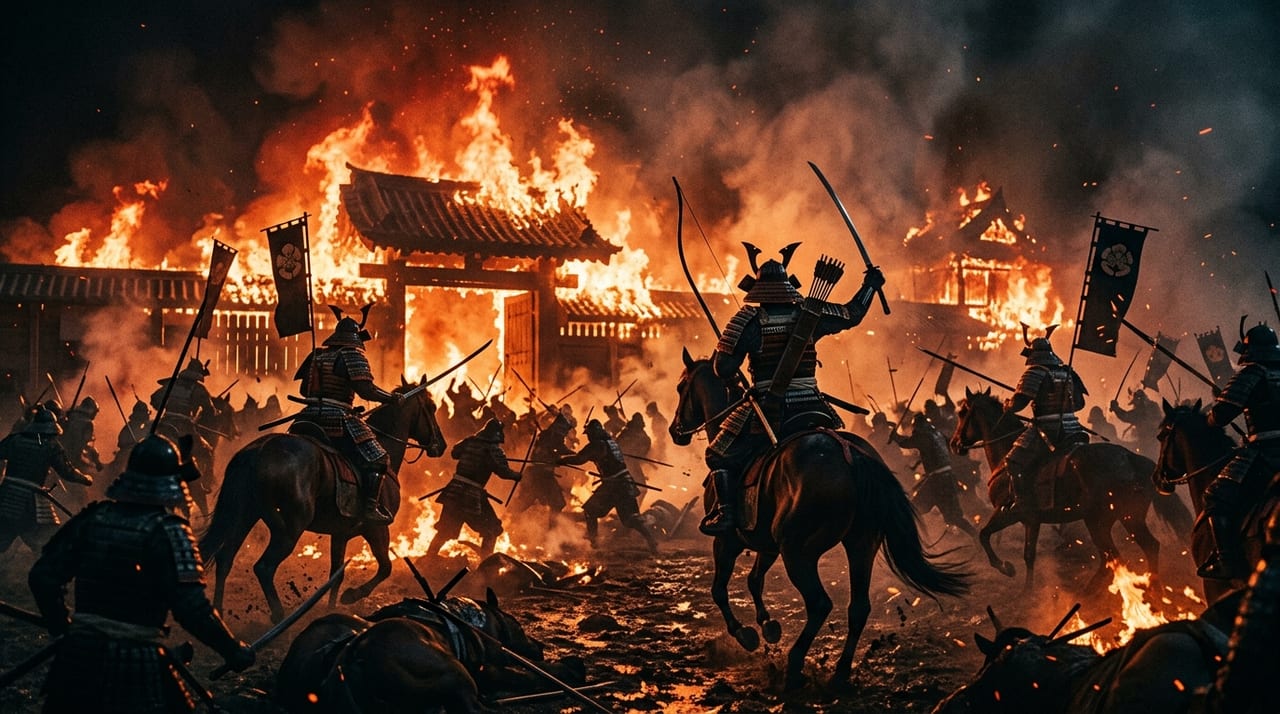
Before dawn on 29 July 1156 (Hōgen 1/7/11), Emperor Go-Shirakawa's side carried out a night raid on Shirakawa Kitadono, on the advice of Shinzei and Yoshitomo, who argued for a preemptive strike.
Kiyomori advanced east along Nijō Avenue, Yoshitomo along Ōimikado Avenue, and Minamoto no Yoshiyasu along Konoe Avenue, attacking Shirakawa Kitadono. Having failed to make headway, the Emperor's side set fire, on Yoshitomo's proposal, to the residence of Fujiwara no Ienari, which lay adjacent to the west. The flames spread to Shirakawa Kitadono, and the warriors of Retired Emperor Sutoku's side fell into confusion amid the blaze. Tametomo's mighty bow at one point troubled Emperor Go-Shirakawa's side, but outnumbered, Retired Emperor Sutoku's side collapsed within a single night of fighting.
Retired Emperor Sutoku fled to Ninna-ji and was later exiled to Sanuki (present-day Kagawa Prefecture). He spent about eight years in Sanuki and died still harboring resentment. In later ages, he was feared as one of the Three Great Vengeful Spirits of Japan.
In the aftermath of the Hōgen Rebellion, the court revived the death penalty, which had not been officially carried out since the Kusuko Incident, and had the defeated warriors executed. Minamoto no Tameyoshi was beheaded by his son Yoshitomo, and Taira no Tadamasa was executed by his nephew Kiyomori. In this cruel order that kin should kill kin, one can read the court's intention not only to use warriors as political tools, but also to have them demonstrate their discipline and obedience through their own force.
This execution left a deep scar among the warriors. Yoshitomo harbored an inner conflict over having killed his own father, and this became a distant cause of his rebellion in the Heiji Rebellion (1159).
From the perspective of sword history, the Hōgen Rebellion is a symbolic event in which warriors were elevated from 'those who carry swords' to 'those who move the nation with swords.' Taira no Kiyomori afterward rose to the post of Grand Minister of State (Daijō-daijin) and enjoyed a splendor summed up in the saying, 'Those who are not of the Taira are not considered people.' Minamoto no Yoritomo, a son of Yoshitomo, later founded the Kamakura shogunate and laid the foundation of warrior government. The swords of the Hōgen Rebellion were swords that changed the course of Japanese history.
The mid-12th century, when the Hōgen Rebellion occurred, was the height of the Ko-Bizen school in the history of Japanese swords. Tachi produced by master smiths of Ko-Bizen such as Tomonari, Masatsune, and Kanehira were prized as the principal weapons of mounted warriors. The hamon is based on ko-midare, and the jigane shows dark-tinged itame-hada. The elegant form with deep koshi-zori is a feature of this period, and the swords worn by warriors who took part in the Hōgen Rebellion are thought to have been of this same lineage.
Also, as typified by the giant bow said to have been used by Minamoto no Tametomo, archery (yabusame and kasagake) and mounted tactics were the core of warrior skills in this era. Swords were worn at the waist as the 'soul of the warrior,' readied for final close combat, but their role remained auxiliary. More than a century after the Hōgen Rebellion, with the spread of infantry combat in the Mongol invasions, the role of the sword transformed into a more central one.
保元の乱(1156年)と平治の乱(1159年)が日本刀史と武士文化に与えた影響を解説。二つの内乱が源平両氏の台頭を決定的にした経緯、当時の刀剣形態(腰反りの太刀)と実戦的要求、乱に登場した武将たちが使用した刀剣の記録、そして武士階級の刀剣文化が公家社会に浸透した過程を詳述する。
2026-05-03
白河上皇から後白河法皇にかけての院政期(1086〜1185年)における刀剣文化を解説。院政権力が刀剣の奉納・収集を制度化した経緯と、源平の動乱が刀剣需要に与えた影響、院政期特有の刀身形態的特徴を紹介する。
2026-05-09
平安時代(794〜1185年)における公家(貴族)と武士(もののふ)の刀剣観の違いを詳解。儀礼・装飾目的の「太刀拵え」と実戦向け刀剣の分岐、宮廷での刀の意味、平安末期の武士台頭と刀の実用化を考察する。
2026-04-26
平安時代中期から後期(9〜12世紀)にかけて、日本の刀剣文化は劇的な変革を迎えた。直刀から反りを持つ太刀への移行、源氏・平氏という武家勢力の台頭、前九年・後三年の役、そして保元・平治の乱を経て、日本刀は武士のアイデンティティの核心へと高まっていった。
2026-04-14