New Arrivals — Browse our catalog for the latest authentic Japanese sword arrivals. Browse →
1051–1062 (Eishō 6 – Kōhei 5)
Mutsu Province (present-day Iwate Prefecture and northern Miyagi Prefecture)
Forces
Minamoto and Imperial Forces
Abe Clan
About 12 min read
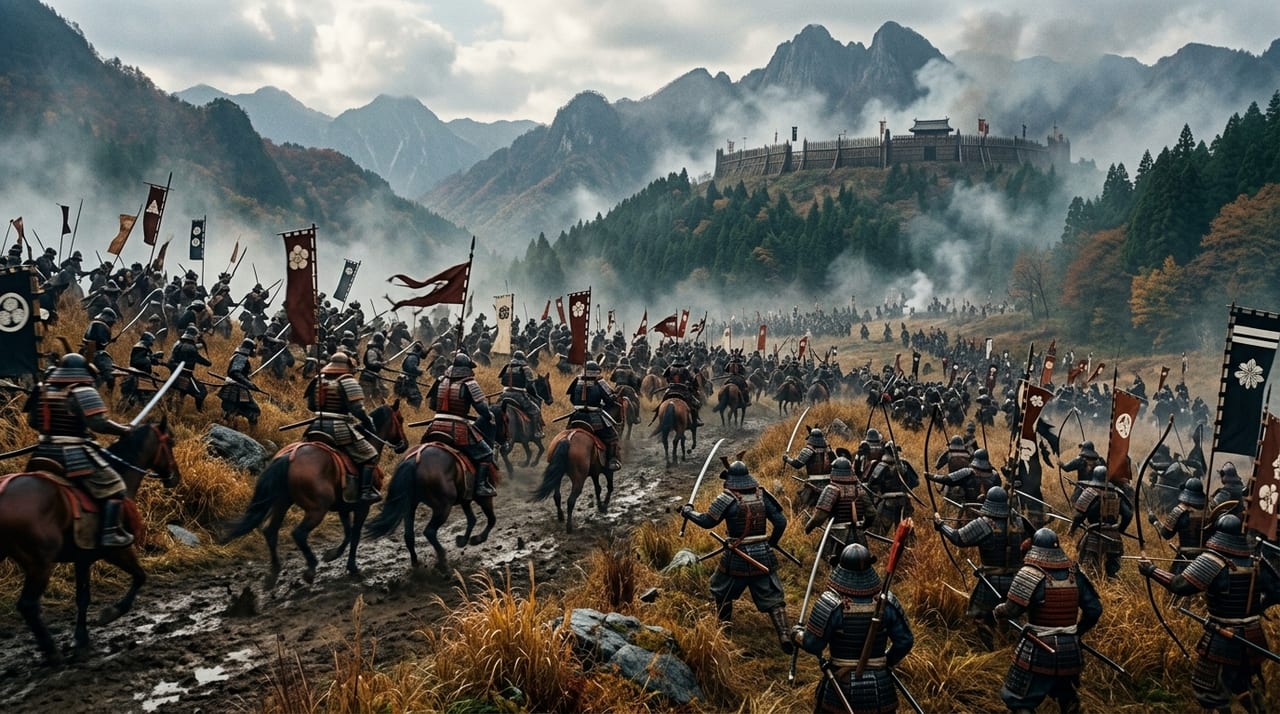
The Former Nine Years' War (Zenkunen War), fought from 1051 (Eishō 6) to 1062 (Kōhei 5) in the Mutsu Province of the northeast (present-day Iwate Prefecture and northern Miyagi Prefecture), was a prolonged confrontation between the father-and-son pairs Minamoto no Yoriyoshi and Yoshiie, and Abe no Yoritoki and Sadatō. It is known as a decisive turning point in Japanese history, marking the independence of the warrior class and the rise of the Minamoto.
The name "Former Nine Years' War" was adopted to distinguish it from the subsequent Later Three Years' War (1083–1087). Until the mid-Kamakura period, it was called the "Ōshū Twelve Years' War" or the "Twelve Years' War." The name "Nine Years' War" is a later coinage. The actual fighting, though intermittent, lasted twelve years.
In the mid-Heian period, the northeast was a frontier region inhabited by people called Emishi, where the direct control of the court hardly reached. Provincial governors (kokushi) under the ritsuryō system nominally claimed authority, but in practice local clans held the real power.
The Abe clan made the Six Districts of Oku (Isawa, Esashi, Waga, Hienuki, Shiwa, and Iwate, in what is now the south-central part of Iwate Prefecture) its base and established de facto autonomy. Abe no Yoriyoshi (later renamed Yoritoki), chief of the fushū, behaved as a regional ruler with a high degree of independence.
Relations with the court deteriorated when the Abe clan withheld the taxes (kōso) owed to the provincial governors and showed defiance. At Onikiribe, the Abe defeated the forces of Fujiwara no Naritō, Governor of Mutsu (Mutsu no kami). Under the next Governor of Mutsu, Minamoto no Yoriyoshi, peace was temporarily maintained through a general amnesty. But the Akutogawa Incident of 1056 (Tengi 4) led to armed conflict.
When fighting resumed in 1056–1057 (Tengi 4–5), it was a string of hardships for Minamoto no Yoriyoshi. The Abe clan's home territory was protected by fortified strongholds called saku (stockades), and Yoriyoshi's forces struggled against the Abe, who knew the mountainous terrain of the northeast intimately.
The Battle of Kinomi in 1057 (Tengi 5) was the greatest battle of the Former Nine Years' War and is known as the fight in which Yoriyoshi suffered most. In this battle, Yoriyoshi's force of about 1,800 was crushed by an Abe army of about 4,000, with several hundred dead. Yoriyoshi escaped the battlefield with only seven horsemen, including his eldest son, Minamoto no Yoshiie (Hachiman Tarō).
After the defeat at Kinomi, Yoriyoshi was in dire straits. But here he displayed important diplomatic skill. He requested reinforcements from Kiyohara no Takenori, a powerful clan leader of Dewa Province, and succeeded in winning over the large Kiyohara force (said by some accounts to number more than 10,000 mounted warriors).
In 1062 (Kōhei 5), Minamoto no Yoriyoshi and Yoshiie, backed by the overwhelming reinforcements of the Kiyohara, took the Kuriyagawa Stockade and the Ubato Stockade, the last strongholds of the Abe clan.
Abe no Yoritoki had died in battle in 1057 (Tengi 5), and his son Sadatō was in command. In the final showdown at Kuriyagawa Stockade, Abe no Sadatō was cut down despite his fierce resistance. Earlier, at Koromogawa, Yoshiie pursued the fleeing Sadatō and called out, "Koromo no tate wa hokorobi ni keri" (the warp threads of the robe have come undone). Sadatō replied, "Toshi o heshi ito no midare no kurushisa ni" (the agony of threads that have aged and grown tangled). This famous exchange is recorded in the Kokon Chomonjū and other sources. It is an episode of poems exchanged between enemy commanders on an actual battlefield, and it is celebrated as a symbol of the culture of the Heian warriors, in which martial and literary arts were fused.
Abe no Munetō surrendered and was exiled to Iyo and Chikuzen. His descendants are said to have later taken root in Kyushu and to have been associated with warrior groups such as the Matsura band.
Among those who won the greatest renown in the Former Nine Years' War was Minamoto no Yoshiie (Hachiman Tarō Yoshiie). Yoshiie received his coming-of-age ceremony at Iwashimizu Hachimangū and called himself "Hachiman Tarō." The Hachiman deity was deeply revered by warriors as a god of war. Yoshiie, under that deity's protection, was deified in later times as an "incarnation of the war god."
No reliable historical record survives of the swords Yoshiie is said to have used. Swords of the mid-Heian period had strong curvature at the waist, and long tachi suited to striking downward from horseback were the mainstream.
Yoshiie also played a leading role as a commander in the subsequent Later Three Years' War (1083–1087), and he gained still greater renown there. Having passed through both northern campaigns, the Former Nine Years' War and the Later Three Years' War, Yoshiie was called "the foremost warrior under heaven," and he made the Minamoto's position as unshakable heads of the warrior houses. From this line of Yoshiie came Minamoto no Tameyoshi (grandfather of Yoritomo). Through the Hōgen and Heiji Disturbances and the Genpei War, the line led on to Minamoto no Yoritomo and the Kamakura shogunate.
The mid-eleventh century, when the Former Nine Years' War was fought, was an important period in the technical history of the Japanese sword. In Mutsu Province too, the smiths of Mokusa (present-day Ichinoseki City, Iwate Prefecture) are known to have made swords in the kenukigata form.
The weapons used by the northeastern warrior bands were produced locally or brought in from the Kantō and Chūbu regions, and most were practical blades by unknown smiths. The works of famous smiths were concentrated among the central aristocracy and the upper ranks of warriors. Frontier warriors often used sturdy but unsigned swords.
However, the combat abilities that the eastern warriors displayed throughout the Former Nine Years' War, including their skill with the long bow, mounted tactics, and endurance campaigns in harsh mountain and cold terrain, speak to the high quality of these warriors as swordsmen. The sword worn alongside the bow was also a symbol of the martial prowess of the eastern warriors.
About 120 years after the Former Nine Years' War, in the Genpei War, the eastern warrior bands on whom Minamoto no Yoritomo relied were the direct inheritors of the lineage forged in the Former Nine Years' War and the Later Three Years' War. The Minamoto's "story of war," which began in the lands of Ōshū, closed its first chapter with the establishment of the Kamakura shogunate.
Minamoto no Yoritomo
Descendant of Yoriyoshi and Yoshiie, the ultimate product of Minamoto's eastern ascendancy
Minamoto no Yoshitsune
Great-great-grandson of Yoshiie, inheritor of the Minamoto warrior tradition
Hōjō Yoshitoki
Kamakura regent, product of the warrior government made possible by Minamoto's eastern wars
Taira no Kiyomori
Taira counterpart to Minamoto in the warrior ascendancy following the eastern wars
Musashibō Benkei
Follower of Yoshitsune, character in the extended Minamoto saga beginning with the eastern wars