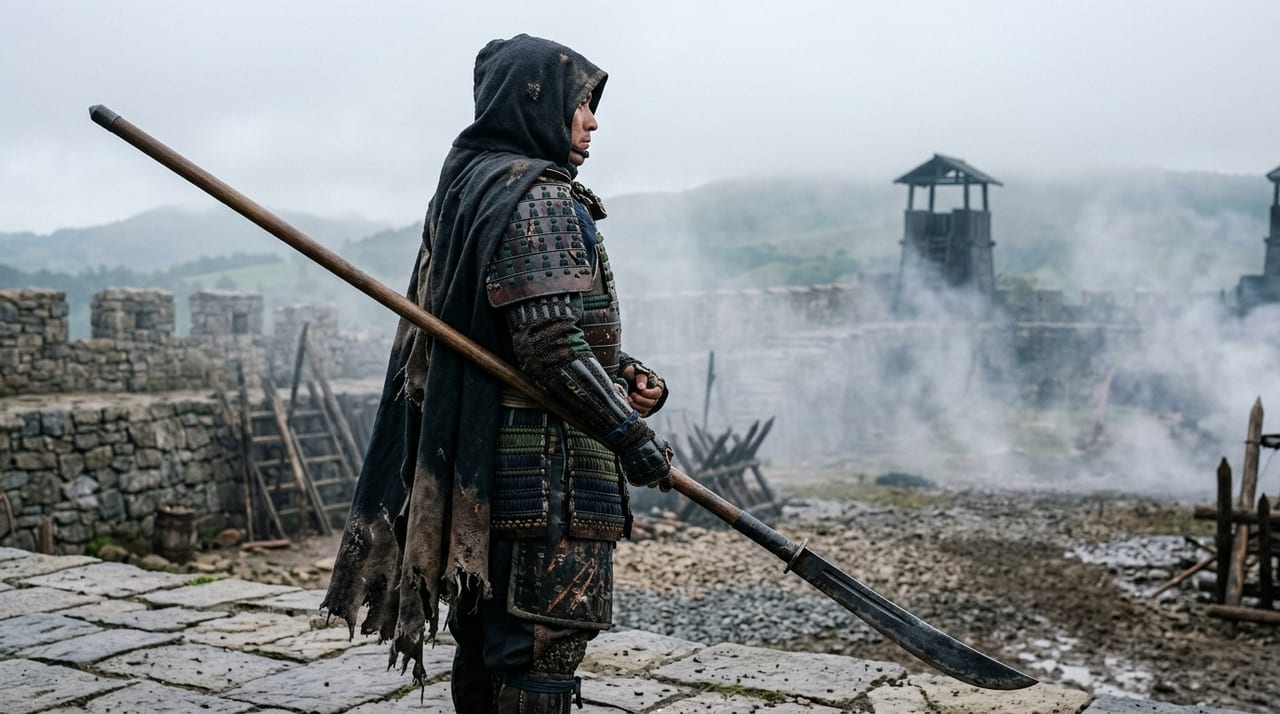
 * Image is for illustrative purposes only.
Musashibō Benkei
武蔵坊弁慶
The Mighty Monk Who Died Standing: The Brawny Warrior Monk Who Sought a Thousand Swords, and Japan's Most Loyal Retainer
Description
Benkei's Origins
Musashibō Benkei is the most famous warrior monk in Japanese history, serving as the most loyal retainer of Minamoto no Yoshitsune. However, contemporary sources mention him only as one of Yoshitsune's retainers, as in Azuma Kagami, and most of his origins and many of his anecdotes derive from the war tale Gikeiki, which took shape in the Muromachi period. In Gikeiki he is said to have been born the son of the bettō (superintendent) of Kumano, and from early childhood he is said to have had a huge build and great strength beyond ordinary people. He became a monk on Mount Hiei, but his fierce temperament could not be contained within the monastic life, and he eventually threw himself into the martial arts.
The Legend of Collecting a Thousand Swords
The most famous legend about Benkei is the story of seizing a thousand swords in Kyoto. Benkei resolved to collect a thousand swords, and he kept challenging the warriors passing along the roads of Kyoto and taking their swords. With 999 swords collected and his long-held goal within reach, he encountered a beautiful boy playing a flute as he passed by. This boy was Minamoto no Yoshitsune (Ushiwakamaru). Benkei challenged Yoshitsune but was utterly defeated by Yoshitsune's nimble movements and outstanding swordsmanship. From then on, Benkei pledged his loyalty to Yoshitsune and never left his side for the rest of his life. However, the setting of the duel at Gojō Bridge dates only from Iwaya Sazanami's Nihon Mukashibanashi of the Meiji era onward; in Gikeiki the events are said to have taken place from Horikawa-kōji to Kiyomizu Kannon.
Benkei's Weapons
The naginata is well known as Benkei's weapon, and it is said that he wielded a naginata even in the final scene at Koromogawa. Gikeiki names "Iwatōshi" as a sword Benkei carried together with a 4 shaku 2 sun tachi. The seven weapons said to have been carried by Benkei have been passed down in later times as "Benkei's Seven Weapons." They are listed as the naginata, iron rake, great mallet, great saw, sasumata, tsukubō, and sodegarami, but there are many differing theories.
As Yoshitsune's Retainer
According to tradition, Benkei followed Yoshitsune and distinguished himself in the campaign against the Taira. However, he appears only by name in contemporary works such as Heike Monogatari and Genpei Jōsuiki, and no specific military exploits are recorded.
The Ataka Barrier and the Kanjinchō
Even after Yoshitsune fell out with his elder brother Yoritomo and was driven out of the capital, Benkei remained loyal. The episode of the Kanjinchō at the Ataka barrier best shows Benkei's loyalty and resourcefulness. When Yoshitsune's party was blocked by the barrier guard Togashi Saemon, Benkei read aloud a blank scroll, pretending it was the Kanjinchō. When Yoshitsune, disguised as a gōriki (porter who carries baggage), came under suspicion, Benkei struck him with a kongōzue (pilgrim's staff). This scene, in which he even enacted the impropriety of striking his lord in order to protect Yoshitsune to the end, is still performed today as a famous scene of the kabuki play Kanjinchō.
The Legend of the tachi-ōjō (Standing Death)
In Bunji 5 (1189), when Fujiwara no Yasuhira's forces attacked Yoshitsune at his residence in Koromogawa in Ōshū, Benkei stood firm at the entrance of the residence to hold off the enemy soldiers, in order to give his lord Yoshitsune time to take his own life. Though struck all over by countless arrows, he did not fall, and he died while still standing. This is the famous "Benkei's tachi-ōjō" (standing death). This heroic end has been told for generations as the ultimate expression of Japan's spirit of loyalty. It is said that the enemy soldiers were so terrified by the sight of Benkei, dead yet still standing, that none of them dared to approach.
The story of Benkei has been beloved in every kind of Japanese performing art, including Noh, kyōgen, kabuki, and jōruri, as a symbol of loyalty and valor. In particular, Kanjinchō, one of the Kabuki Jūhachiban, is known as a masterpiece that most vividly depicts Benkei's loyalty. The thousand swords he sought to collect and his heroic last stand, in which he gave his life for his lord, can be called the very origin of the spirit of bushidō.
Notable Swords
- Iwatōshi (named in *Gikeiki* as a blade Benkei carried together with a 4 shaku 2 sun tachi)
- A thousand swords (the legend, recounted in *Gikeiki* and other sources, that he seized 999 swords from warriors passing through Kyoto)