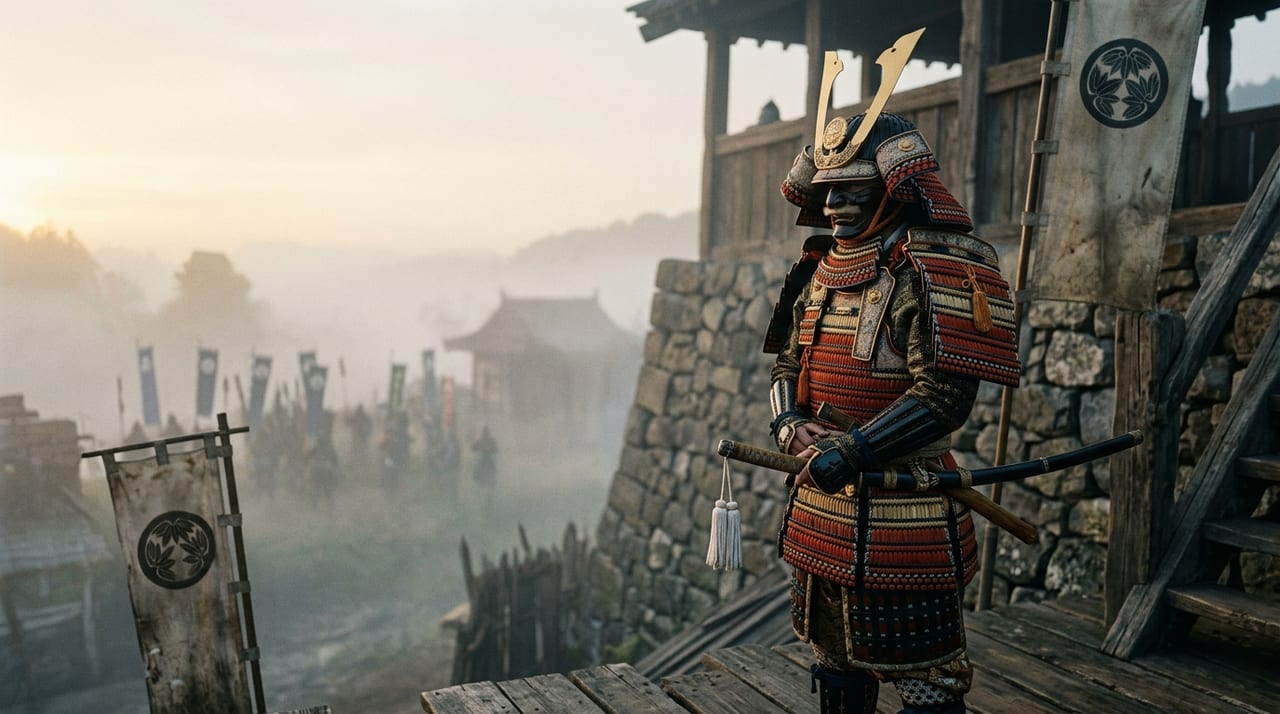
 * Image is for illustrative purposes only.
Minamoto no Yoritomo
源頼朝
Founder of the Kamakura Shogunate—The lonely hegemon who destroyed the Taira and established the first samurai regime, transforming Japanese history
Description
The Exiled Nobleman
Born in 1147 (Kyūan 3) as the third son of Minamoto no Yoshitomo, Minamoto no Yoritomo was exiled to Izu Province after his father died in defeat in the Heiji Rebellion (1159). Exile at the age of fourteen was a harsh fate, but it became a trial that tempered Yoritomo. During more than twenty years of biding his time in Izu, Yoritomo married Masako, daughter of Hōjō Tokimasa, deepened his bonds with the warrior clans of the Kantō, and steadily prepared for an uprising against the Taira.
Uprising and the Downfall of the Taira
In 1180 (Jishō 4), Yoritomo received the reishi (princely decree) of Prince Mochihito, raised an army in Izu, and killed Yamaki Kanetaka, the mokudai (provincial deputy) of Izu Province. He was defeated in the Battle of Ishibashiyama that followed, but he escaped to Awa Province and sought to turn the tide by rallying the warrior clans of the Kantō. Afterward his advance was remarkable, and with the exploits of Kiso Yoshinaka, Yoshitsune and others contributing, he succeeded in destroying the Taira at Dan-no-ura in 1185 (Bunji 1). The strategy Yoritomo employed placed greater weight on political maneuvering and the organization of warrior bands than on direct military force. The heirloom swords he inherited as the Minamoto's legitimate line were, for Yoritomo, the very symbol of authority and legitimacy.
Founding of the Kamakura Shogunate
In 1192 (Kenkyū 3), Yoritomo was appointed seii taishōgun and founded the Kamakura shogunate. This marked the birth of the first warrior government in Japanese history and the starting point of roughly seven centuries of rule by the warrior class. The shogunate's rule rested on a lord-vassal relationship bound by go'on (favour), by which the shōgun confirmed the holdings of his gokenin and granted them new lands, and by hōkō (service), by which the gokenin served through military duty and other obligations.
Famous Swords and Heirlooms of the Minamoto
Among the swordsmiths of the period, the renowned makers of the old swords of Yamashiro, Hōki and Bizen are well known. The swords most famous as ancestral blades of the Minamoto are 'Higekiri' and 'Hizamaru.' According to the 'Tsurugi no Maki' (Book of Swords) of the Heike Monogatari, Higekiri was entrusted to Yoritomo by his father Yoshitomo during the Heiji Rebellion. Hizamaru, after Yoshitsune named it 'Usumidori,' passed into Yoritomo's hands following the vendetta of the Soga brothers, and the two blades were thus reunited. These swords were passed down as treasured blades that symbolized the legitimate line of the Minamoto.
The Origins of Bushidō and the Sword
Yoritomo valued the way of the bow and horse and staged large-scale hunts, including the great hunt at the foot of Mount Fuji (Fuji no Makigari). Under his rule, a code of conduct for warriors, centered on loyalty to one's lord and the cultivation of martial skill, gradually took shape. The sword occupied the center of that code of conduct and served as the proof of what made a warrior a warrior. The warrior ideal that Yoritomo established became the prototype of the later 'Bushidō.'
A Lonely Final Period and Death
In the 1st month of Kenkyū 10 (1199), Yoritomo died. He fell ill on the return journey from the bridge dedication ceremony at the Sagami River at the end of the previous year, and the cause is said to have been either a fall from his horse or illness. He was 53 years old. Although Yoritomo built the Kamakura shogunate, a vast political machinery, his final years were lonely: he hounded his half-brother Yoshitsune to his death and purged one Minamoto kinsman after another. Yet the system of warrior government that Yoritomo built continued to shape Japanese society throughout the Kamakura period and is forever engraved in history as the foundation of the age of the warrior. The world of swords spoken of together with the name Minamoto no Yoritomo conveys to the present the brilliance of the first era in which the warrior became rooted in Japanese society.
Notable Swords
- Hizamaru (an ancestral sword of the Minamoto. The name is traditionally said to derive from an occasion when it was tested on a condemned criminal, cutting through him down to the knees. Yoshitsune named it 'Usumidori,' and it passed into Yoritomo's hands after the vendetta of the Soga brothers, as told in the 'Tsurugi no Maki' (Book of Swords) of the Heike Monogatari)
- Higekiri (an ancestral sword of the Minamoto. The 'Tsurugi no Maki' (Book of Swords) of the Heike Monogatari relates that it was entrusted to Yoritomo by his father Yoshitomo during the Heiji Rebellion. A sword held by Kitano Tenmangū, known as Onikiri, is identified with this blade)