New Arrivals — Browse our catalog for the latest authentic Japanese sword arrivals. Browse →
November 9, 1180 (20th day, 10th month, Jishō 4)
Bank of the Fuji River, Suruga Province (present-day Fujikawa, Fuji City, Shizuoka Prefecture)
Forces
Minamoto no Yoritomo's Forces (Eastern Warrior Coalition)
Taira no Koremori / Taira no Tadanori's Forces (Punitive Army)
About 17 min read
In the 10th month of Jishō 4 (1180), the Battle of Fujikawa was fought on the banks of the Fuji River in Suruga Province (present-day Fuji City, Shizuoka Prefecture). In the scale of the Genpei War as a whole, it was not a large engagement, but its historical significance is remarkable. The battle is known for the legendary episode in which Minamoto no Yoritomo, who had raised his army in Izu, startled the Taira punitive force with "the sound of water birds' wings" and sent it into rout. It is a symbolic event showing how the warrior bands of the East rapidly gathered around Yoritomo, and it became a decisive foundation for the later establishment of the Kamakura shogunate.
From the perspective of sword history, the age of the Fuji River (the late Heian period) was a time when the form of the Japanese sword was developing rapidly toward completion. The tachi carried by the warriors who fought in the Genpei War were early works of the "kotō" (old swords) made by swordsmiths of Bizen, Yamashiro, and Yamato, and in Bizen Province in particular, the smiths of the Ko-Bizen school were rising. The tachi carried by the warriors who faced the Fuji River were masterpieces from the eve of the golden age of Japanese swords. The Minamoto family treasures, "Hizamaru (Usumidori)" and "Higekiri," are symbolic tachi passed down in the context of this era, and it is thought that Yoritomo too faced the eastern battlefield carrying the famous swords of his ancestors.
The direct trigger for Minamoto no Yoritomo's uprising was the ryōji (imperial decree) issued in the 4th month of Jishō 4 (1180) in the name of Prince Mochihito. Prince Mochihito was a son of Retired Emperor Go-Shirakawa, and he called on warriors and nobles who were dissatisfied with Taira no Kiyomori to subjugate the Taira. However, the Prince Mochihito uprising was suppressed in the 5th month of that year, and Prince Mochihito himself was killed in battle. Even so, the spark of the ryōji continued to live on in the hearts of the Minamoto and other anti-Taira forces across the country.
Yoritomo, who had been exiled to Izu, raised his army in the 8th month of that year with the support of the father and son Hōjō Tokimasa and Hōjō Yoshitoki. Although he killed the mokudai (deputy governor) Yamaki Kanetaka in the first battle, the Battle of Yamaki, he was defeated by the Taira forces led by Ōba Kagechika at the Battle of Ishibashiyama, and Yoritomo fled to Awa Province (Chiba Prefecture). This defeat at Ishibashiyama was a crisis for Yoritomo, but at the same time it became an occasion that made many warriors of the East aware of the fact that "Yoritomo had risen."
However, warrior bands of the East joined Yoritomo one after another as he regrouped from Awa. Powerful eastern warriors such as Chiba Tsunetane, Kazusa Hirotsune, and Miura Yoshizumi followed Yoritomo, and his military strength grew rapidly. Furthermore, Takeda Nobuyoshi and Yasuda Yoshisada of the Kai Genji also rose in arms and coordinated with Yoritomo, and the East as a whole was tightening its unity against the Taira. This rapid gathering of warrior bands was an unexpected situation for the Taira side, and it showed that the eastern warriors were being organized all at once under the banner of "Yoritomo."
In response to Yoritomo's rebellion, Taira no Kiyomori dispatched a punitive army under Taira no Koremori, his eldest grandson, as commander-in-chief. Koremori was young at the time and had little actual battle experience. Taira no Tadanori, his deputy, was a warrior known also as a poet, but as a whole the army did not understand well the reality of the Bandō warriors. The punitive army included many court nobles and aristocratic commanders from the capital, and it is also said that its character was more of a show of force than an effort to win battles.
The punitive army advanced east along the Tōkaidō, but its march was difficult. It struggled to secure provisions and advanced while troubled by the lack of cooperation from the eastern people and warrior bands. Furthermore, the Kai Genji forces under Takeda Nobuyoshi threatened the Taira army from the flank in the areas of Kai and Suruga. For the Taira army, which did not know the climate, terrain, and logistical realities of the East, the autumn mountains and fields of the East were a harsh environment.
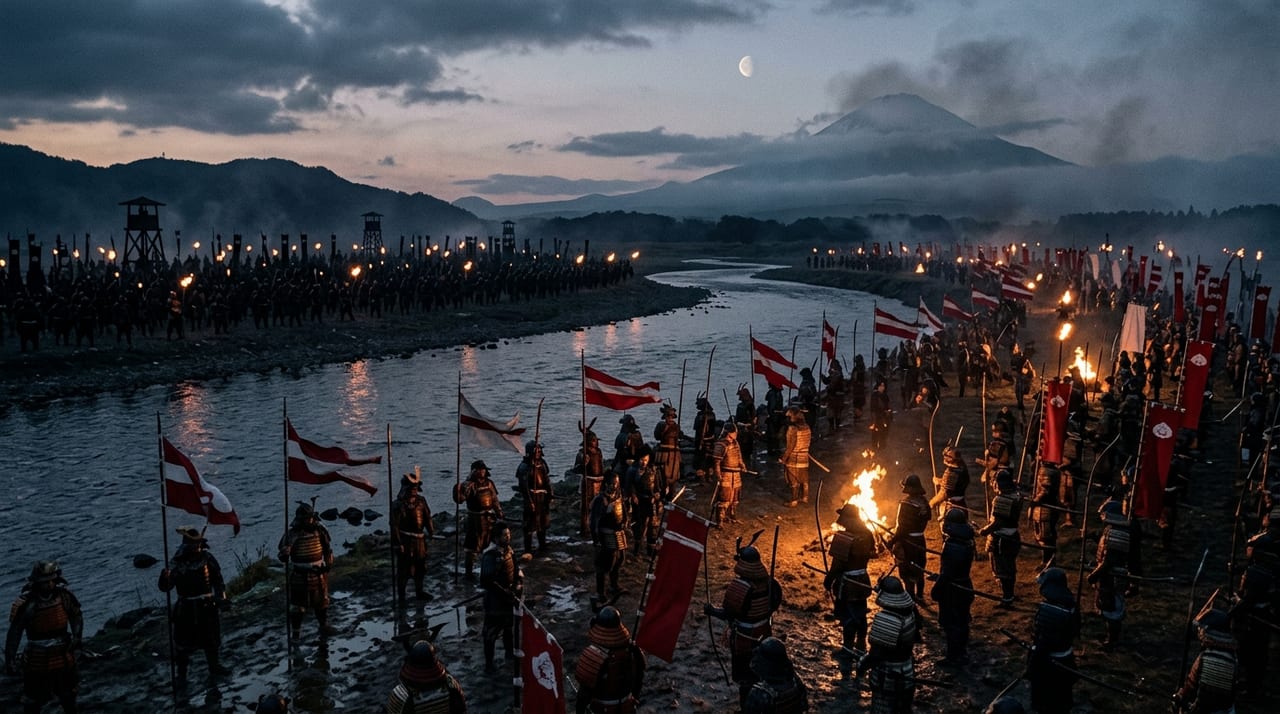
In the middle of the 10th month of Jishō 4 (1180), Taira no Koremori's army entered Suruga Province and set up camp on the west bank of the Fuji River. On the east bank, the forces of the Kai Genji under Takeda Nobuyoshi advanced, and Yoritomo's army had also entered Suruga. As the two sides faced each other and a decisive night battle drew near, an unusual event occurred within the Taira camp.
The most famous scene of the Battle of Fujikawa, as recorded in the "Azuma Kagami" and "The Tale of the Heike," is the rout during the night. Countless water birds that had been sleeping on the surface of the Fuji River were startled by something and took flight all at once. The sound of their wings resounded through the dark night, and the Taira forces, mistaking it for a night attack by the Minamoto, fell into panic. The cry "The enemy is coming!" spread like a chain reaction, and the Taira army fled in disorder without fighting and without crossing the Fuji River.
This episode of "the sound of water birds' wings" is thought to contain legendary elements formed in later retellings, rather than being an accurate reflection of historical fact. Nevertheless, the fact that such an accidental sound caused such a complete collapse shows that the Taira army had reached its psychological limit. It was an event that clearly demonstrated the psychological fragility of a Taira army unaccustomed to the terrain, climate, and realities of the eastern warrior bands.
The tachi of this era were the very "soul of the warrior," worn at the waist even on the night battlefield. The fact that the Taira warriors fled in the night at Fuji River without even drawing their tachi from their waists paradoxically shows the essence of the warrior's code, that "a battlefield cannot be handed over to a warrior who has no resolve to draw his sword." The tachi of the late Heian period were masterpieces of kotō with beautiful curves and sharpened blades, and the swords of the Taira warriors, which never left their scabbards and merely carried them away in flight, eloquently told the psychological state of their owners.
Yoritomo, having learned of the Taira army's rout, had an opportunity to pursue. However, Yoritomo did not pursue and decided to return to Kamakura. Yoritomo himself wished to pursue the Taira to the capital, but Kazusa Hirotsune, Chiba Tsunetane, Miura Yoshizumi, and others argued that the East should be secured first, and Yoritomo followed their advice. There are various theories about this decision, but the most persuasive explanation is the political rationality of "giving priority to consolidating control over the Kanto."
Yoritomo's goal was not only the overthrow of the Taira, but the establishment of a warrior government based on the East. Rather than pursuing toward the capital, he gave the highest priority to first consolidating his base in the East and placing the Kanto under unshakable control. This decision of "the longer way is the surer way" became the foundation for the firm regime of the later Kamakura shogunate.
Upon returning to Kamakura, Yoritomo organized administrative bodies such as the samurai-dokoro, the kumonjo (later mandokoro), and strengthened his control over the eastern warrior bands. What symbolized the unity of the warrior bands of this period was the quality and rank of the tachi carried by each commander. The tachi possessed by Hōjō Tokimasa, Chiba Tsunetane, Kazusa Hirotsune, and others who followed Yoritomo embodied the rank and martial reputation of their respective houses.
In the era of the Jishō 4 (1180) that saw the Battle of Fujikawa, Japan's sword industry was entering the peak of the "kotō" (old swords). In particular, the swordsmiths of Bizen Province, after the Ko-Bizen school, saw the rise of the Osafune school in the Kamakura period, and thereafter continued to produce the highest-quality swords throughout the Kamakura period.
Famous as tachi carried by the commanders who fought in the Genpei War are "Usumidori (Hizamaru)," said to be the tachi of Minamoto no Yoshitsune and later dedicated to Hakone Gongen, and "Higekiri," which was handed down from Minamoto no Yorimitsu. These were swords passed down across generations as treasures of the Minamoto, and it is thought that Yoritomo, who fought at the Battle of Fujikawa, also carried a famous ancestral tachi.
The Genpei War was a war fought in the era when Japanese swords reached their completed form in the "kotō period." The warriors of this era poured into the single tachi at their waist both their pride as warriors and their "loyalty to their lord." The Taira warrior who fled in fear of the sound of water birds' wings at Fuji River also carried a tachi at his waist that was, in principle, a sacred embodiment of the spirit of the warrior's code. That the act of "fleeing without drawing one's sword" has continued to be told as a symbol of the fall of the Taira is precisely because of the belief that the Japanese sword is a symbol of "the soul and resolve of the warrior."
Taira no Kiyomori
Taira no Kiyomori — the Taira hegemon who received the devastating news of Fujikawa; the countdown to Taira extinction had begun
Minamoto no Yoshitsune
Minamoto no Yoshitsune — who rejoined his brother Yoritomo after Fujikawa and became the primary force in the eventual Taira destruction
Minamoto no Yoritomo
Minamoto no Yoritomo — who routed the Taira punitive force at Fujikawa and consolidated control of eastern Japan
Hōjō Tokimasa
Hōjō Tokimasa — who supported Yoritomo's uprising and fought at Fujikawa, founding ancestor of the Hōjō regents