New Arrivals — Browse our catalog for the latest authentic Japanese sword arrivals. Browse →
23rd day of the 8th month, Jishō 4 (1180)
Ishibashiyama, Sagami Province (present-day Odawara City, Kanagawa Prefecture)
Forces
The forces of Minamoto no Yoritomo (warriors of Izu and western Sagami, newly risen in revolt)
The Taira-aligned forces of Ōba Kagechika (provincial warriors of Sagami)
About 16 min read
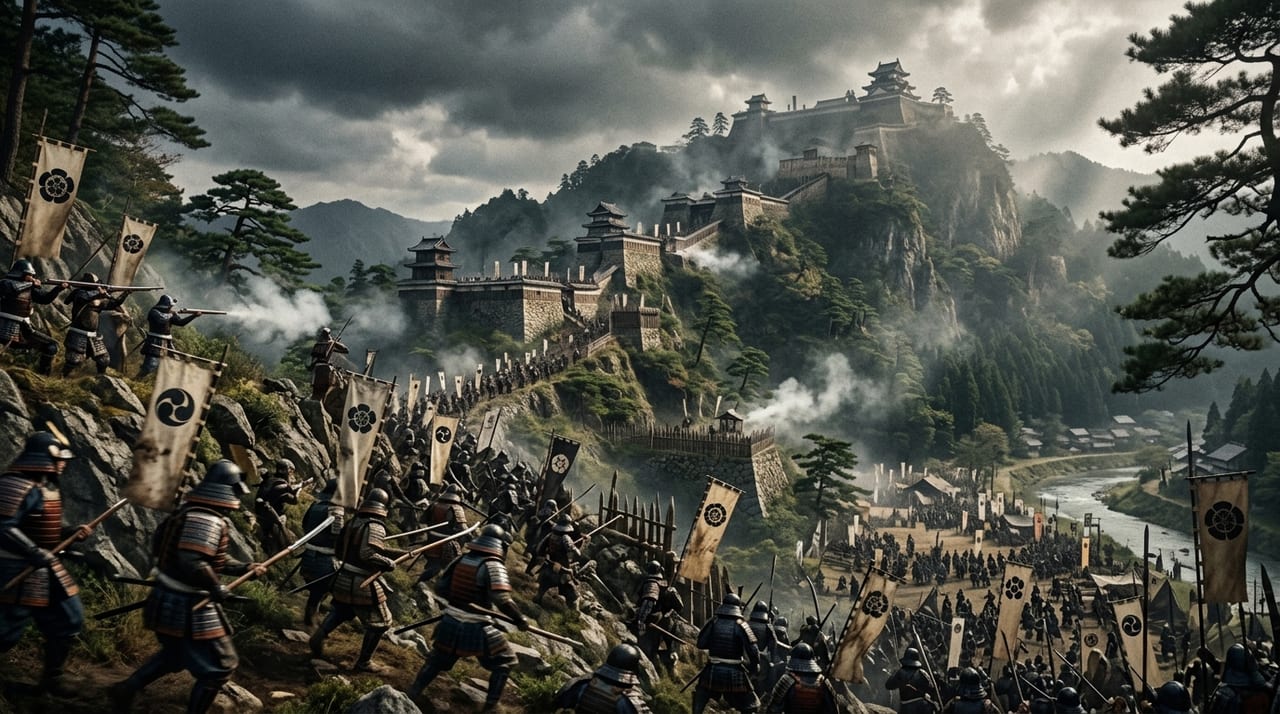
The Battle of Ishibashiyama (Ishibashiyama no tatakai) was fought on the 23rd day of the 8th month of Jishō 4 (1180). In it, Minamoto no Yoritomo, who had raised arms in Izu, suffered a crushing defeat at the hands of the forces led by Ōba Kagechika and others of the Taira faction at Ishibashiyama in Sagami Province (present-day Odawara, Kanagawa Prefecture). This battle, in which Yoritomo suffered a defeat said to be the only one of his life, ironically became the starting point of his rise, which would lead to the later founding of the Kamakura shogunate.
In Jishō 4 (1180), Minamoto no Yoritomo received a ryōji (directive) from Prince Mochihito calling for the suppression of the Taira. On the night of the 17th day of the 8th month, he had his father-in-law Hōjō Tokimasa, with whom he had long been on friendly terms, and warriors such as Doi Sanehira, of Izu and western Sagami, attack the residence of the deputy governor of Izu, Yamaki Kanetaka. In this way he raised troops against the Taira.
On the 20th day of the 8th month, Yoritomo left Izu with a small band of followers and advanced to Doi in Sagami Province, the estate of Doi Sanehira (present-day Yugawara, Kanagawa Prefecture). There he organized his forces while waiting for nearby warriors to join him. On the 23rd day of the 8th month, he deployed about 300 mounted soldiers at Ishibashiyama.
The first target, Yamaki Kanetaka, had originally been an exile banished to Izu. Because he was on close terms with Taira no Tokitada, he became deputy governor, and he had been rapidly expanding his power in Izu.
In response, Ōba Kagechika, a powerful Sagami warrior whom the Taira had ordered to put down Yoritomo, set up a defensive position at Ishibashiyama with an overwhelming force of more than 3,000 mounted warriors. On Yoritomo's side, the Miura clan, a powerful Sagami family led by Miura Yoshizumi, had left their home base to join as allies, and they were heading toward him as reinforcements. However, heavy rain fell on the day of the battle, the 23rd day of the 8th month. The Miura forces could not cross the Maruko River (Sakawa River) because of its swollen waters, and so they were unable to join Yoritomo's camp.
Ōba Kagechika judged that he should settle the matter before the Miura forces arrived and reinforced Yoritomo's army. Under cover of a stormy, dark night, he launched a surprise attack. The two armies faced each other across a valley. After fierce fighting, the Minamoto side, without reinforcements and outnumbered, was routed.
In this battle, Okazaki Yoshizane's son, Sanada Yoichi Yoshitada, was killed in action, and Kudō Shigemitsu was defeated and took his own life. Yoritomo's side suffered many casualties and a crushing defeat. Yoritomo himself escaped the battlefield with great difficulty and was driven to flee into the mountains of Hakone. The Miura clan, upon receiving word of Yoritomo's defeat, reluctantly turned back to their home base on the 24th.
The defeated Yoritomo and his retainers were pursued by Ōba's army. Guided by Iida Ieyoshi, a warrior on Ōba's side who was sympathetic to Yoritomo, they fled into the mountains of Sugiyama, within the territory of Doi Sanehira. Doi Sanehira is said to have advised that, since they could not escape as a large party, he would hide Yoritomo alone, even at the cost of his own life.
Ōba's army searched the mountains relentlessly, and Yoritomo and his retainers are said to have hidden in a cave called "Shitodo no Iwaya." At this time, Kajiwara Kagetoki, a warrior serving in Ōba's army, found Yoritomo hiding there but spared him out of compassion. He told Kagechika and the others, "There is no sign of people on this mountain; we should search the other mountain," and led them in a different direction. It is said that in this way he saved Yoritomo's life. Because of this debt of gratitude, Yoritomo later favored Kagetoki, and Kagetoki built his position as a senior retainer in the Kamakura shogunate.
Yoritomo, having narrowly escaped death, crossed from Cape Manazuru by small boat to Awa Province (present-day southern Chiba Prefecture). There he gathered the local warrior bands and restored his strength. With the participation of the powerful warrior bands of Kazusa Hirotsune and Chiba Tsunetane of the Bōsō Peninsula, Yoritomo quickly came to command an army on the scale of tens of thousands of mounted warriors. In the 10th month of that year, he entered Kamakura in Sagami Province. From then on he made it his base, and he went on to build the foundation of the military government in the Kantō.
Although the Battle of Ishibashiyama was a defeat said to be the only one of Yoritomo's career as a commander, through this defeat he came to know firsthand the true condition of the warrior bands of the eastern provinces, both the forces that sided with the Taira and the latent forces that supported the Minamoto. In addition, the existence of warriors such as Kajiwara Kagetoki, who, though on the enemy side, did Yoritomo a favor, set a precedent that foreshadowed how gokenin would be controlled in the later Kamakura shogunate.
For the warriors of the eastern provinces before the Sengoku period, whether to remain loyal to their lord by bearing a sword or naginata, or to switch sides after reading the situation, was always a painfully real choice. The hesitation and decision of Iida Ieyoshi and Kajiwara Kagetoki at Ishibashiyama have been widely passed down through the historical chronicle Azuma Kagami and the war tale Genpei Seisuiki. They are recounted as an anecdote symbolizing the loyalty and bonds of favor that characterized the later warrior bands of Kamakura. Had it not been for the defeat in this battle, the course of history in which Yoritomo regathered the warrior bands of the Kantō from Bōsō and laid the foundation of the military government at Kamakura might also have taken a different form. The Battle of Ishibashiyama is positioned as a particularly important battle in the history of Japan's warrior society. It was a turning point at which a warrior-led regime of its own, the later Kamakura shogunate, was born in an age when the Taira were at their height.
What determined the outcome of the Battle of Ishibashiyama was not simply the difference in numbers, but the complex antagonism among the local warrior bands of the Bandō at that time. Some of the Bandō Taira, led by Ōba Kagechika, did not move to pursue Yoritomo solely out of loyalty to the Taira government. Rather, they were strongly opposed to the warrior bands on Yoritomo's side, as an extension of their struggles over local estates and power. The Miura clan's attempt to join Yoritomo's side is likewise said to have had its background in rivalries among local powers. Thus the Battle of Ishibashiyama had the character not so much of a simple clash between the two great powers, the Minamoto and the Taira, but of a battle in which the complex interests in conflict within the Bandō warrior bands came to the surface, happening to take the shape of a Minamoto-versus-Taira framework.
The Battle of Ishibashiyama was a defeat suffered during the period before Yoritomo had established a firm position as head of the warrior houses, when he was merely one exile banished to Izu. As an uprising in which he endured bitter hardship under unfavorable circumstances, it is hard to imagine from the absolute authority Yoritomo later held in the Kamakura shogunate. It is described in detail in the Kamakura shogunate's historical chronicle Azuma Kagami. This defeat in the first engagement, and the story of his recovery from it, were widely read in warrior society from the medieval to the early modern period. They served as an important episode that impressed upon posterity Yoritomo's qualities as a ruler and his leadership in binding the warrior bands of the east together.
The Ishibashiyama battlefield is located in present-day Odawara, Kanagawa Prefecture. Historical sites related to the battle remain in the surrounding area, including Sanada Reisha, which enshrines Sanada Yoichi Yoshitada, who died in battle, and the "Shitodo no Iwaya" in Yugawara, where Yoritomo is said to have hidden. These historic sites are positioned within the region's historical heritage as commemorative places that convey the hardship of Yoritomo's uprising and the dramatic turn from there to the founding of the Kamakura shogunate. Yoritomo's rapid comeback, reaching Kamakura only about a month and a half after the defeat at Ishibashiyama, reflects how great the latent dissatisfaction of the warriors of the Bandō was toward the Taira government. It has been passed down among later military commanders as a symbolic case showing that a single great defeat did not necessarily determine a warlord's future. The narrative structure of a retainer saving his lord's life and remaining loyal in desperate circumstances, and of a defeated party recovering, embodies the spirit of "isshokenmei" and "go-on and hōkō" that Japan's warrior society long valued. It gives the Battle of Ishibashiyama a significance beyond that of a mere military defeat.