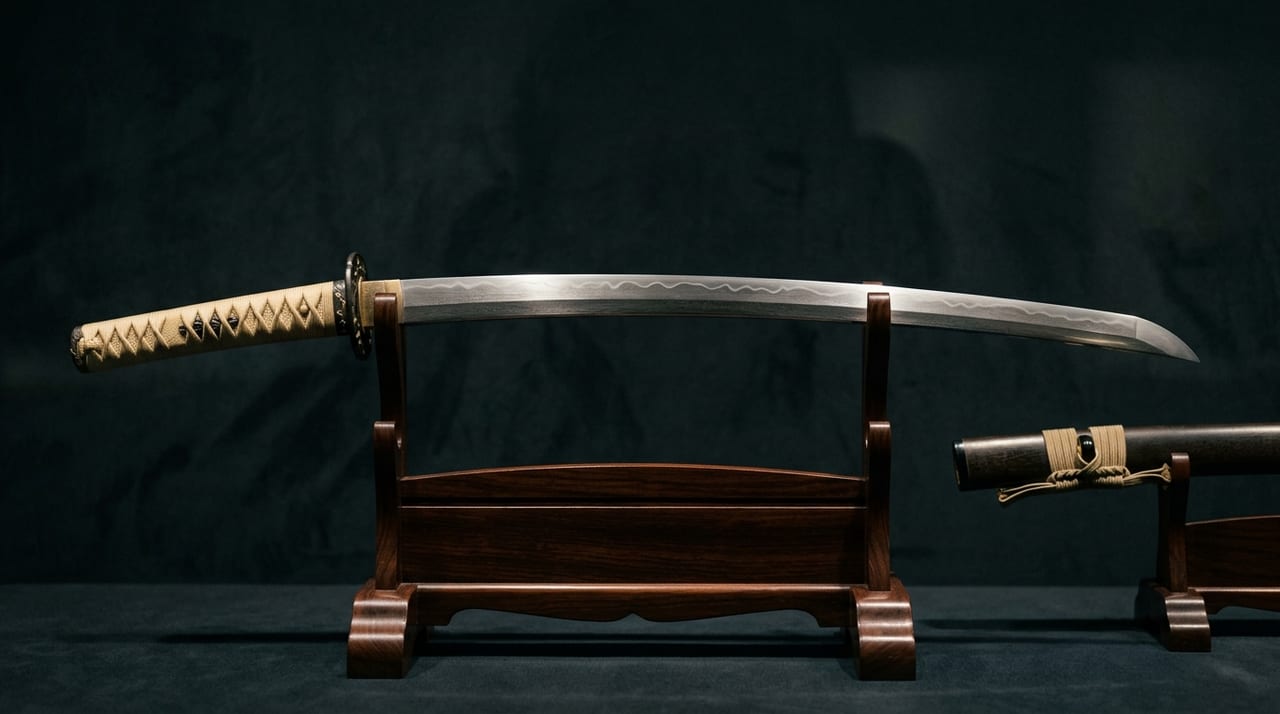
 * Image is for illustrative purposes only.
Hizamaru
膝丸
Also known as: Usumidori • Kumokiri • Hoemaru • Tachi with Four Names • Yoshitsune's Blade
Description
Overview
Hizamaru is a tachi that tradition holds was handed down through the Seiwa Genji as the “treasured Minamoto heirloom.” It is a famous sword paired with its brother sword, Higekiri. Today the tachi held by Daikaku-ji in Saga, Kyoto (the former Saga Palace), signed “□忠 (Meibutsu Usumidori / Hizamaru),” is said to correspond to Hizamaru, and it is designated an Important Cultural Property. According to tradition, Minamoto no Mitsunaka, the eldest son of Minamoto no Tsunemoto, founder of the Seiwa Genji, summoned a smith of Tang-Chinese origin from Mikasa District of Chikuzen Province and, under the protection of Hachiman Daibosatsu, had him forge the two swords Higekiri and Hizamaru. However, this is a legend in the form of a tale, and the production date and maker of the tachi held by Daikaku-ji have not been confirmed.
Style and Characteristics
The Usumidori (Hizamaru) held by Daikaku-ji is a shinogi-zukuri tachi, and its tang bears a signature containing the character 忠 (□忠). Whereas the brother sword Higekiri, held by Kitano Tenmangū as “Tachi, signed Yasutsuna (Meibutsu Onikirimaru / Higekiri),” is traditionally attributed to Yasutsuna, a smith of Hōki Province, Hizamaru also has the elegant tachi form of an ancient sword, showing the bearing of old tachi from the Heian to the Kamakura period. Detailed observations of the jigane (steel) and hamon (temper line) differ among sources. It is a sword with the dignity befitting the tradition of a treasured Minamoto heirloom.
Designation and Collection
“Tachi, signed □忠 (Meibutsu Usumidori / Hizamaru)” is held by Daikaku-ji as an Important Cultural Property. It has long been protected as a temple treasure, but in recent years it has also been shown at special exhibitions. At the special exhibition “Former Saga Palace: Daikaku-ji,” held at the Tokyo National Museum from January to March of Reiwa 7 (2025), it was displayed in the same case as its brother sword Higekiri (held by Kitano Tenmangū). This was the first time the two were shown together in Tokyo, and it drew great attention.
Anecdotes and Provenance
As a spirit sword that bore the martial fortunes of the Minamoto, Hizamaru is said to have changed its name each time its owner changed, to Kumokiri, Hoemaru, and Usumidori, and each of its four names carries a tale of demon-banishing or martial valor. Its brother sword Higekiri likewise received the name “Onikiri (Onikirimaru)” from the legend that Watanabe no Tsuna, one of Minamoto no Yorimitsu’s Four Heavenly Kings, cut off an oni’s arm at Ichijō Modori Bridge (or at Rashōmon). The two swords have long been celebrated together as treasured heirlooms of the Minamoto house. These are traditions embellished by war chronicles and temple and shrine origin stories, and they have not been confirmed as historical fact. After leaving Minamoto hands, Hizamaru (Usumidori) passed down through the ages to Daikaku-ji in Saga, where it has been protected as a temple treasure to the present day. The accompanying Usumidori Tachi Denrai is said to have been handed down at Yasui Monzeki and moved to Daikaku-ji after the Meiji Restoration; however, there are various theories about the course from its leaving Minamoto hands to its arrival at Daikaku-ji. In recent years, interest in the brother swords has grown through works that take swords as their subject. When the swords were displayed together with Higekiri at the Tokyo National Museum in Reiwa 7 (2025), many sword enthusiasts visited.
Legends & Stories
Legends and Anecdotes
The four names of Hizamaru are a mirror reflecting the very history of the Minamoto. The first name, Hizamaru, derives from the fact that when Minamoto no Mitsunaka had a newly forged tachi used to execute a criminal to test its sharpness, it easily cut through the knee, bone and all. This cruel origin plainly shows the essential nature of the Japanese sword as a tool of the warrior house. The second name, Kumokiri, is connected with Minamoto no Yorimitsu’s subjugation of the tsuchigumo (earth spider). One night, when Yorimitsu lay ill in bed, a giant spider monster (tsuchigumo) appeared at his pillow. Yorimitsu took up Hizamaru, which he had placed beside his pillow, and struck at the spider. The wounded spider fled, and when Yorimitsu had his retainers follow the trail of blood, a giant spider was found hiding inside a mound at Kitano. When it was slain, Yorimitsu’s illness quickly healed. From this demon-slaying exploit, Hizamaru came to be called Kumokiri. The third name, Hoemaru, derives from a mysterious phenomenon. In the time of Minamoto no Tameyoshi, it is said this tachi would howl at night with a sound like a snake’s cry. A sword that gives voice on its own: this marvel was interpreted as the spiritual power dwelling in Hizamaru roaring in search of a master, and so it was given the name Hoemaru. And the fourth name, Usumidori. Hoemaru was passed to the Kumano Bettō, Tameyoshi’s son-in-law, and dedicated to Kumano Gongen. But when the Genpei conflict broke out, it is said that Kumano Bettō Tanzō presented it to Minamoto no Yoshitsune. Yoshitsune gave this tachi the elegant name Usumidori, after the spring mountains of Kumano, and from then on it became Yoshitsune’s sword in the Genpei War. From the Hiyodorigoe downhill charge at the Battle of Ichinotani (1184) and the surprise attack at the Battle of Yashima (1185), through to the Battle of Dan-no-ura (1185), where the Taira were driven to ruin, Usumidori rode across the battlefields alongside Yoshitsune. Minamoto no Yoshitsune is one of the most beloved tragic heroes in Japanese history, and the name Usumidori as Yoshitsune’s sword is the most romantic and widely known of Hizamaru’s four names. From Hizamaru to Kumokiri, to Hoemaru, and then to Usumidori: this tachi took on a new legend with each change of name and lived on alongside the history of the Minamoto. It is the most beautiful proof that the Japanese sword is not mere matter but a “storytelling presence.”