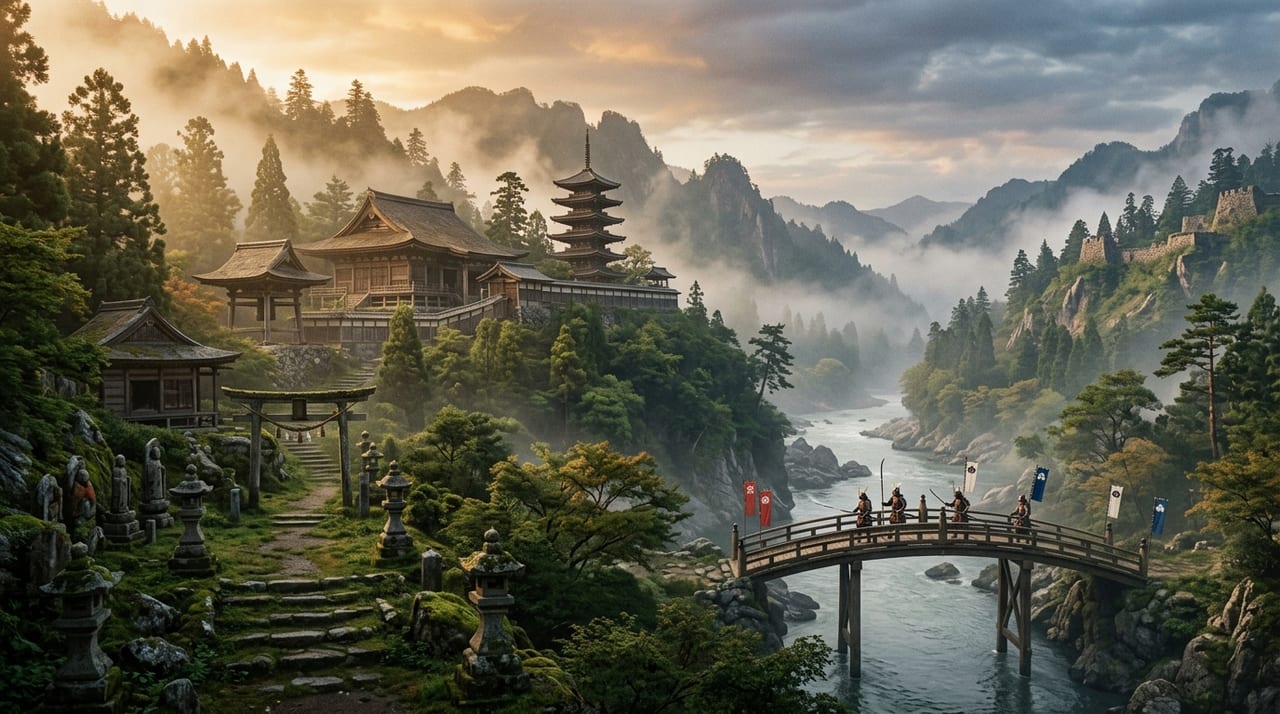
 * Image is for illustrative purposes only.
The Genpei Conflict Period
源平合戦期
The Genpei Conflict between the Minamoto and Taira clans, as they vied for dominance over Japan, marked a turning point in the practical development of the tachi. From Minamoto no Yoritomo's raising of an army to the naval battle at Dannoura, five years of intense warfare surged demand for swords and honed the skills of master smiths.
Description
The Jishō-Juei Rebellion and Swords
Beginning in the 4th year of Jishō (1180), when Minamoto no Yoritomo raised an army in response to the imperial mandate of Prince Mochihito, the Genpei Conflict (Jishō-Juei Rebellion) became a pivotal turning point in the history of Japanese swords. Until then, samurai warfare had been relatively scattered and limited in scale, but this conflict evolved into nationwide mobilization and continuous large-scale battles. The successive intense battles—the Battle of Fujikawa (1180), the Battle of Kurikara Pass (1183), and the battles at Ichinotani, Yashima, and Dannoura (1184–1185)—dramatically increased demand for swords on the battlefield. Particularly at the naval battle of Dannoura, close-quarters combat unfolded on ships, where the tachi's ease of handling and reliability determined life and death.
The Birth and Loss of Celebrated Blades
Many of the blades that saw service during the Genpei period were lost in the chaos of war or passed down to later generations as celebrated treasures. The Kogarasu-maru (Small Raven) is known as a prized possession of the Taira clan, reportedly received from the emperor by Taira no Sadamori. This tachi preserves the ancient form of the "kissaki morohazukuri" (dual-edge point construction), with both edges near the tip, making it a precious artifact for studying the formal development of Japanese swords. Among the treasures of the Minamoto, a pair of brother swords—the Hizamaru and Hige-kiri—were transmitted. The blades borne by Minamoto no Yoritomo, Yoshitsune, and Yoshinaka were later revered as the spiritual swords of heroes, with their legends and physical forms inseparably intertwined.
Sword Smiths' Activities and Surging Demand
The five years of the Genpei Conflict represented an unprecedented surge in demand for sword smiths nationwide. Smiths from Yamashiro, Yamato, and Bizen in particular were inundated with commissions from samurai and forced to expand production while maintaining quality. In Bizen of this era, Ko-Bizen school smiths were actively engaged and already demonstrated the high technical standards that would become the foundation of the later Osafune lineage. Norimune, regarded as the founder of the Ichimonji school, crafted suguha-like hamon with ko-midare, sometimes mixed with archaic gunome-chōji, and his techniques were inherited by celebrated smiths of later generations. The Awatasuguachi school of Yamashiro also responded to samurai demand by creating robust tachi suited for actual combat, producing celebrated pieces that achieved a remarkable harmony of elegance and practical utility.
The Establishment of Samurai Sword Aesthetics
The Genpei Conflict profoundly shaped samurai spiritual culture. The katana worn at the hip became regarded as the samurai's very life, and the notion that celebrated blades should be transmitted through generations as family treasures was solidified during this era. Blades that demonstrated prowess on the battlefield were believed to possess "spiritual power that aided in martial deeds," and customs developed whereby swords were dedicated to shrines and temples or presented to emperors and shoguns. Of the "Three Imperial Regalia" that sank at Dannoura upon the fall of the Taira clan, the Hōken (the substitute body of the Kusanagi sword) was lost, an event that left the sacred nature of the sword deeply imprinted on Japanese consciousness. From this era onward, the Japanese sword transcended mere weaponry to embody a dual significance: "the soul of the samurai" and "a sacred implement."
Cross-Regional Exchange of East and West Sword Culture
The Genpei Conflict brought opportunities for samurai from the east (the Bandō warrior clans) and west (the Taira and court factions) to move and engage across the nation, promoting inter-regional exchange of sword culture. Kantō warriors traveled to the capital to commission work from Kyoto smiths, while western smiths were invited eastward, creating a flow of human exchange. This cross-pollination fostered mutual influence in techniques that would later lead to the establishment of the Gokaiden (five traditions of forging from five regions) and contributed to the overall elevation of Japanese sword craftsmanship.
Characteristics of This Era
- Tachi of the surging combat era. Characterized by a chū-zori to koshi-zori curvature as the foundation, with blade width and depth solidly constructed to withstand actual combat. Elegance and robustness are achieved at exceptionally high levels.
- The era when the Ko-Bizen school was active. The hamon is archaic in character, mainly straight (suguha) with small midare and small chōji mixed in, leading to the later Ichimonji school's splendid chōji-midare.
- The period of Yamashiro Awatasuguachi school activity. Their refined craftsmanship—featuring fine koitame wood-grain patterns with deep niye in straight blades and subtle midare—was embraced by samurai, elevating the social status of sword smiths.
- Faith in celebrated blades took root in samurai culture. Swords whose exploits in battle were transmitted as legend came to be revered as spiritual blades, with customs of dedicating them to shrines and transmitting them as family treasures becoming established.
- The loss of the Hōken (the substitute body of the Kusanagi sword) at Dannoura became a symbolic historical event of the sword's sacred nature, exerting lasting influence on sword culture. It marks one of the origins of the concept that the Japanese sword equals the soul of the samurai.