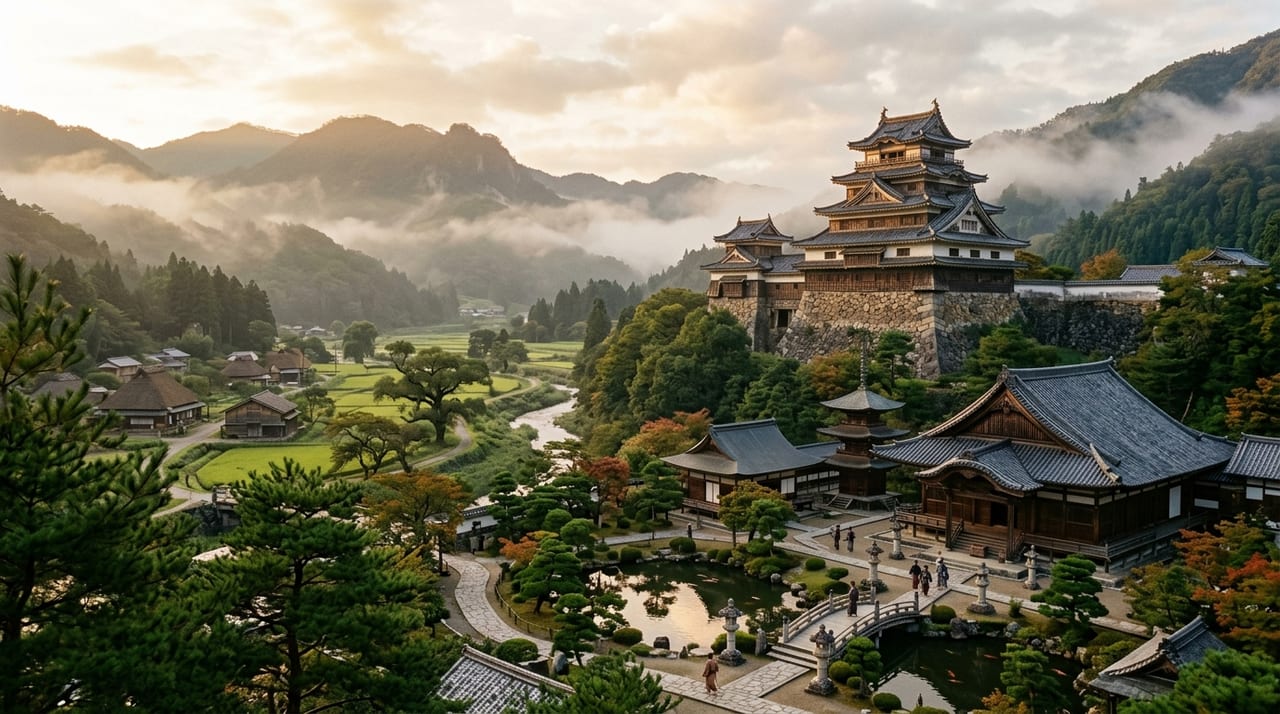
 * Image is for illustrative purposes only.
Genroku Sword Culture
元禄の刀剣文化
The Genroku culture that flourished during the reign of the fifth shogun, Tokugawa Tsunayoshi, brought about a major transformation in the world of swords. In this age of peace without war, swords transformed completely from weapons into works of art, and the authentication activities of the Honami family reached their peak. The merchant culture of the Kansai region (Kyoto and Osaka) brought sword appreciation down to the common people, and sword collecting became an important aspect of Edo culture.
Description
The Genroku Era: The Flowering of Peace and Culture
The Genroku era (1688–1704) came about a century after the establishment of the Edo shogunate, a time when lasting peace without warfare had become firmly established. The fifth shogun, Tokugawa Tsunayoshi, shifted from a martial to a civil form of governance and actively promoted learning, the arts, and culture. From this cultural ferment emerged the "Genroku culture," giving rise to successive masterpieces such as Matsuo Basho's haikai poetry, Chikamatsu Monzaemon's puppet theater, and Hishikawa Moronobu's woodblock prints, all of which would shine throughout posterity.
Sword culture shared the spirit of this age. While swords remained symbolic of the warrior's soul, they were no longer used in actual combat. Instead, sword appreciation became increasingly refined as an aesthetic and intellectual activity—viewing and enjoying them, collecting them, and developing connoisseurship. In this sense, Genroku-period sword culture was the direct forerunner of modern Japanese sword collecting culture.
The Golden Age of the Honami Family
The Genroku period was the age of greatest prosperity for the Honami family. Honami Kōjō, Kōchū, and others successively rose to prominence, and their certificates of authentication (orikami) came to be sought after by the shogunate, daimyo, and wealthy commoners alike.
The activities of the Honami family extended far beyond authentication. As practitioners of comprehensive sword culture spanning polishing, connoisseurship, education, and scholarship, they reigned at the center of the sword world of this era. The Kyoho Meibutsucho (Register of Famous Swords), compiled during the Kyoho era (1716–1736), was the culmination of knowledge and authentication experience accumulated in the Genroku period and became the most important standard reference for sword authentication in later generations.
What the Honami family most valued in the Genroku period was the "re-evaluation of old swords." Swords by master smiths of the Kamakura, Nanbokucho, and Muromachi periods were re-examined and reclassified, and previously unsigned swords that had been repolished were given new attributions. Through this process, the basic evaluation system for Japanese sword authentication that exists today was established.
Sword Collecting by Daimyo and Merchants
A distinctive feature of sword collecting in the Genroku period was the participation not only of daimyo but also of wealthy merchant classes. Backed by the flourishing commercial economy of the Kansai region (Osaka and Kyoto), some wealthy merchants began investing substantial sums in collecting famous swords.
Among the daimyo, a culture developed of carefully preserving swords received as gifts from the shogun or swords collected according to the individual taste of the clan lord. The number of swords stored in the weapons repositories (bugugurar) of each clan increased, and specialized curators (okatanaban) were appointed to perform daily maintenance and care. The Sendai clan's Date family sword collection also flourished, and records indicate that successive clan lords devoted considerable effort to acquiring and preserving famous swords.
Merchant purchases of swords in this era reflected not only pure aesthetic interest but also considerations of asset management. Swords receiving high evaluations in the register of famous swords tended to have stable or rising financial value, and the view that "swords are precious works of art that can be converted to cash" became established among both warriors and merchants.
Sword Smiths of the Genroku Period and Their Styles
The Genroku period corresponds to the mid-Shinto era, and the style that best exemplifies sword culture of this age is the "Osaka Shinto." After developing as the castle town of Toyotomi Hideyoshi, Osaka continued to flourish as a center of commerce and culture, holding a position comparable to Edo as another major center of sword manufacturing.
The reputation of Tsuda Echizen-no-kami Sukehiro and Inoue Shinkai, Osaka Shinto master smiths who were active during the Kanbun through Tenna eras, continued to be revered in the Genroku period, and their swords maintained high regard for their deep nioi in the hamon and the beauty of their brilliant jigane. In particular, Sukehiro's wavy hamon pattern known as "toranmidare" is regarded even today as a masterpiece embodying refined aesthetic sensibility and receives the highest praise.
In Edo, Nagasone Kotetsu, who had been active earlier, was renowned as the supreme master of Edo Shinto, and his fame showed no decline in the Genroku period. Kotetsu's swords are distinguished by extremely fine forging of the jigane and brilliant hamon, and because authentic pieces are difficult to discern, many fakes exist. The anecdote that Kondo Isami, a swordsman of the Bakumatsu period, possessed a Kotetsu blade attests to the enduring fame of Kotetsu's work even until the end of the Edo period.
Publication of Sword Literature and the Spread of Knowledge
The Genroku period saw a rapid increase in sword-related publications and writings. In addition to authentication documents, genealogies, and transmission records by members of the Honami family, enlightenment texts aimed at sword enthusiasts were also published. In this age when mass production through woodblock printing became possible, the seeds of a shift from sword knowledge as a warrior's secret teaching to general education began to appear.
Works on swords documenting the lineages, characteristics, and appreciation methods of different schools became required reading for the warrior class and formed a shared vocabulary among sword-enthusiast warriors and merchants. This accumulation and dissemination of knowledge laid the foundation for sword research in later generations. Many of the criteria used in modern Japanese sword authentication for determining provenance, period, and maker derive from the system of knowledge established during the Genroku period.
Characteristics of This Era
- Complete transformation of swords into works of art in an age of peace. Released from practical battlefield use, swords came to be evaluated entirely on aesthetic grounds—the brilliance of the jigane, the refinement of the hamon, and the grace of the sugata.
- The authentication activities of the Honami family reached their peak, and systematic re-evaluation of old swords advanced. The system of knowledge that would form the basis of the Kyoho Meibutsucho was established in this era and became the source of modern sword authentication standards.
- The golden age of Osaka shintō. Master smiths of the Kanbun–Enpō period, who preceded the Genroku era, emerged in Osaka, including Sukehiro with his tōran-midare hamon and Inoue Shinkai with his deep niō hamon. Together with Kotetsu of Edo, they produced the finest works of the shintō era.
- Wealthy merchants entered the sword-collecting market, expanding the base of sword enthusiasts from the warrior class to the commercial and industrial sectors. Swords became established as economic assets, and the market for famous swords gained liquidity.
- Sword-related publications and writings proliferated, advancing the "cultivation" of sword knowledge. A shift began from warrior-class secret teachings to enlightenment texts for the general public, and sword culture's audience expanded.
- Sword management systems in each clan were formalized, with appointments of curators and expansion of weapons repositories. The Sendai clan's Date family also devoted successive generations to organizing and preserving their sword collections, contributing to the establishment of sword culture in northeastern Japan.