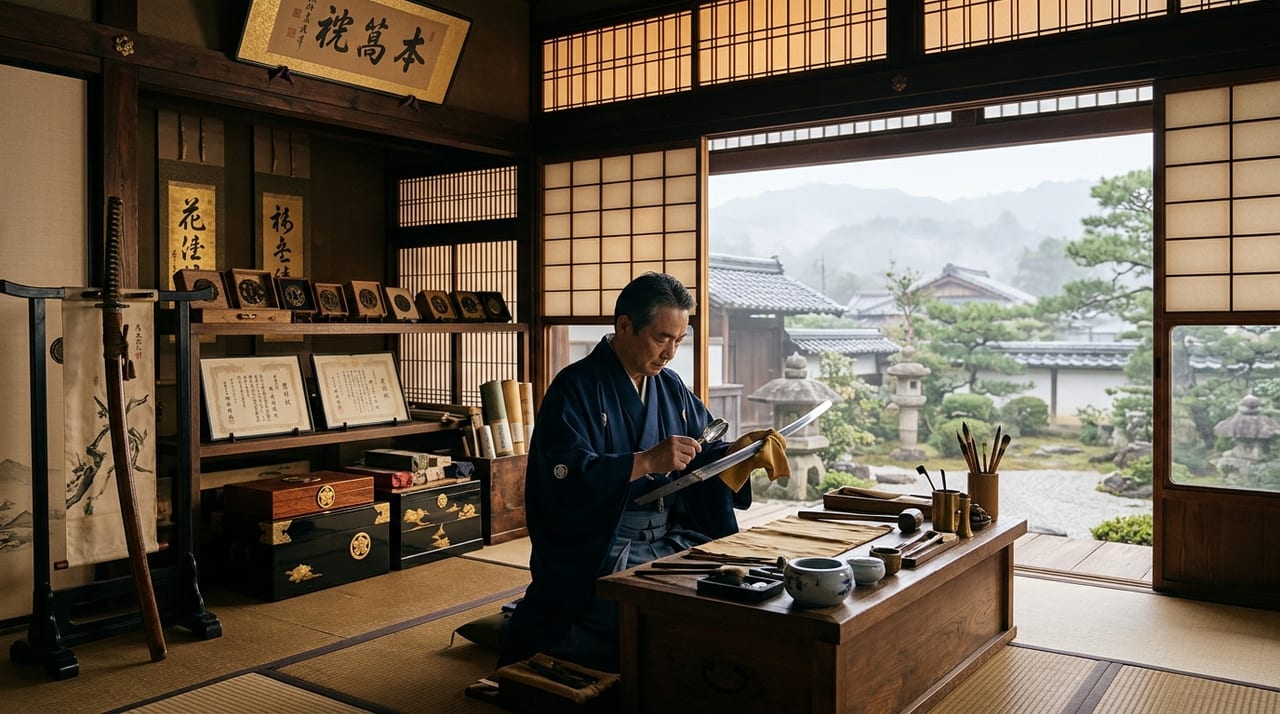
 * Image is for illustrative purposes only.
The Domain-Retained Smiths — Swordmaking Under Daimyo Patronage
諸藩のお抱え刀工制度
Throughout the Edo period, the daimyo of the various domains retained skilled smiths as "o-kakae kaji" (domain-retained smiths), maintaining and advancing swordmaking within their territories. Standing alongside the shogunal official-smith system as a pillar of early-modern sword production, this institution—exemplified by Sukehiro's patronage under the Osaka castle warden and Naotane's retention by the Yamagata domain—stabilized the livelihoods of master smiths and sustained regional sword culture.
Description
What Is the Domain-Retained Smith System?
During the Edo period, daimyo of the various domains took skilled swordsmiths from within their territories into their service, granting them stipends and employing them as exclusive makers of blades. These were called "domain-retained smiths" or o-kakae kaji. While the shogunate maintained its own official smith system (goyō tōkō seido), the individual domains each secured their own retained smiths to maintain their military preparedness and preserve technical standards. For the smiths, this meant a stable stipend and guaranteed social standing. For the domains, it meant keeping outstanding craftsmen from being taken by other domains.
Concrete Examples
Examples of retained smiths are numerous. Tsuda Echizen-no-kami Sukehiro, after receiving the title Echizen-no-kami in Meireki 3 (1657), became a retained smith of Aoyama Munetoshi, Osaka jōdai, and supported the flourishing of Osaka shintō. In the late Edo period, Taikei Naotane, a master of the shin-shintō, became a retained smith of the Akimoto family of the Yamagata domain in Dewa. In this way, domain patronage continued to function as the operating base for eminent smiths throughout the period from the shintō era to the late-Edo shin-shintō era.
Relationship to the Kyōhō Sword Revival
The eighth shogun, Tokugawa Yoshimune, sought to revitalize the sword world, including having Mondo-no-shō Masakiyo and Ippei Yasuyo of Satsuma make swords in Edo in Kyōhō 6 (1721). This Kyōhō sword revival policy was linked to the movement of domains to secure and retain outstanding smiths, and it supported the maintenance of sword-making culture in the regions. Because the shogunate's policies and the domains' retained smith systems complemented each other, the sword-making tradition was preserved nationwide even in an age of peace.
Maintaining Regional Sword Culture
The domain-retained smith system became the foundation supporting the sword traditions of various regions, such as Kaga, Satsuma, and Hizen. Because domains protected their retained smiths, the production regions and styles of the provinces were able to survive with their individuality intact, in a sword production landscape that tended to concentrate in the central cities (Osaka, Edo, and Kyoto). Each domain's smiths produced swords presented to the lord and gift swords associated with sankin-kōtai, carrying out sword-making activity tied to domain authority.
From the Late Edo Period to the Modern Era
In the late Edo period, demand for retained smiths temporarily rose amid a climate of strengthening domain military preparedness. However, the abolition of the han system (1871) and the Haitōrei (1876) removed the institutional foundation on which domains retained smiths. Many smiths who lost their patronage were forced to close their workshops, but the regional sword-making techniques they had maintained under domain protection were passed down as the foundation for the revival of swordmaking in the modern era.
Characteristics of This Era
- The retained smith system, in which daimyo of various domains took outstanding smiths into their service on stipends as "domain-retained smiths" (o-kakae kaji)
- Its position as one pillar of early-modern sword production, alongside the shogunate's official smith system
- Concrete cases such as Tsuda Sukehiro's service under Osaka jōdai and Taikei Naotane's service under the Akimoto family of the Yamagata domain
- Maintenance of regional sword culture linked to the Kyōhō sword revival policy
- Loss of the institutional foundation through the abolition of the han system and the Haitōrei, and transmission of techniques to the modern sword revival