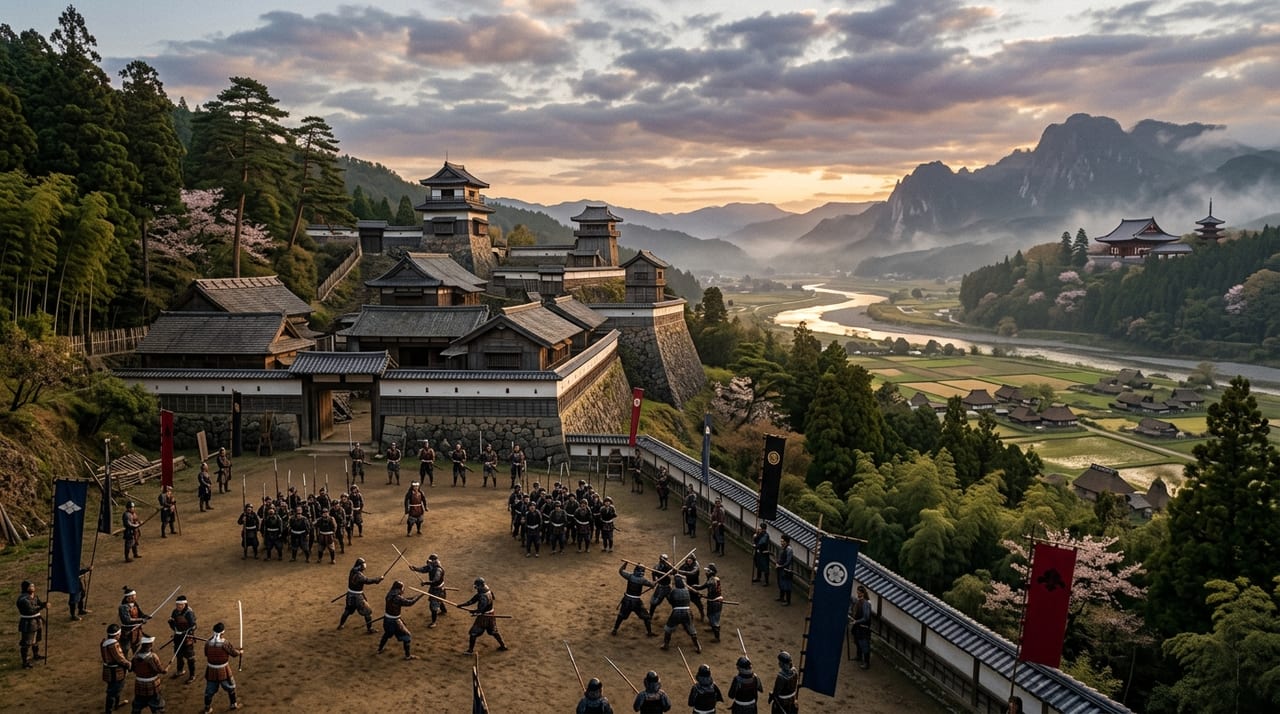
 * Image is for illustrative purposes only.
Nagamaki
長巻
A sword roughly two meters long overall, with the blade and handle nearly equal in length. It developed from the ōdachi in the Nanboku-chō period and reached its peak in the Sengoku period. The Taikōki records that Toyotomi Hideyoshi and Oda Nobunaga favored having it used, and the nagamaki units of the Uesugi clan are also well known.
Description
Nagamaki is a distinctive weapon whose blade and handle are nearly equal in length, reaching about two meters overall. Its name comes from the fact that the handle, like the blade, is wrapped in silk or leather.
The nagamaki developed in the Nanboku-chō period from the nakamaki no-dachi, in which the handle of the large, unwieldy ōdachi was lengthened and thread or leather was wound tightly around the base of the blade. It appeared in the Muromachi period. Its peak came in the Sengoku period, and the Taikōki records that Toyotomi Hideyoshi and Oda Nobunaga favored having it used. The nagamaki units of the Uesugi clan are also known.
The defining feature of the nagamaki is that its length of more than two meters places it between the spear and the sword. It has the reach of a spear while excelling at cutting like a sword, and it was highly effective in infantry combat. Its manufacture as a sword followed the techniques of ordinary swords, but securing the strength to support the long handle was an important challenge.
When the Edo shogunate was established, individuals were basically forbidden to own swords with blades three shaku or longer. For this reason, many nagamaki were shortened and reworked into swords or wakizashi, a process called nagamaki naoshi. As a result, the number of surviving nagamaki is limited, and they are a valuable legacy in the history of swords.
Characteristics of This Era
- Two-meter-class overall length
- Long haft equal in length to the blade
- Combines cutting power and reach
- Effective in group combat of the Sengoku period
- Many remade as nagamaki naoshi in the Edo period
Related Columns
長巻(ながまき)の構造と用途——南北朝から戦国期に活躍した長柄刀剣の実像
長巻は刀身と同程度の長さを持つ長柄を特徴とする日本刀の一形態で、南北朝から戦国時代に騎馬武者や歩兵が戦場で用いた。薙刀・野太刀との違い、現存する名品、拵えの構造を詳しく解説する。
2026-07-09
薙刀と長巻の違い——斬撃武器の形態比較と戦場での使い分け
薙刀(なぎなた)と長巻(ながまき)の刀身形状・柄比・発達した時代の違いを解説。平安末期から戦国時代の変遷、戦場での用途区分、現代における武道・美術品としての位置づけを比較する。
2026-05-05
長巻・大薙刀・大太刀の形態分類——刀身断面・柄比・NBTHK審査基準から読む南北朝期長大刀剣の分け方
南北朝〜室町時代に多様な形式が生まれた長大刀剣——長巻・大薙刀・大太刀——の形態的差異と分類基準を解説する。それぞれの柄と刀身の比率・帯び方・用法の違い、現存する著名遺品の特徴、現代の刀剣研究での分類論争まで体系的に整理する。
2026-04-20
江戸幕府の刀剣規格化——「定寸」への収斂と身分による帯刀の秩序
江戸幕府が定めた刀剣の長さ規定と「定寸」への収斂、磨上げの流行、大小二本差しや苗字帯刀といった身分秩序との結びつきを解説する。
2026-09-22