New Arrivals — Browse our catalog for the latest authentic Japanese sword arrivals. Browse →
March 22, 1185 (19th day, 2nd month, Genryaku 2)
Yashima, Sanuki Province (present-day Yashima, Takamatsu City, Kagawa Prefecture)
Forces
Minamoto Forces (Yoshitsune's Army)
Taira Forces (at Yashima)
About 10 min read
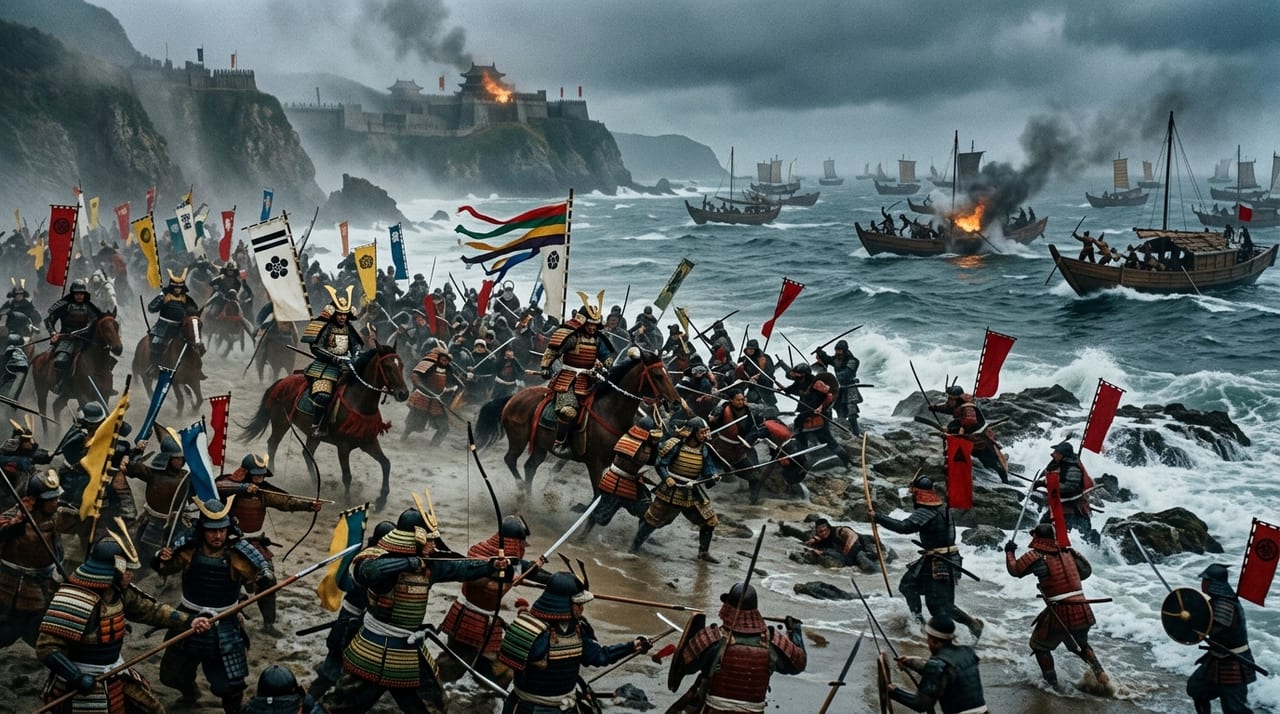
On the 19th day of the 2nd month of Genryaku 2 (1185), the Genpei War battle fought at Yashima in Sanuki Province (present-day Yashima, Takamatsu City, Kagawa Prefecture) is among the most dramatically depicted episodes in the Heike Monogatari, condensing both the military stratagems of history and human drama. Minamoto no Yoshitsune's crossing through a storm with only 150 riders, Nasu no Yoichi's famed bow, and Akushichibyōe Kagekiyo's pulling of the shikoro: as a prelude to the Battle of Dan-no-ura, the Battle of Yashima created the decisive current toward the destruction of the Taira.
In 1183 (Juei 2), defeated by the forces of Kiso Yoshinaka, the Taira fled the capital and escaped westward, carrying Emperor Antoku and the Three Sacred Treasures. In 1184 (Juei 3), after being crushed by the forces of Yoshitsune and Noriyori at the Battle of Ichi-no-Tani, the Taira moved their base to Yashima in Sanuki Province (present-day Kagawa Prefecture). Yashima was originally an island (now connected to the mainland), a natural fortress surrounded by the sea on three sides.
On the 16th day of the 2nd month of Genryaku 2, Yoshitsune, ignoring his retainers' objections, forced the crossing to Shikoku in the midst of a fierce storm. In foul weather under which sailing would normally be impossible, Yoshitsune led just over a hundred riders and landed at Katsuura in Awa Province (present-day Tokushima Prefecture). This was not mere adventurism but Yoshitsune's brilliant assessment of the situation. Against Taira forces who did not imagine an enemy attack in a storm, there lay a rational calculation to exploit precisely that 'unexpected' moment.
Yoshitsune's army, having landed in Awa, pushed forward by forced march along the mountain roads of Shikoku and attacked the Taira encampment at Yashima from the south. The Taira had placed their main strength at sea, and their land defenses were thin. When Yoshitsune's elite troops charged in, setting fires as they went, the Taira forces at Yashima fell into great confusion. Faced with a surprise attack by only about 150 Minamoto riders, the Taira could not grasp the actual size of the enemy and, mistaking it for a large army, reportedly panicked.
The most famous episode of the Battle of Yashima is "Nasu no Yoichi's Fan Target." A single Taira small boat rowed out to sea and taunted the Minamoto by hanging a red fan painted with the sun from the tip of a pole raised on the prow. Yoshitsune ordered Nasu no Yoichi, an archer of great skill, to shoot it. Yoichi, mounted on the sandy beach, was several dozen meters from the small boat offshore. He shot his arrow with precision at the fan swaying on the boat amid the rough waves. The fan rose into the air and fell into the sea. Both the Genpei armies are said to have admired this beautiful feat of archery and applauded.
This scene of the "Fan Target" has been passed down through the ages as a symbol of the "aesthetics of the bow" in Japan's archery culture. Momentary art lives on the battlefield, and this is also the core of the worldview of the Heike Monogatari. Next, when a Taira warrior on the boat began to dance, Yoshitsune coldly ordered that the warrior be shot down. This scene is recorded in contrast as an episode showing Yoshitsune's strategic composure.
The Genpei War era (1180–1185) was also an important turning point in the history of the Japanese sword. The mainstream of this period was the elegant tachi of the Ko-Bizen and Ko-Hōki traditions, but functional improvements to swords were gradually advancing alongside the accumulation of combat experience.
Famous swords appearing in the Heike Monogatari and its variant texts include Kogarasumaru, Higekiri, and Hizamaru. These were venerable tachi passed down in the illustrious houses of the Minamoto and the Taira, and beyond their practical use on the battlefield, they carried meaning as symbols of family status and authority.
The Kusanagi no Tsurugi, one of the Three Sacred Treasures and the divine sword borne by the Taira, is said to have sunk into the sea with Emperor Antoku in the later Battle of Dan-no-ura. The fact that a divine sword symbolizing imperial authority vanished beneath the sea at the end of war is remembered as one of the most tragic episodes in the history of the Japanese sword.
Among the highlights for the Taira at the Battle of Yashima, the heroic fighting of Akushichibyōe Kagekiyo (Taira no Kagekiyo) is renowned. According to the Heike Monogatari, Kagekiyo tore off the shikoro (helmet neck guard) of the Minamoto warrior Mionoya Jūrō with his bare hands. This anecdote of the "shikoro-biki" (shikoro-pulling) was passed on to later noh chants and kabuki, in the "Kagekiyo plays."
About two months after the Battle of Yashima, on the 24th day of the 3rd month of Genryaku 2 (April 25, 1185), the Battle of Dan-no-ura took place. The drowning of Emperor Antoku and the sinking of the sacred sword (the Kusanagi sword) bring the Genpei War to its close, a scene that illuminates the depths of history where the sword culture of Japan and the authority of the emperor intersect. Yoshitsune's brilliant generalship and the tragic fall of the Taira: Yashima, as the midpoint between them, will be long remembered as a battle that embodied the archetype of "beautiful defeat" in Japan's bushidō culture.
Minamoto no Yoshitsune
Minamoto no Yoshitsune — the genius commander whose storm crossing and surprise attack took Yashima
Taira no Tomomori
Brave Taira commander who defended Yashima; forerunner of his tragic end at Dan-no-ura
Minamoto no Yoritomo
Minamoto leader who deployed his brother Yoshitsune's military genius to destroy the Taira
Musashibō Benkei
Yoshitsune's loyal retainer, the warrior-monk who protected his lord at Yashima
Nasu no Yoichi
Master Archer Who Shot the Fan Target