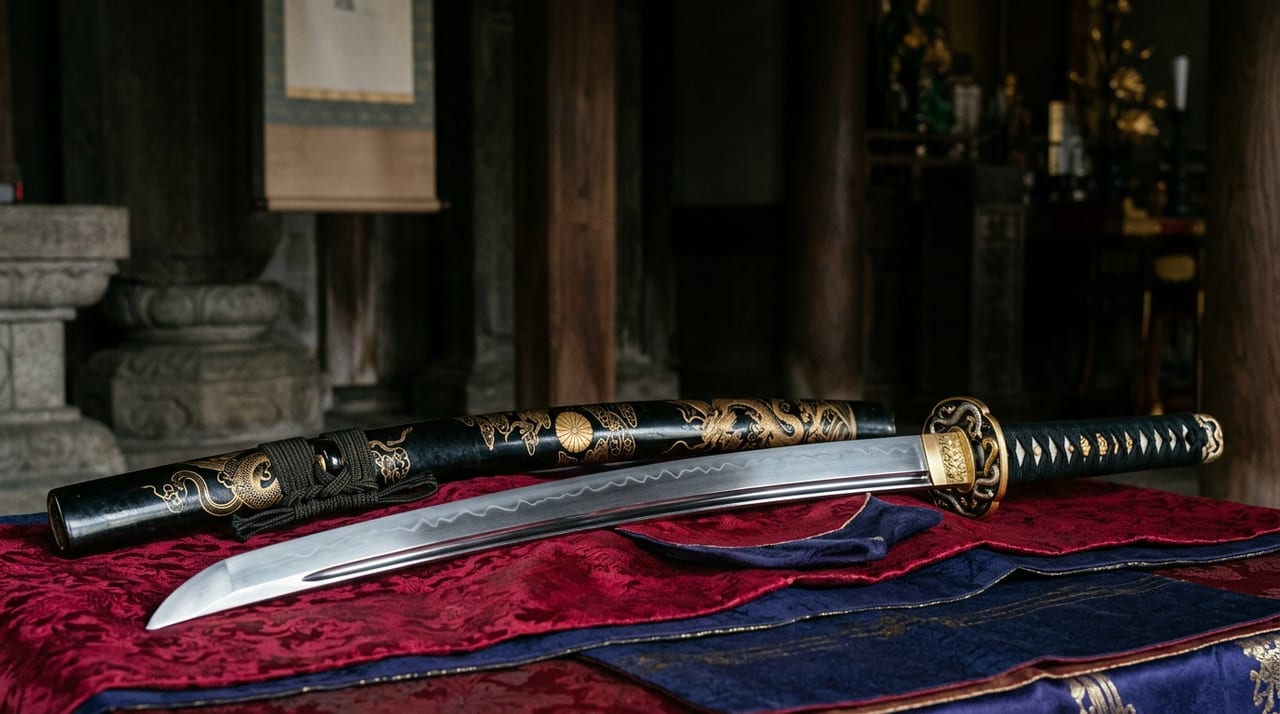
 * Image is for illustrative purposes only.
Kusanagi-no-Tsurugi
草薙剣
Also known as: Sword of the Gathering Clouds of Heaven; one of the Three Imperial Regalia
Description
Overview of the Kusanagi-no-Tsurugi: The Sword of the Three Imperial Regalia
The Kusanagi-no-Tsurugi, together with the Yata no Kagami (Yata Mirror) and the Yasakani no Magatama (Yasakani Jewel), forms the Sanshu no Jingi (Three Sacred Treasures of Japan), a sacred sword that has remained at the core of Japan's history, culture, and religion as a symbol of the emperor's legitimate right to rule. Its original name is the Ame-no-Murakumo-no-Tsurugi (Sword of the Heavenly Cloud Gathering). It is a divine sword said to have been taken from the tail of Yamata no Orochi (the eight-forked serpent) when Susanoo-no-Mikoto slew the monster in Izumo Province. It later received the name Kusanagi-no-Tsurugi (Grass-Mowing Sword) based on the myth that Yamato Takeru-no-Mikoto, on his eastern campaign, was trapped by bandits who set fire to the grassland, and he cut down the grass with this sword to escape. The name ties the sword's practical power to the hero's story for all time.
The Myth of Yamata no Orochi and the Ame-no-Murakumo-no-Tsurugi
According to the Kojiki and Nihon Shoki, Susanoo-no-Mikoto was expelled from Takamagahara, descended to earth, and arrived at the upper reaches of the Hi River in Izumo Province. There he learned that Kushinada-hime, daughter of an elderly couple, was about to be offered as a sacrifice to Yamata no Orochi, a great serpent with eight heads and eight tails, and Susanoo resolved to slay the beast. He made the serpent drunk on strong sake (yashiori no sake) and cut off its eight heads with his sword. When the blade chipped on cutting the tail, he split the tail open out of curiosity and found a sword inside it. This was the Ame-no-Murakumo-no-Tsurugi. Susanoo declared it a “precious sword” and presented it to Amaterasu-Ōmikami. This origin myth, of a divine sword born from within a giant serpent, remains one of the most dramatic scenes in Japanese mythology and is still deeply engraved in the cultural memory of the Japanese people.
Yamato Takeru and the Kusanagi-no-Tsurugi: The Hero's Journey
The story of how the Ame-no-Murakumo-no-Tsurugi came to be called the Kusanagi-no-Tsurugi is tied to one of the greatest hero myths in Japan. The sword, received from Amaterasu-Ōmikami, was enshrined at Ise Jingū. Later, when Yamato Takeru-no-Mikoto visited Ise Jingū before his eastern campaign, he received the sword from his aunt, Yamato-hime-no-Mikoto. When bandits in the eastern lands set fire to the field to burn Yamato Takeru to death, he used the sword to mow down the grass around him and then, with flint, set a counter-fire to escape. From this event the name Kusanagi-no-Tsurugi is said to have arisen. This tale, of a hero escaping a deadly situation with the power of a divine sword, embodies the basic theme of Japanese mythology that divine power works through human hands. The Kusanagi-no-Tsurugi has remained at the center of Japan's epic tradition as “the hero's sword.”
Enshrinement at Atsuta Jingū and Historical Changes
The Kusanagi-no-Tsurugi is currently enshrined as the sacred object (goshintai) at Atsuta Jingū in Nagoya. The shrine is said to have been founded in the 43rd year of the reign of Emperor Keikō (traditionally 113). It is also said that Miyazu-hime, consort of Yamato Takeru, began enshrining the sword after his death. The Kusanagi-no-Tsurugi has since passed through many historical trials. In the 7th year of Emperor Tenji (668), the Silla monk Dōgyō stole the Kusanagi-no-Tsurugi and tried to take it by sea to the Korean Peninsula, but was caught in wind and rain and failed. The sword was kept at the imperial court for a time and was returned to Atsuta in Shuchō 1 (686), according to the Nihon Shoki. In the Battle of Dan-no-ura of the Genryaku 2 (1185) period at the end of the Heian era, the Taira clan took all three Imperial Regalia to the west. It is also said that they sank into the sea after the Battle of Yashima and the Battle of Dan-no-ura. The mirror and the jewel were recovered, but the sacred sword sank in the Kanmon Strait and was lost. What sank at that time was a substitute kept in the imperial court, and the original is said to be enshrined at Atsuta Jingū. Many, however, regard the sword that sank as the Ame-no-Murakumo-no-Tsurugi itself.
The Political Significance of the Sword as One of the Three Imperial Regalia
The political significance of the Kusanagi-no-Tsurugi as one of the Three Imperial Regalia is immeasurable. At the enthronement of an emperor, the transmission of the Three Imperial Regalia is the core of the ritual, and the principle that “whoever holds the Imperial Regalia is the true emperor” functioned as a consistent political principle even during the turmoil of the Nanboku-chō period. When Emperor Go-Daigo took the Three Imperial Regalia to the Southern Court during the Nanboku-chō period (1336–1392), the location of the regalia became directly linked to the question of “which emperor is legitimate,” and possession of the regalia became, quite literally, proof of the legitimacy of political power. Even today, the transmission of the Three Imperial Regalia is regarded as the most important ceremonial act in the enthronement rituals, and the Kusanagi-no-Tsurugi continues to stand at the foundation of the Japanese state as “the oldest symbol of the emperor's legitimacy, continuing from myth into the present.”
The Mystery of Non-Disclosure: The Kusanagi-no-Tsurugi Today
The Kusanagi-no-Tsurugi is placed outside the usual cultural property designation system and has not been designated a National Treasure. This does not mean, however, that it is outside state management. As the sacred object of Atsuta Jingū, it is strictly protected, and it is extremely difficult for anyone other than the emperor and Shinto priests, including researchers, to see the actual object. Old documents contain fragmentary descriptions of what the sword looks like, but no modern scientific investigation has been carried out, and its true form remains shrouded in mystery. This quality of a “sword that cannot be seen” embodies in the most extreme form the essence of the sacred in Japanese culture, the sensibility of hisureba hana (“what is hidden is more beautiful”), in which sanctity grows through concealment. The existence of the Kusanagi-no-Tsurugi continues to function culturally as an ultimate example of the Japanese mystique that “the greatest power lies in not being seen.”
Legends & Stories
The Myth of Yamata no Orochi: One of the Dragon-Slaying Tales
Susanoo-no-Mikoto's slaying of Yamata no Orochi is one of the most dramatic stories in Japanese mythology and is noted as a representative example of the “dragon-slaying” myths found across the world. A monstrous serpent with eight heads and eight tails devours one maiden every year. The hero defeats the monster not by brute force but by strategy, intoxicating it with strong sake. And the motif of a “treasure in the dragon's belly” appears in the story. Mythologists regard these elements as “universal mythemes,” and the Susanoo story shares typological features with dragon-slaying myths across Eurasia. The most distinctively Japanese element, however, is that Susanoo did not keep the sword but presented it to Amaterasu-Ōmikami. This expresses “the hero's humility” and the Japanese philosophy of divine swords, that “power belongs to the gods,” in its purest form.
The Tragedy of Dan-no-ura: The Sacred Treasures and the Sea
On the 24th day of the 3rd month of Genryaku 2 (1185), the Battle of Dan-no-ura, known as the final decisive battle between the Taira and the Minamoto, was not only a military defeat but also a scene of cultural and religious tragedy. As the Taira's defeat became certain, Nii no Ama (Tokiko, wife of Taira no Kiyomori), a lady-in-waiting of the Taira, held the young Emperor Antoku and threw herself into the sea, saying, “There is also a capital beneath the waves.” The Three Imperial Regalia are said to have sunk with Emperor Antoku. The Yata Mirror was recovered, and the Yasakani Jewel was also retrieved, but for the Kusanagi-no-Tsurugi the tradition took hold that it “sank to the sea bottom and was lost.” This “loss of the sacred treasure” was received in medieval Japan as a serious religious and political crisis. The court and the Minamoto ordered shrines and temples to pray, and they searched for the sacred sword, but it was never found. The story of this “lost sacred treasure” is still told today as one of the deepest symbols of loss in Japanese culture.
The Theft by the Silla Monk Dōgyō
According to the Nihon Shoki, in the 7th year of Emperor Tenji (668), the Silla monk Dōgyō stole the Kusanagi-no-Tsurugi from Atsuta Jingū and tried to take it home to the Korean Peninsula by ship. However, the record says he lost his way in wind and rain and failed. This incident holds meaning beyond a simple theft. It shows that the Kusanagi-no-Tsurugi was already internationally known as a “supreme treasure” at that time, that a religious figure from the Korean Peninsula had a special interest in the Japanese divine sword, and that the belief that “stealing the sword brings divine punishment” was expressed in the form of a storm. In these respects, Dōgyō's incident forms an important chapter in the history of the Kusanagi-no-Tsurugi legend.
Enthronement and the Transmission of the Three Imperial Regalia
In the enthronement rituals of Japan's emperors, the transmission of the Three Imperial Regalia is regarded as the most important and sacred act. In a rite known as the Kenjitō Shōkei no Gi (Ceremony for the Succession of the Sword and Seal), the Kusanagi-no-Tsurugi (its substitute or replica) and the Yasakani no Magatama are passed on to the heir to the throne. At the enthronement of the reigning Emperor in 2019 (Reiwa 1), this rite was carried out solemnly as one of the first important sequences of the enthronement ceremonies. The principle that “whoever holds the Three Imperial Regalia is the emperor” has been consistent since the age of myth. Within that continuity, the Kusanagi-no-Tsurugi functions as “the oldest symbol of the continuity and legitimacy of the Japanese state.” The Kusanagi-no-Tsurugi, which no one can see or touch yet which is believed to certainly exist, embodies the essential Japanese sensibility of “deep trust and reverence for what is unseen.” Even today, after more than a thousand years, the Kusanagi-no-Tsurugi remains the spiritual core of the Japanese state and of the imperial institution.